An independent review of Baseline
What DIY AI found when it tested Baseline, including the parts we got wrong.
DIY AI published an independent review of Baseline today. Steven Jones tested the Consumer plan on 13 October, working through the filters, company reports, source panels, peer charts, saved screens, watchlists and notes. NVIDIA, ASML, Coca-Cola and PHINIA were the test cases, and JPMorgan was used as a coverage check.
The review is broadly positive. It found Baseline most useful for understanding how a business works, and it now places us in its equity research software comparison as the specialist for qualitative work, beside broader platforms such as Koyfin. It also found things we had got wrong. We think the criticisms are fair, and this post sets out what they were and what we are doing about them.
What the review found useful
The part it rated most highly was the route from a business question to a shortlist and then to the reasoning behind each score. Filtering for Pricing Power of 5 in the United States and the Netherlands returned 57 companies, including NVIDIA and ASML. The review treated that as a starting universe to investigate rather than a list of things to buy, which is how we intend it to be used.
On the company reports, it picked ASML’s Segment Overview, which explains that ASML reports a single segment and that the technology, geography and end-use splits investors talk about are overlapping views of the same revenue. It also liked the Key Debates format, where each debate is set out as context, bull case, bear case, a current assessment and the evidence that would settle it. Coca-Cola was its example of the scoring making distinctions within a familiar name: Pricing Power scores 4 because brand preference, pack mix and distribution support price, while a consumer can still switch drinks freely.
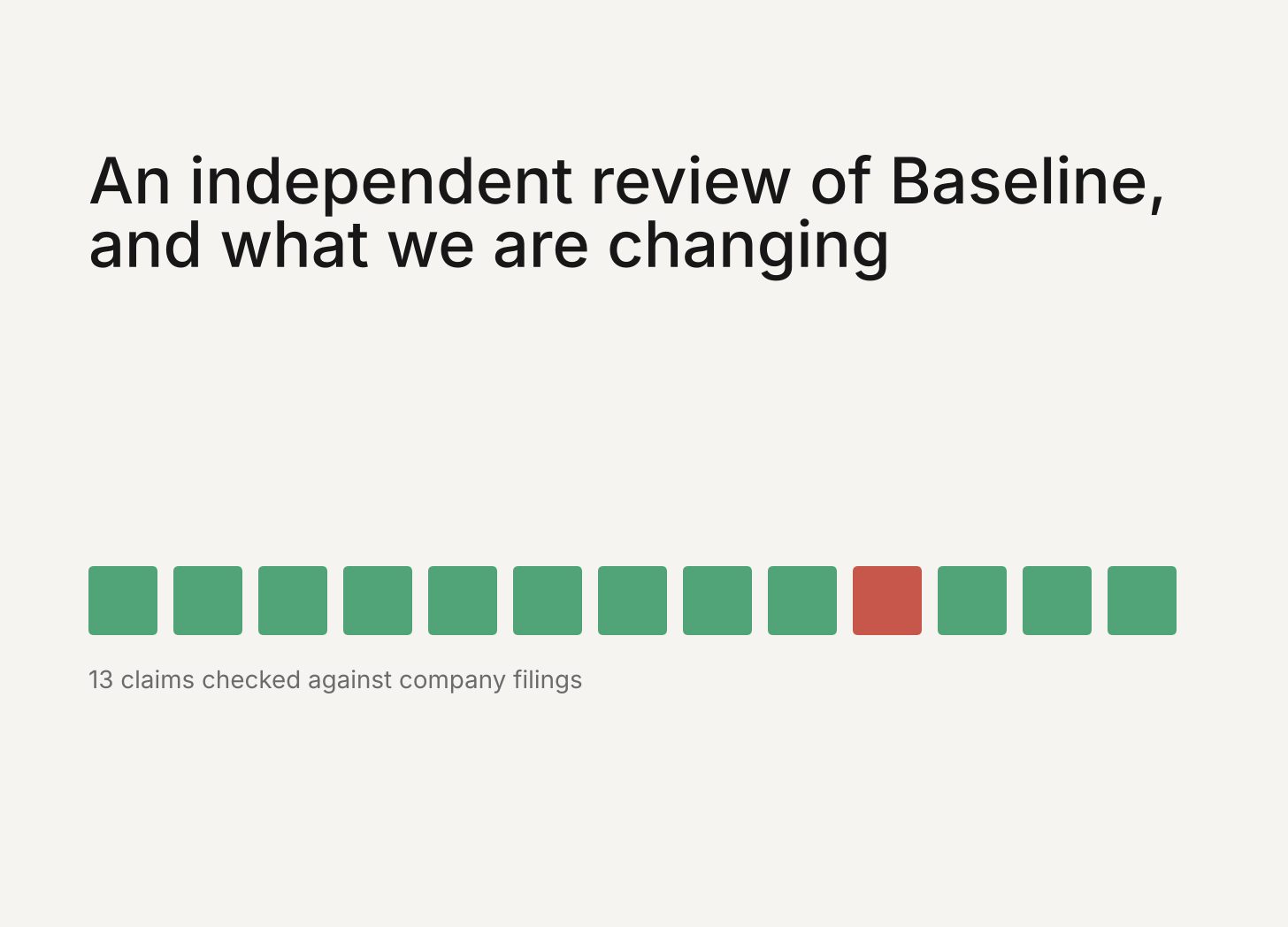
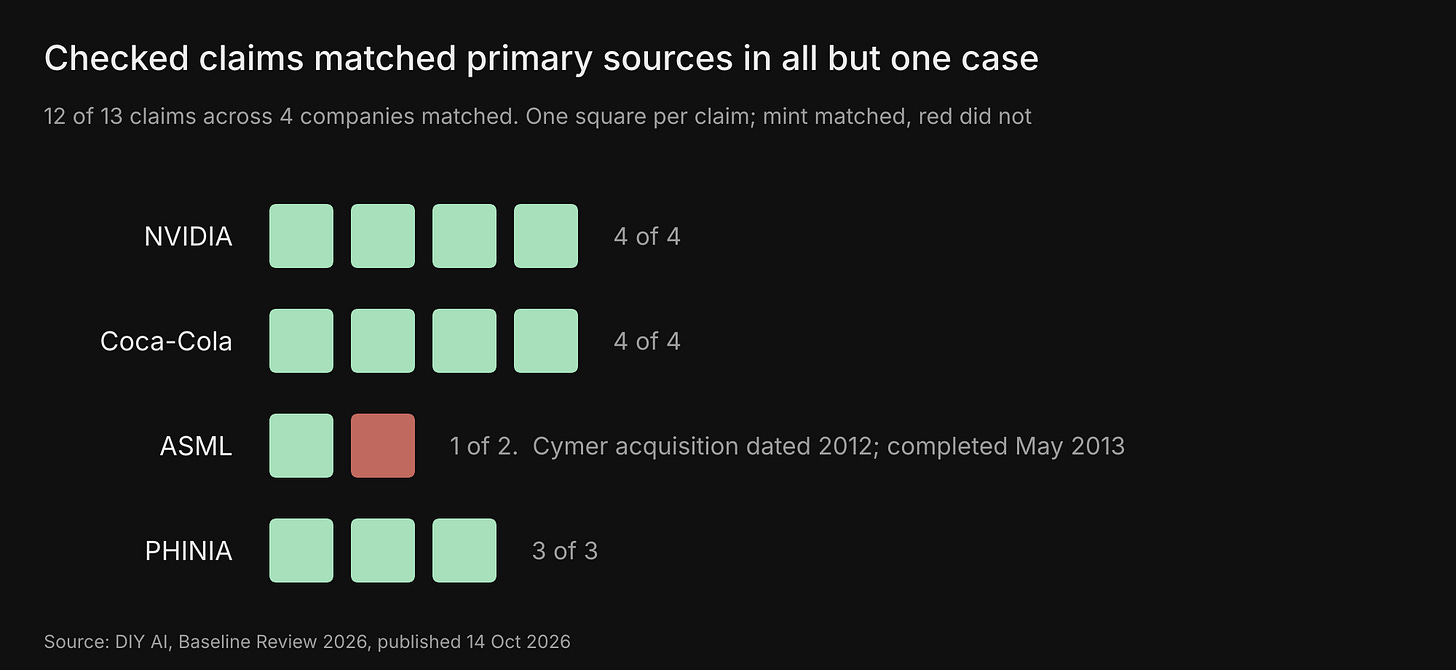
The review also checked 13 factual claims across four companies against primary sources, mostly company results releases and SEC filings. Twelve matched. It is a small, targeted sample and the review says so, but the figures it checked for NVIDIA, Coca-Cola and PHINIA were all correct.
The one miss was a historical date rather than a reported figure. ASML’s Stock Story puts the Cymer acquisition in 2012, which is when the deal was announced; it completed in May 2013.
What it found wrong
The most important finding concerns Baseline View, our top-level synthesis. NVIDIA’s Baseline View was generated on 2 September and refers to a Pricing Power score of 4. The detailed Pricing Power report was regenerated on 21 September and now scores 5. Baseline View runs when every other field has run. We are currently fine-tuning some infrastructure to improve the quality of some outputs, and as such we are slightly behind on refreshing Baseline View.
What we are changing
Baseline View will be regenerated whenever we refresh all other fields quarterly (after results). More usefully, we are adding a consistency check that compares dates and headline facts across a company’s sections and flags disagreements before they reach the site. We are also extending clickable citations to Baseline View so that it can be audited in the same way as the detailed reports.
A few points on scope
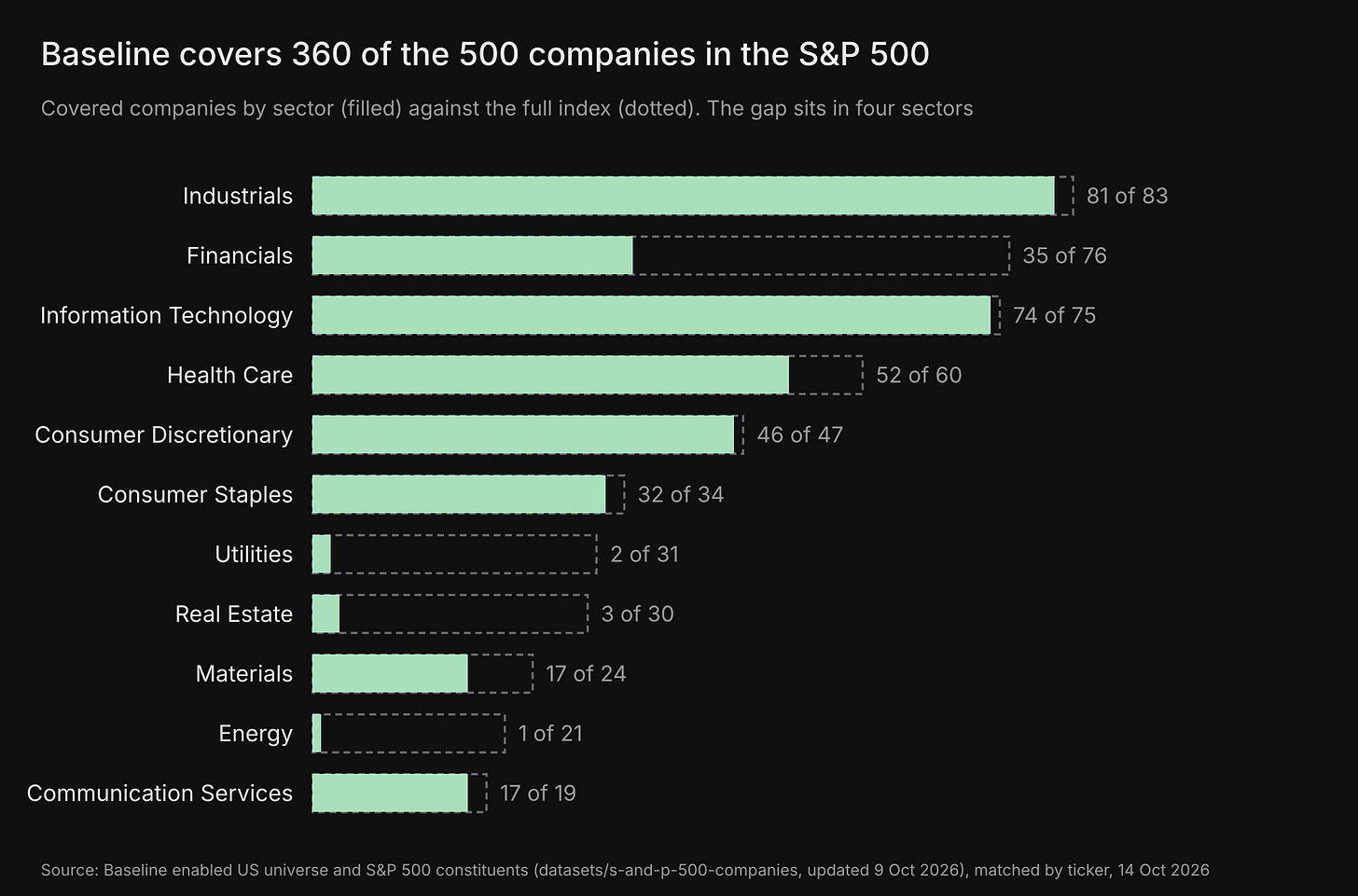
The review searched for JPMorgan and found it was not covered. Banks and insurers are left out of the Baseline universe by design, because most of our framework, pricing power, barriers to switching, unit economics, does not translate well to balance-sheet businesses. The same rationale applies to Real Estate. We take requests to add stocks onto the platform from paying customers.
It also noted that there is no way to build or edit a valuation model in the Consumer plan. We intend to launch valuation functionality soon, which should complete the investment due diligence coverage.
Finally, the review did not find an API. Baseline has an MCP server that connects the scores and reports to Claude and ChatGPT, so that an analyst can query the universe from their own assistant. If you would like access, let us know.