Baseline scores Anthropic poorly
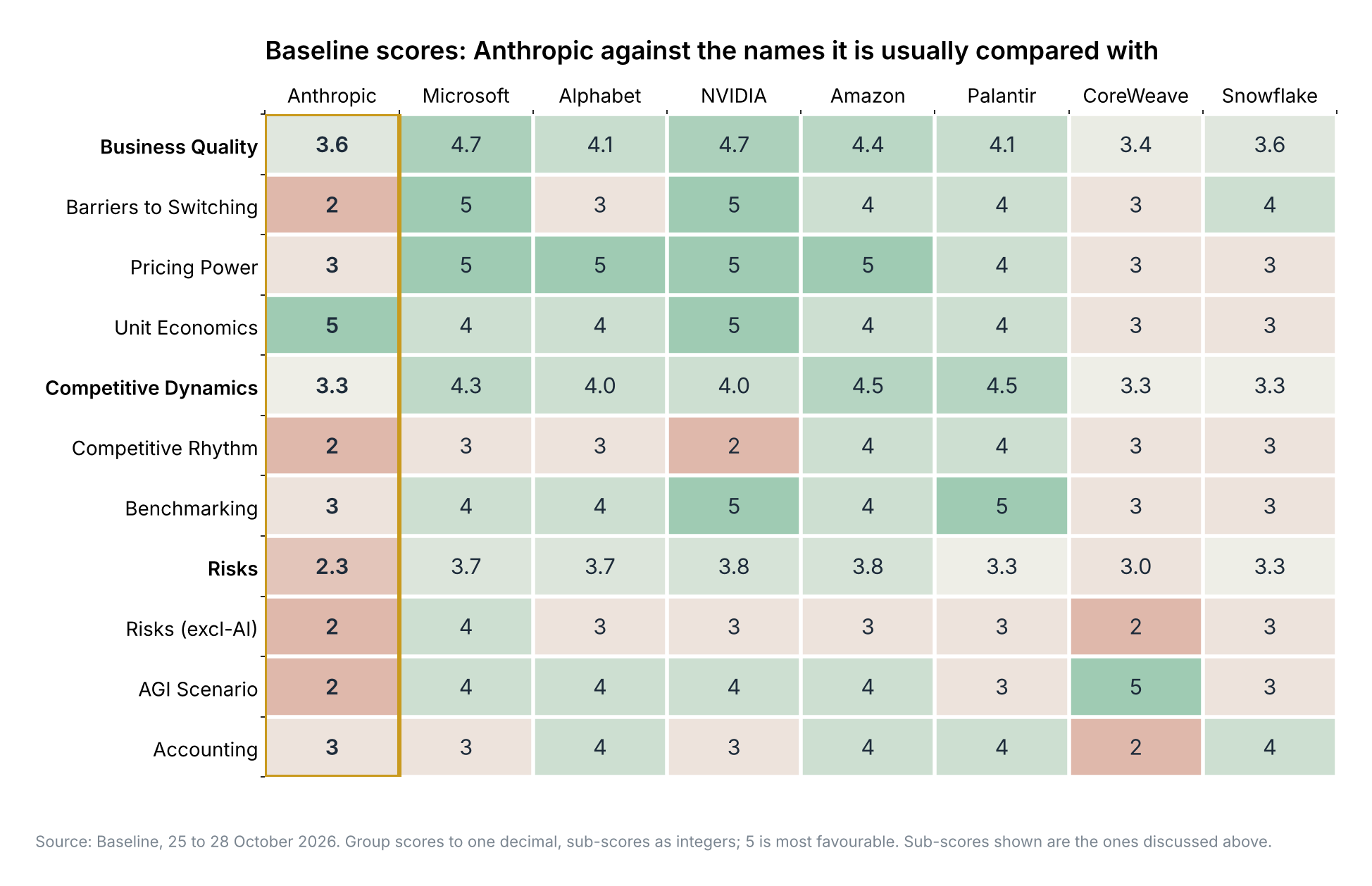
We ran the S-1 through every field. The scores land below every hyperscaler and level with Snowflake
Anthropic filed its S-1 on Monday, so we added it to Baseline. It made some interesting conclusions, mostly from the notes and the commitments schedule, which typically get overlooked. The full write-ups for are on the console.
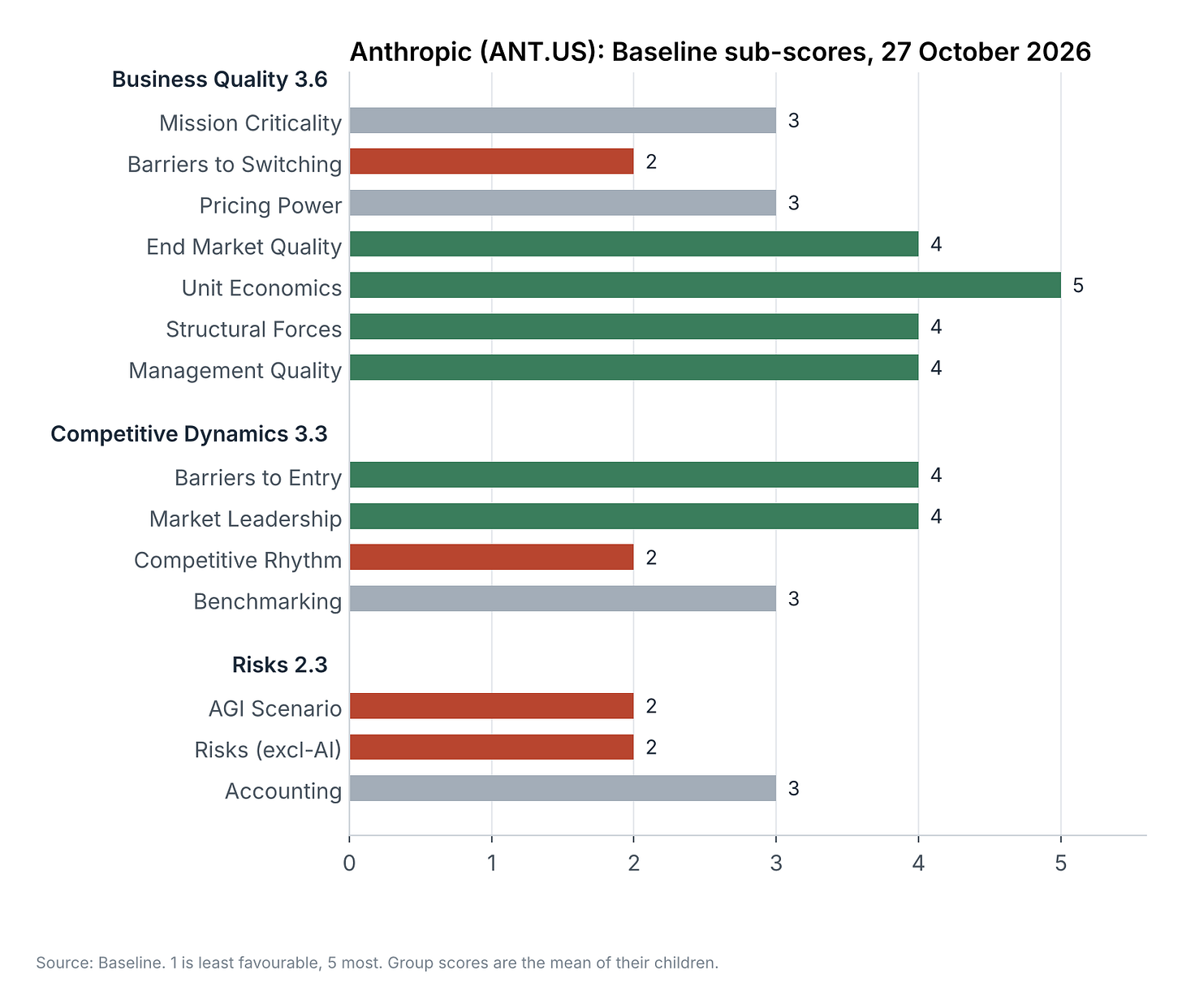
Where the 85% gross margin came from
Anthropic does not put a gross margin on its income statement, so you have to go to Note 8 on p. F-40 and work it out. Cost of revenue is $2,380m on $16,286m of first-half revenue, so 85%. Same sum for FY2025 gives 40%. For the first half of 2025, 12%. For FY2024, minus 95%.
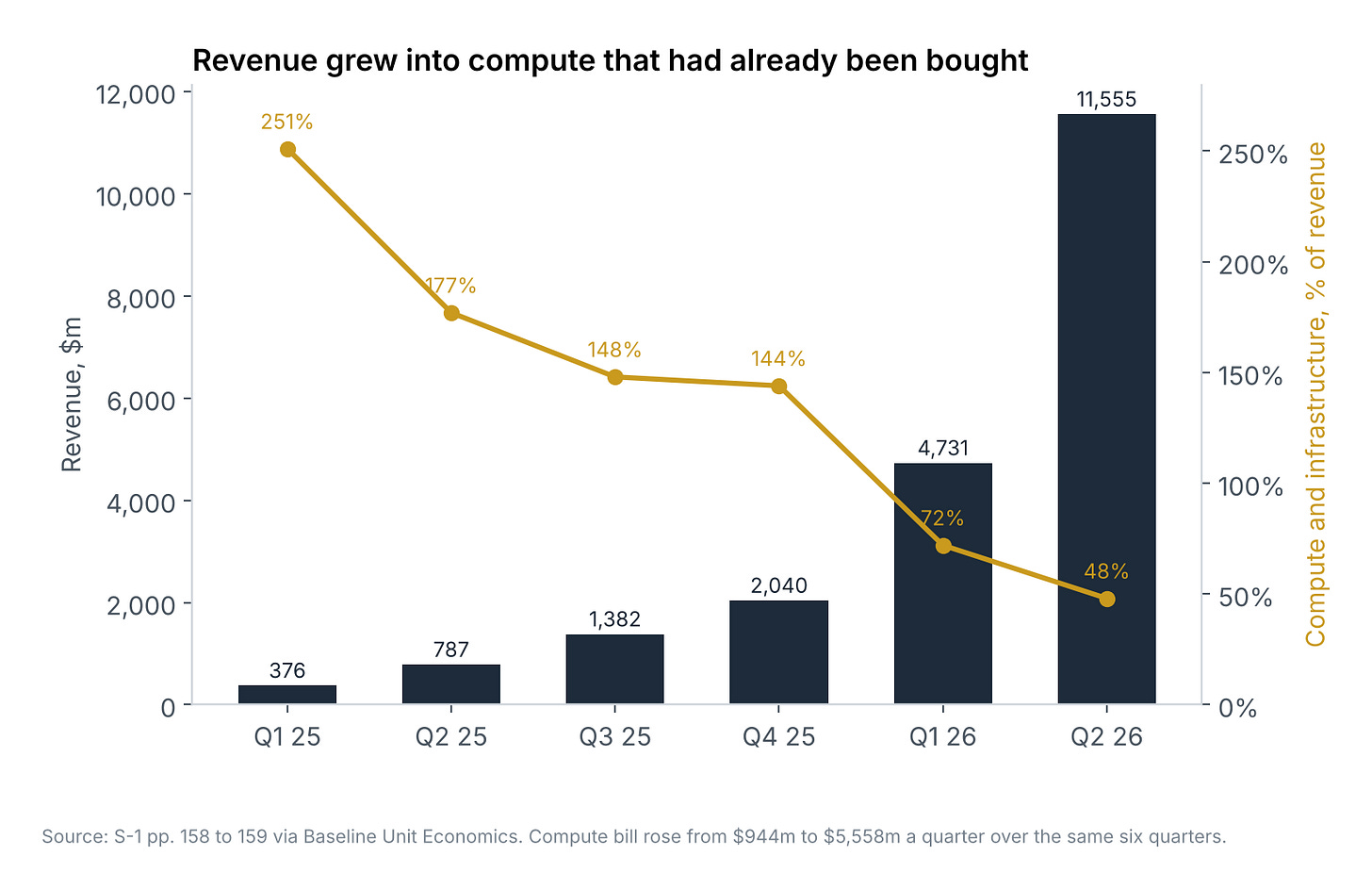
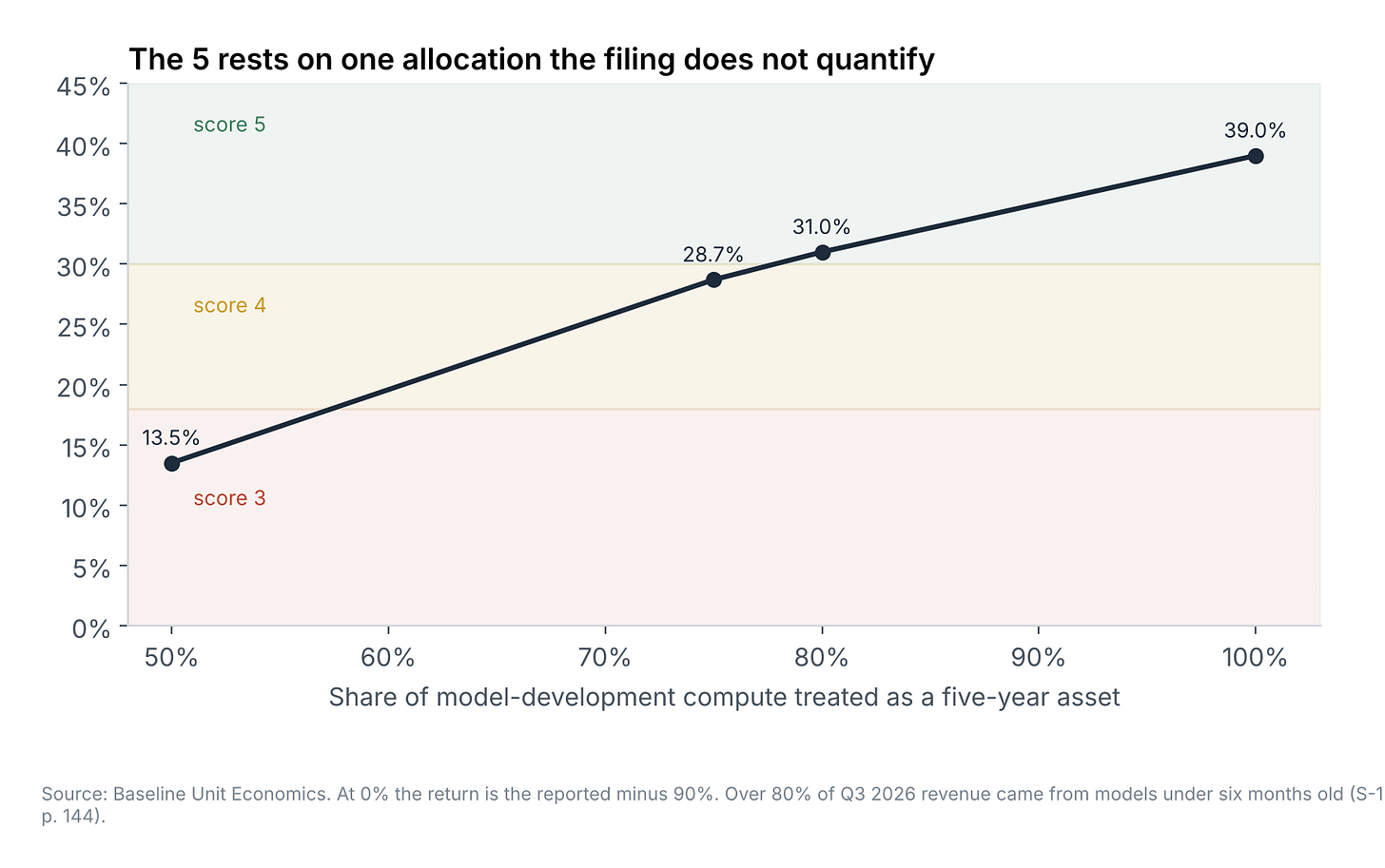
Unit Economics scores 5. Our method capitalises R&D over five years and half of eligible sales and marketing over three, adds back the $1.5bn Bartz settlement, and asks what return the business earned on that capital. On the twelve months to June 2026 the answer is 39%, above the 30% floor for the top band.
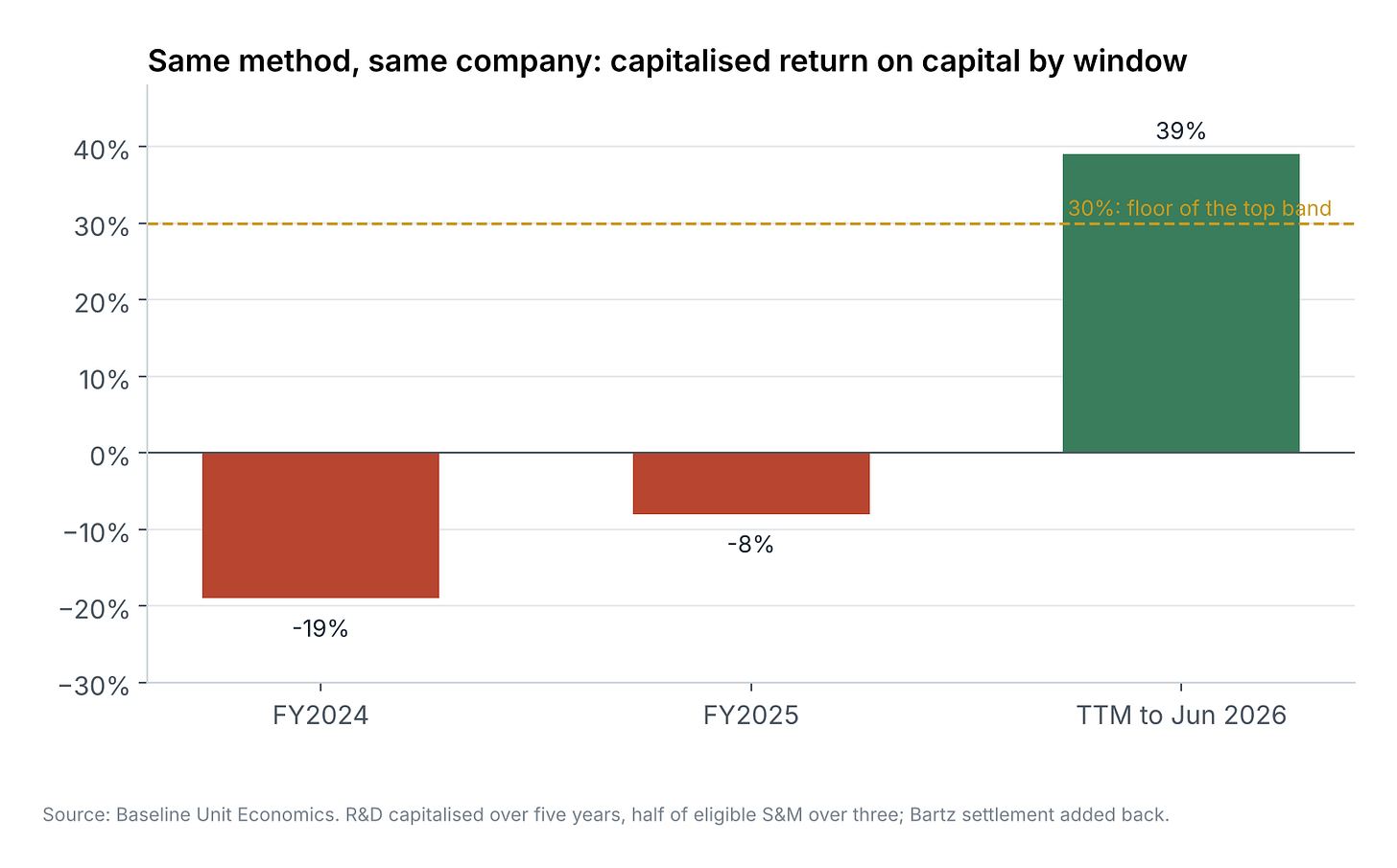
Run the same method on the audited year, FY2025, and you get minus 8%, where nothing about the method changed. The trailing year spans exactly one compute cycle, trough to peak. But it is one cycle, and the next one is already contracted at roughly ten times the size.
The 5 also leans on $14.2bn of trailing R&D, which Note 8 says is mainly model-development compute, being treated as a five-year asset. Over 80% of third-quarter revenue came from models released in the previous six months. Shortening the asset life does not move the band, oddly, because it shrinks the capital base as well as the profit. Reclassifying development compute as serving cost does.
The cloud partners’ cut, and why Accounting is a 3
Accounting scores 3. 48% of first-half revenue went through the Amazon, Google and Microsoft marketplaces. Anthropic books those sales gross and pays the cloud provider a fee that sits in sales, marketing and partnerships rather than coming off revenue. Our write-up accepts the policy under ASC 606. What it does not accept is that the fee is never disclosed, only its movement: up $341m in 2025 and up $2.7bn in the first half of 2026.
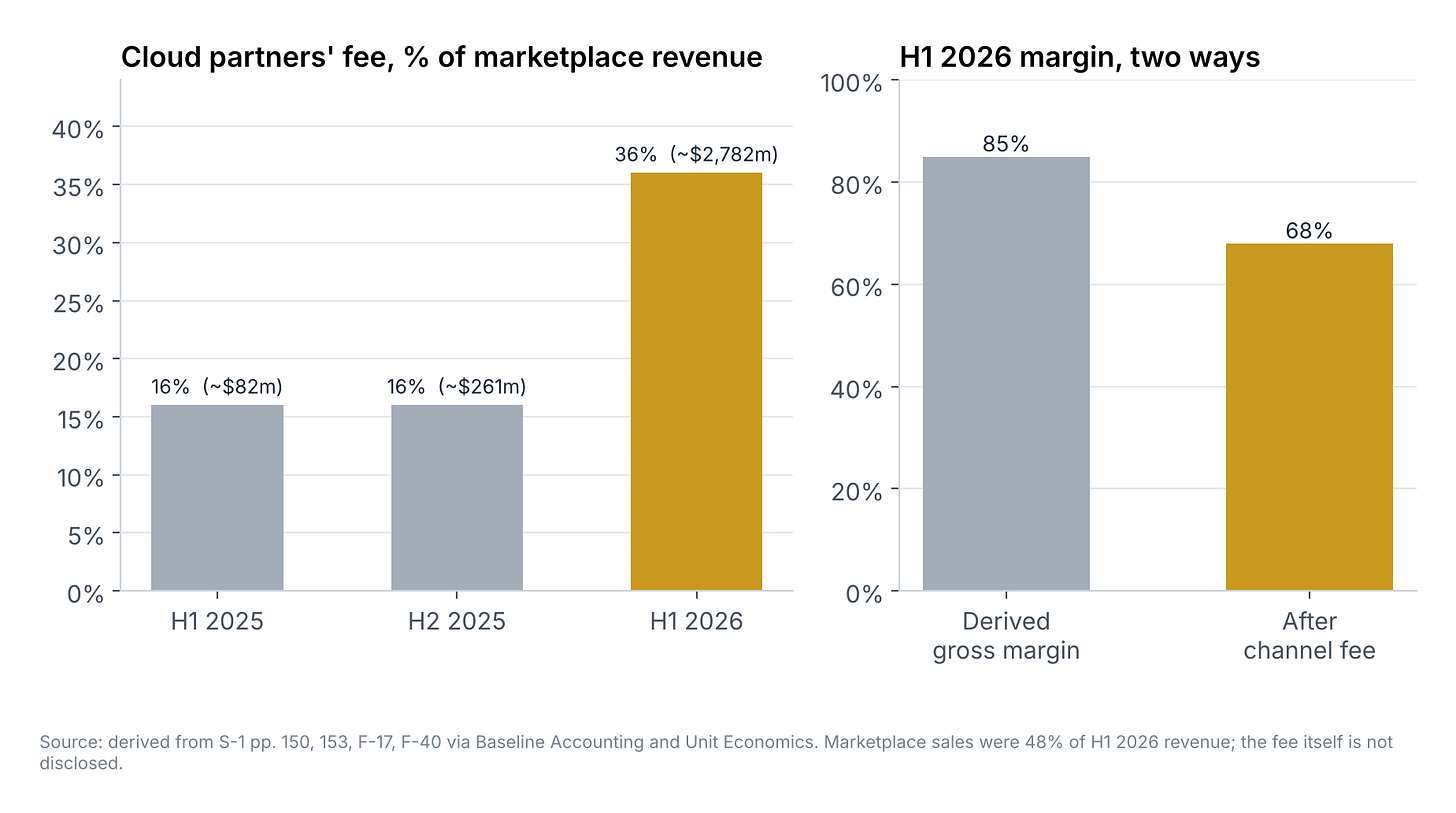
Against marketplace revenue of roughly $2.2bn in 2025 and $7.8bn in the first half, the implied rate went from about 16% to about 36% in six months, and management’s only comment is that the line will fluctuate with the terms of its channel arrangements. The write-up does two things with that. It restates revenue net of the fee, nearer $13.5bn than $16.3bn, and it restates the margin: the 85% becomes about 68% once the people who collected the cash have been paid.
The second reason Accounting is not a 4 is that the economic loop with Amazon and Google cannot be sized at all. They supply compute, collect customer cash, earn the fee, buy the service, and hold notes and non-voting stock, and the filing gives no figure for revenue earned from or fees paid to either of them. Neither appears in the related-person section, because Class N is non-voting and the 5% test is of voting securities. The 10%-plus customers are labelled A to D. The write-up calls the benign reading plausible and untestable.
Prices only go one way, and Pricing Power is a 3
Pricing Power scores 3, and the write-up is odd because it finds every source of pricing power present and none of them used. Fortune 500 customers spend under 0.1% of their expenses with Anthropic. Internal use of Claude at list price has exceeded the company’s own payroll since April. Net revenue retention is about 900%.
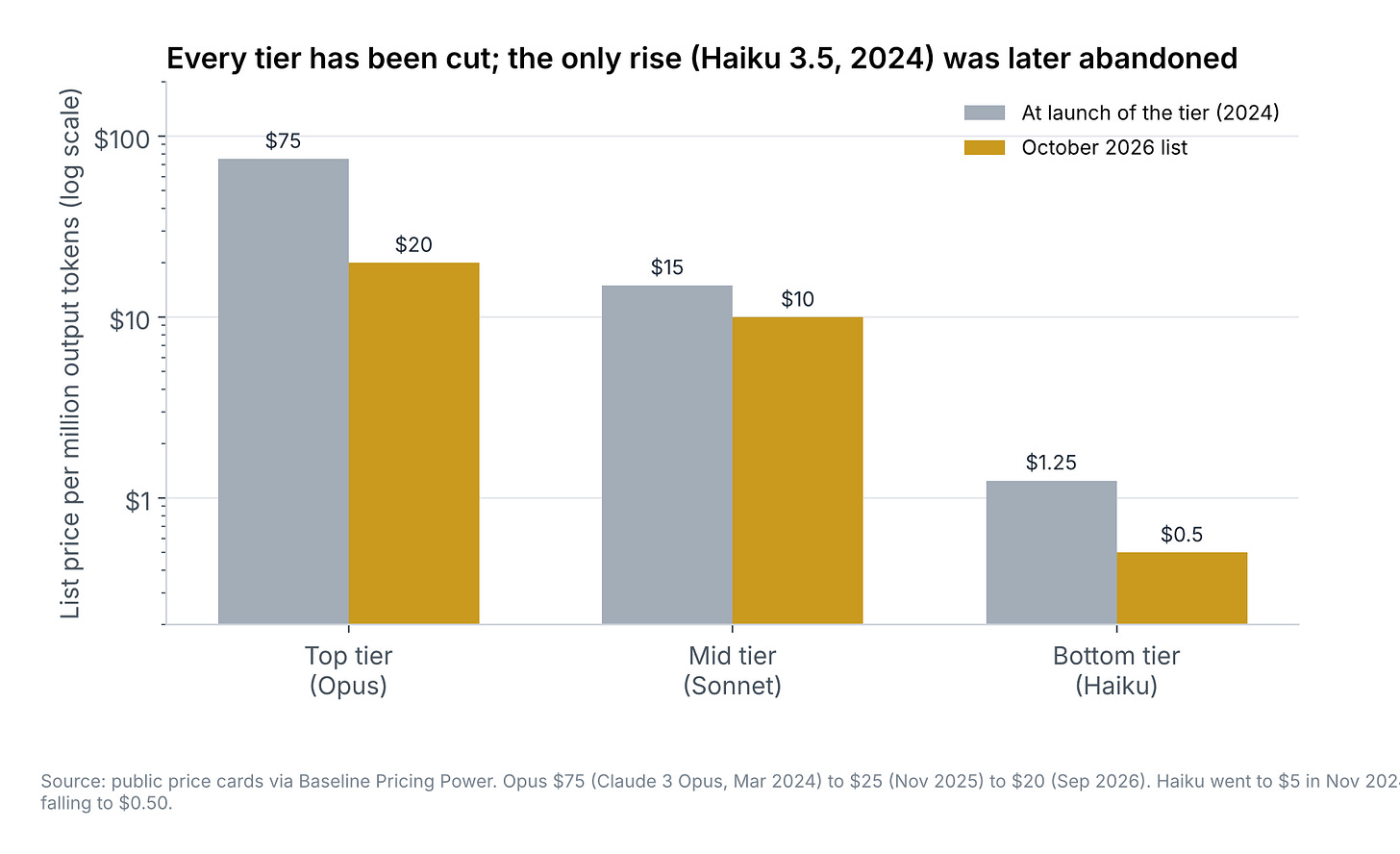
The reason it is not a 4 is the record. The flagship tier has gone from $15 and $75 per million tokens in March 2024 to $4 and $20 in September 2026, a 73% cut. The mid tier is down a third, the bottom tier is at ten cents, subscriptions have not moved since launch. The one increase in the company’s history, Haiku 3.5 in November 2024, was trimmed and then dropped.
The condition for a 4 asks for price raised above cost most years with little volume loss, and margins held through a downturn. Anthropic has never raised a flagship price and has never been through a downturn or a period of loose compute supply, and the S-1 itself credits lower prices with accelerating demand.
By October 2026 every Claude tier has a rival listed at exactly the same price: GPT-6 Astra matches Fable 5.1 at $10 and $50, GPT-5.6 Sol matches Opus 5.5 at $4 and $20, Gemini 4 Argon matches Sonnet 5.5 at $2 and $10. A year ago Anthropic could list Opus at four times OpenAI’s input price and grow 1,300% through it. If Google prices a Gemini model at Opus-equivalent capability at its historical $1.25 to $2 input level, or an open-weight release closes the agentic coding gap, the write-up says the score goes to a 2.
Why Risks is 2.3
Risks (excl-AI) scores 2, and the write-up’s central exposure is a duration mismatch. Fixed or minimum compute commitments were about $265.6bn at 30 June. Leases not yet commenced were another $321.4bn. Agreements signed since add roughly $245bn. Terms run up to 20 years with escalators, take-or-pay true-ups payable regardless of usage, and cross-default provisions.
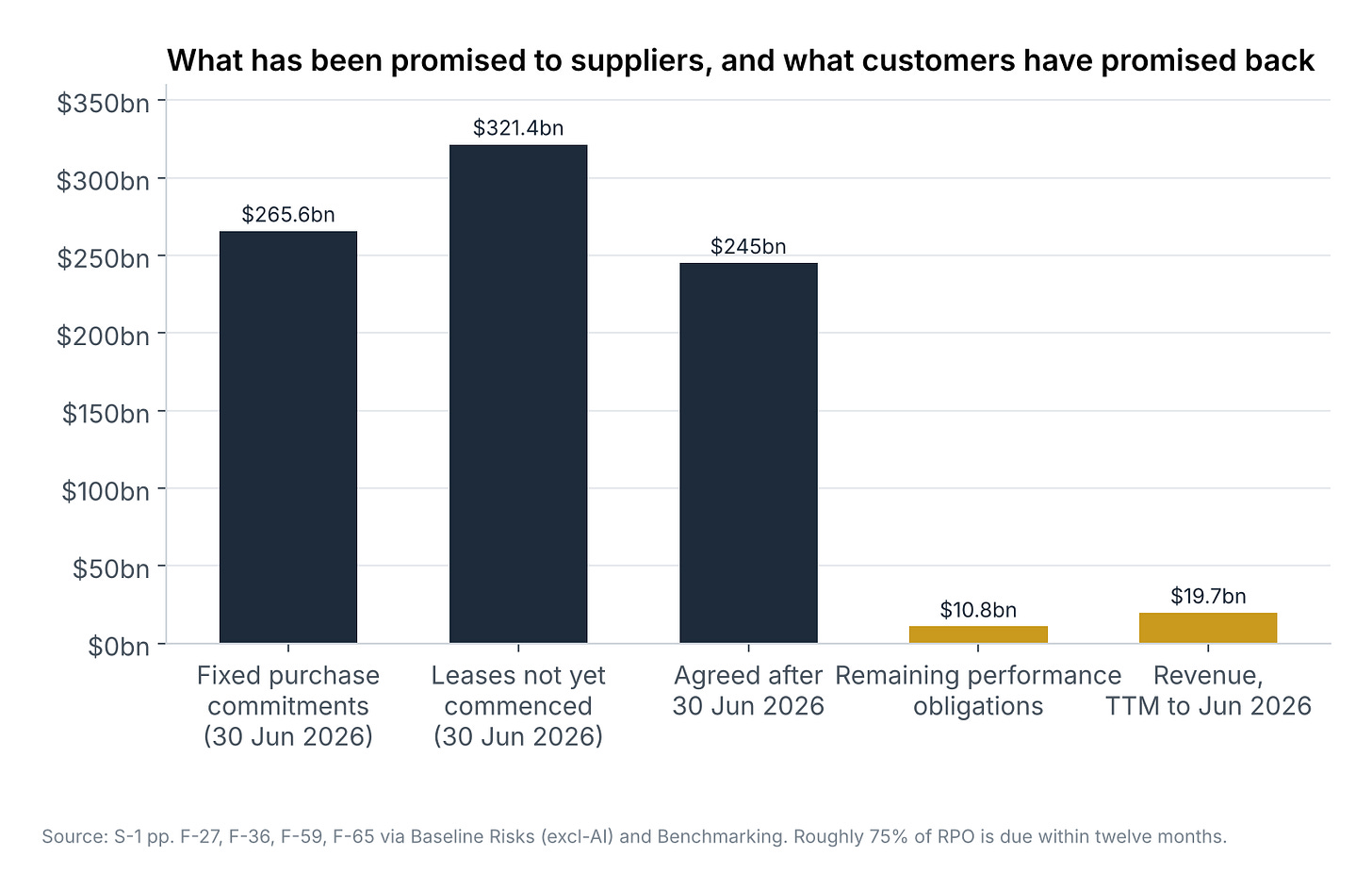
On the other side, remaining performance obligations were $10.8bn, about a quarter of a year’s revenue at the second-quarter run-rate. 80% of revenue is consumption, and the filing says in plain words that much of it has no long-term commitment and that many top customers can stop spending at any time.
What keeps it off a 1 is $131.7bn of liquidity, demand that still exceeds supply, a fungible compute pool and a district court win on the Department of War designation. The qualification is that those mitigations are untested against a demand deceleration, several of the risks are correlated, and the cash cushion is the common defence that the first risk to fire would consume.
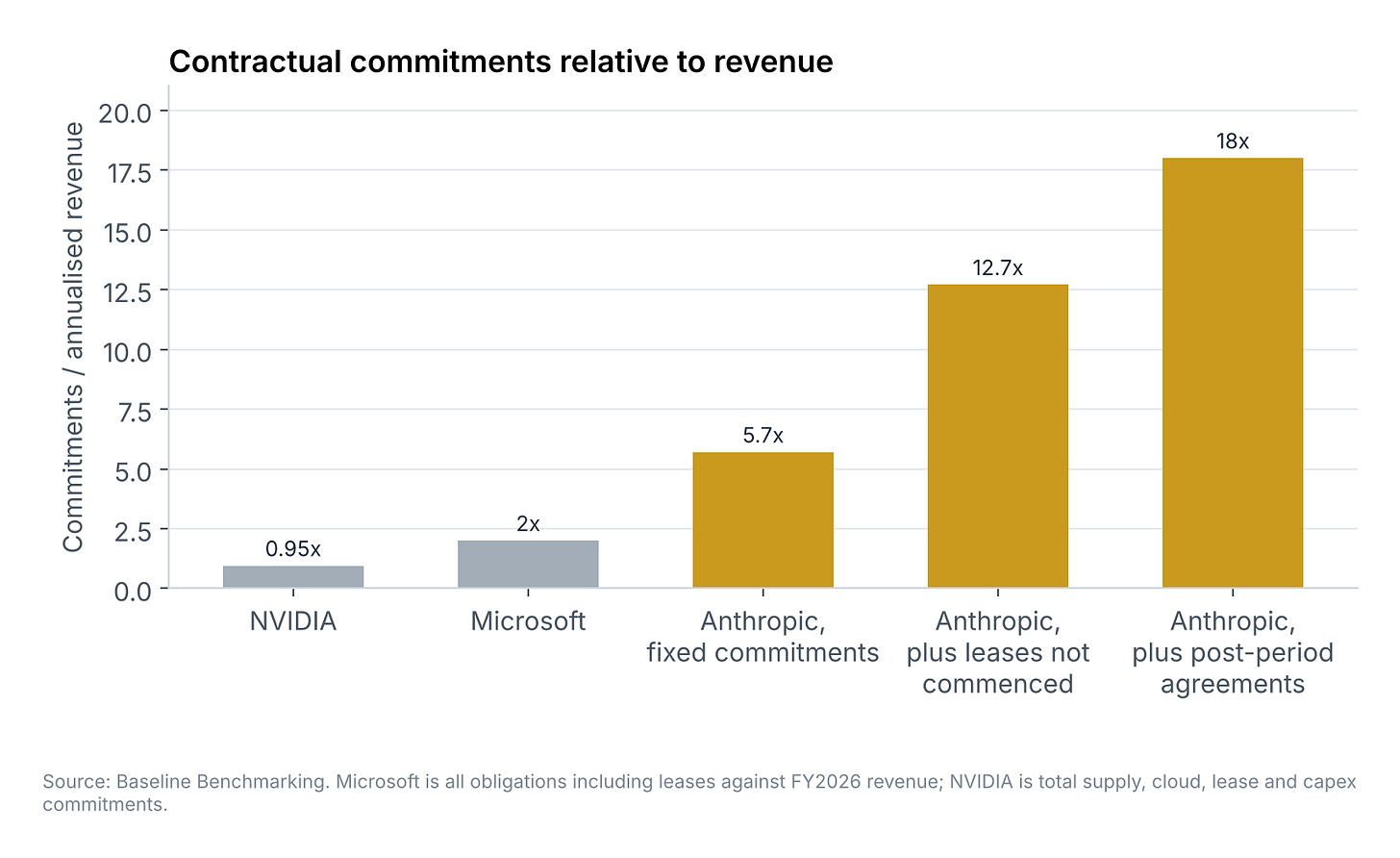
AGI Scenario scores 2, and that write-up has the plainest description of the structure: a fixed, decade-long cost base rented from suppliers who are also competitors, against a cancellable, deflating commodity revenue line. The filing’s own risk factor says competition “could increasingly depend on access to large-scale compute rather than on model development capability”, and Anthropic does not own the compute.
The reasons that keep it off a 1; contracted capacity an entrant cannot replicate, direct contracts with every Fortune 10 company, and the Claude Code habit, are described as real but unproven as sources of pricing power.
Where that leaves the scores
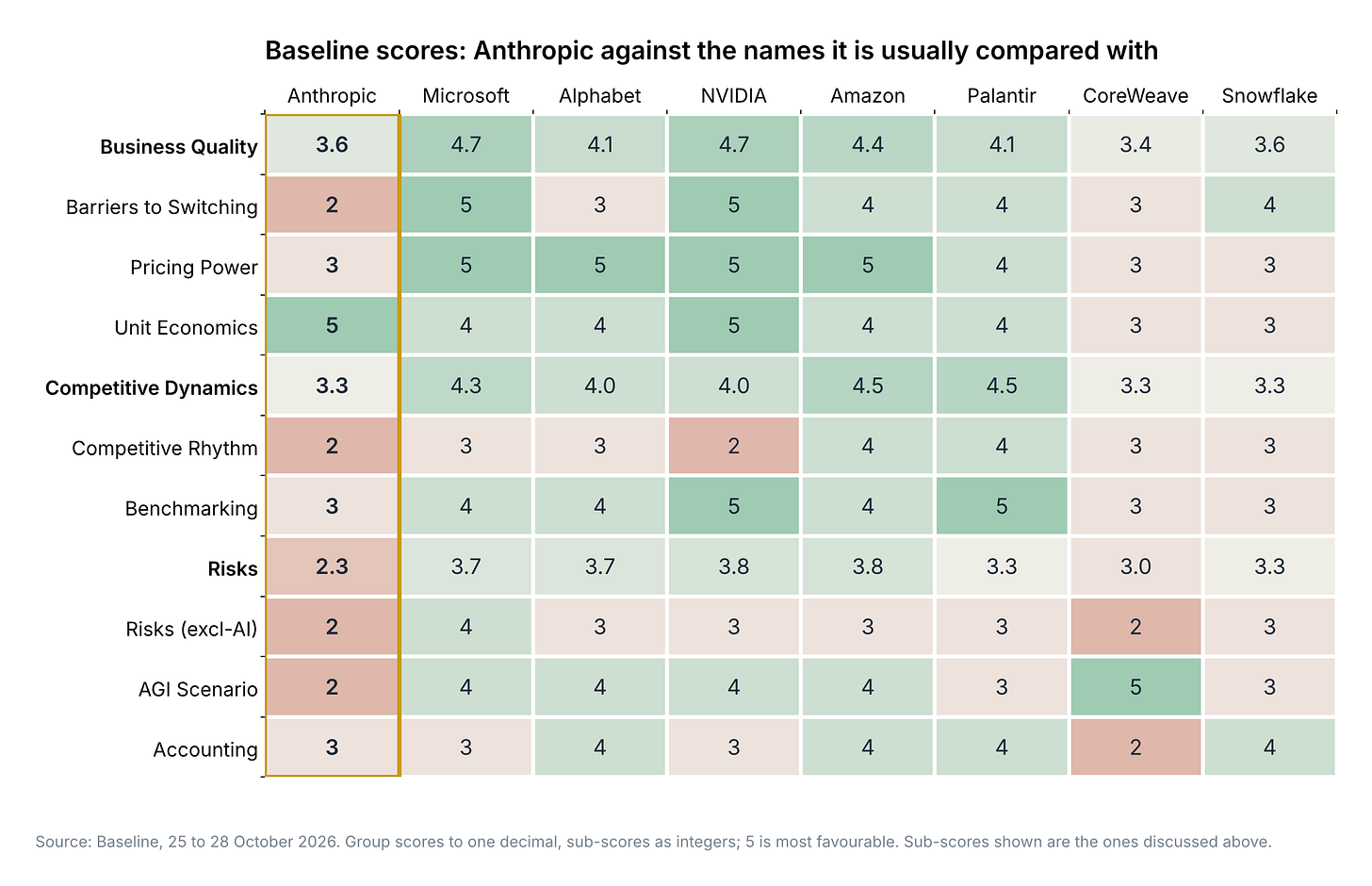
Against the usual comps, Anthropic's Business Quality of 3.6 is level with Snowflake, its Risks of 2.3 is the lowest in the set, and its one 5, Unit Economics, sits next to a 2 on Barriers to Switching where Microsoft and NVIDIA score 5.
Anthropic earns like the best in the universe on capacity it has already paid for, customers can leave by changing a model name, and it has promised its suppliers many times what its customers have promised back. Our write-ups put the odds of a rival leading on agentic coding for at least one cycle at better than even.