Buffett's pricing power quote, on Baseline
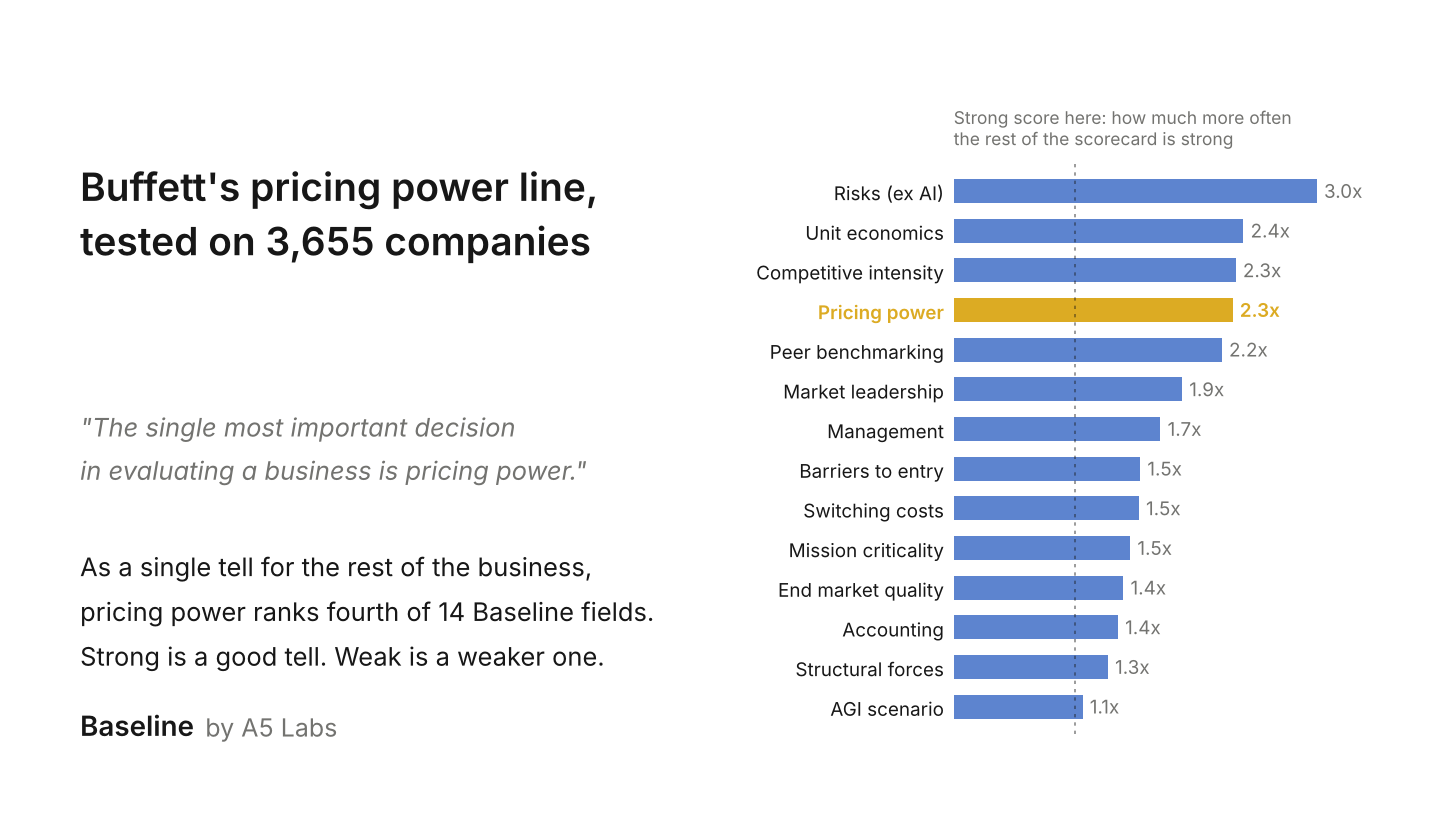
Strong pricing power is a good indicator. Weak pricing power is less meaningful.
In September we ran Buffett’s line about brilliant managers and bad businesses through the Baseline universe (Reputations that remain intact). Buffett was right, a good market rescues weak management more often than good management rescues a weak market. The piece got more replies than anything else we have published, so we are exploring another.
We now assess his interview with the Financial Crisis Inquiry Commission in May 2010: “The single most important decision in evaluating a business is pricing power.” If you can raise prices without losing business, he went on, you have a very good business; if you need a prayer session before raising them 10%, you have a terrible one.
What we ran
The claim is that pricing power is the one thing to know. So if you knew a company’s pricing power score and nothing else, how much would you know about the rest of the business? And is pricing power the score that tells you most, or does something else do better?
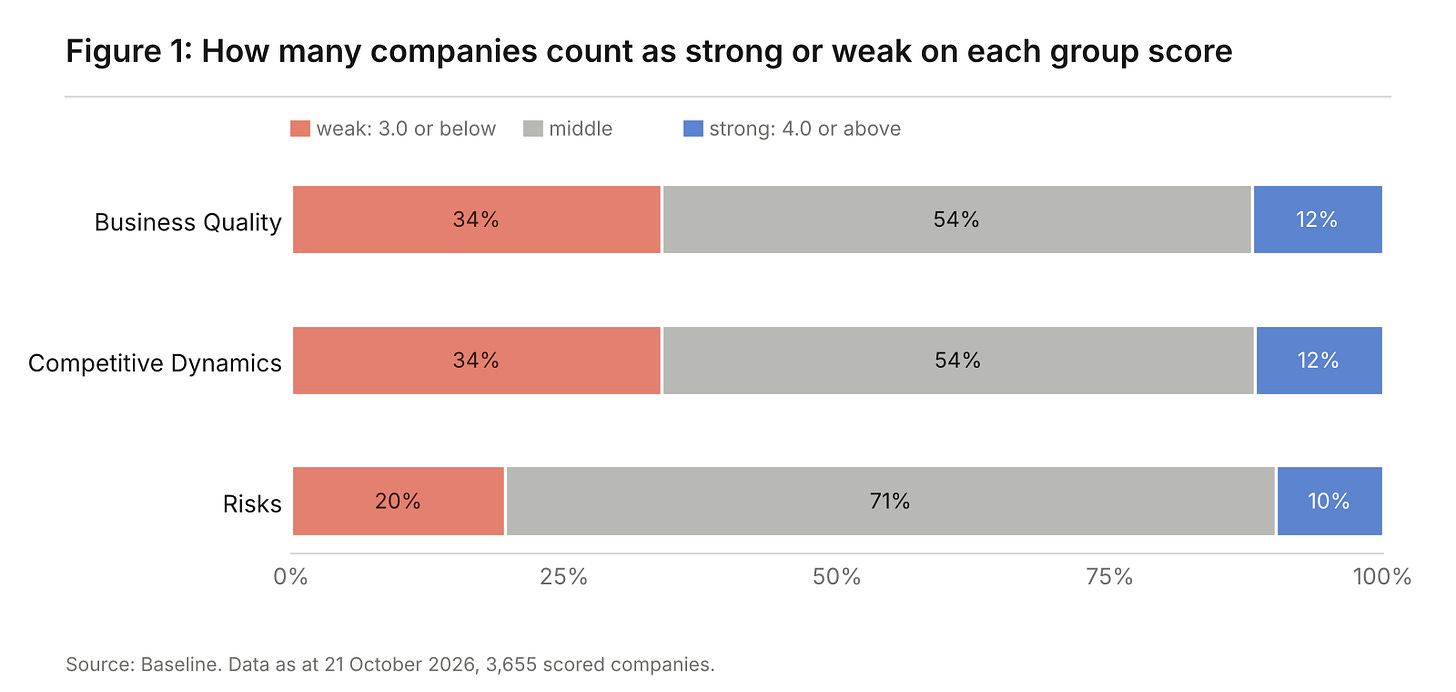
Baseline scores 14 fields per company, each 1 to 5, in three groups. Business Quality has seven fields, pricing power among them. Competitive Dynamics has four (barriers to entry, market leadership, competitive intensity, peer benchmarking). Risks has three (AGI scenario, risks ex AI, accounting). Each group score is the mean of its fields.
For pricing power we looked at the two groups it does not belong to, i.e. Competitive Dynamics and Risks. Business Quality is left out because pricing power is one seventh of it, so a high pricing power score would lift Business Quality.
The question for the 1,102 companies scoring 4 or 5 on pricing power is what share of them have Competitive Dynamics at 4.0 or above, and what share have Risks at 4.0 or above. Across the whole universe those figures are 12% and 10%, so anything well above that means strong pricing power is telling you something. For the 1,089 companies scoring 1 or 2 on pricing power, the question is the reverse: what share have the other groups at 3.0 or below, against universe rates of 34% and 20%.
Then the same test for the other 13 fields, each against the two groups it does not sit in, so that every field is scored the same way and can be ranked.
Results
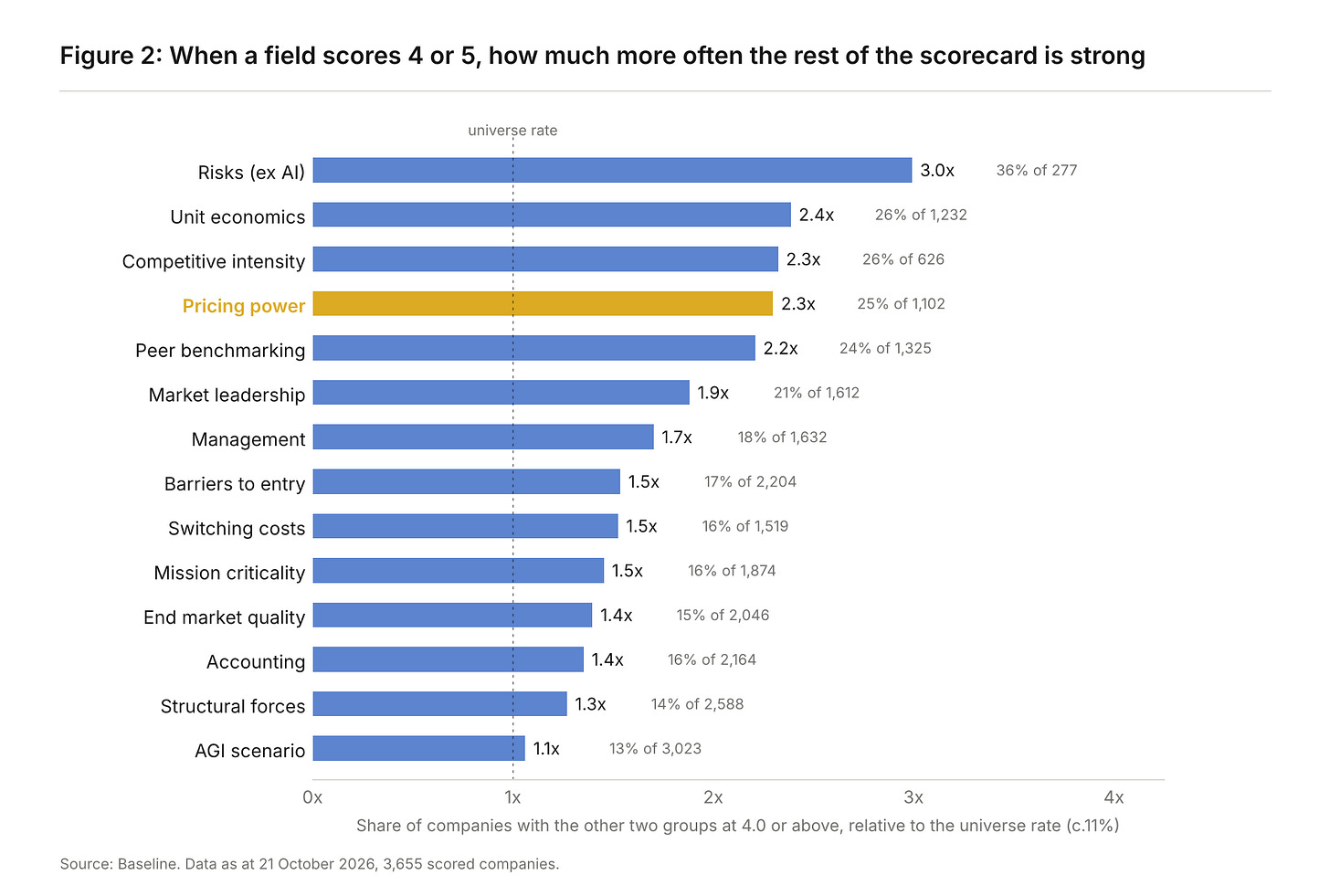
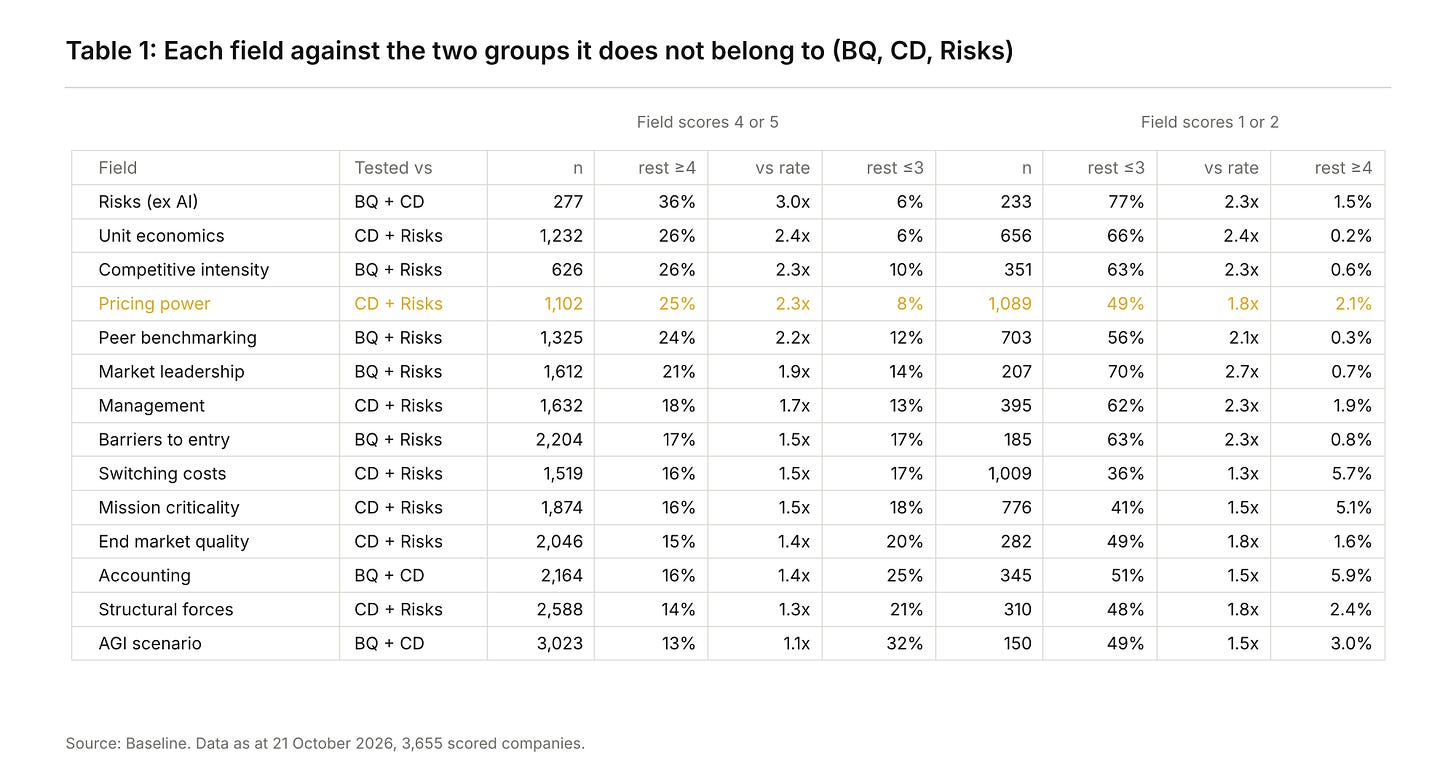
Strong pricing power is a good tell. Of 1,102 companies scoring 4 or 5, 28% have Competitive Dynamics at 4.0 or above and 22% have Risks at 4.0 or above, against universe rates of 12% and 10%. Averaged, that is 2.3 times the base rate, fourth of 14 and within rounding of unit economics and competitive intensity.
The field that beats it clearly is risks ex AI: a company with a 4 or 5 on risk exposure has a strong Business Quality or Competitive Dynamics score three times as often as the universe. Risks ex AI is also the rarest high score in the set, with 277 names at 4 or 5, so it is the pickiest field as well as the most informative one.
The fields at the bottom are the ones that are easy to score well on. AGI scenario has 3,023 companies at 4 or 5, and a strong score there tells you almost nothing about the rest. Structural forces, accounting and end market quality are in the same position: a 4 is common, so a 4 does not discriminate.
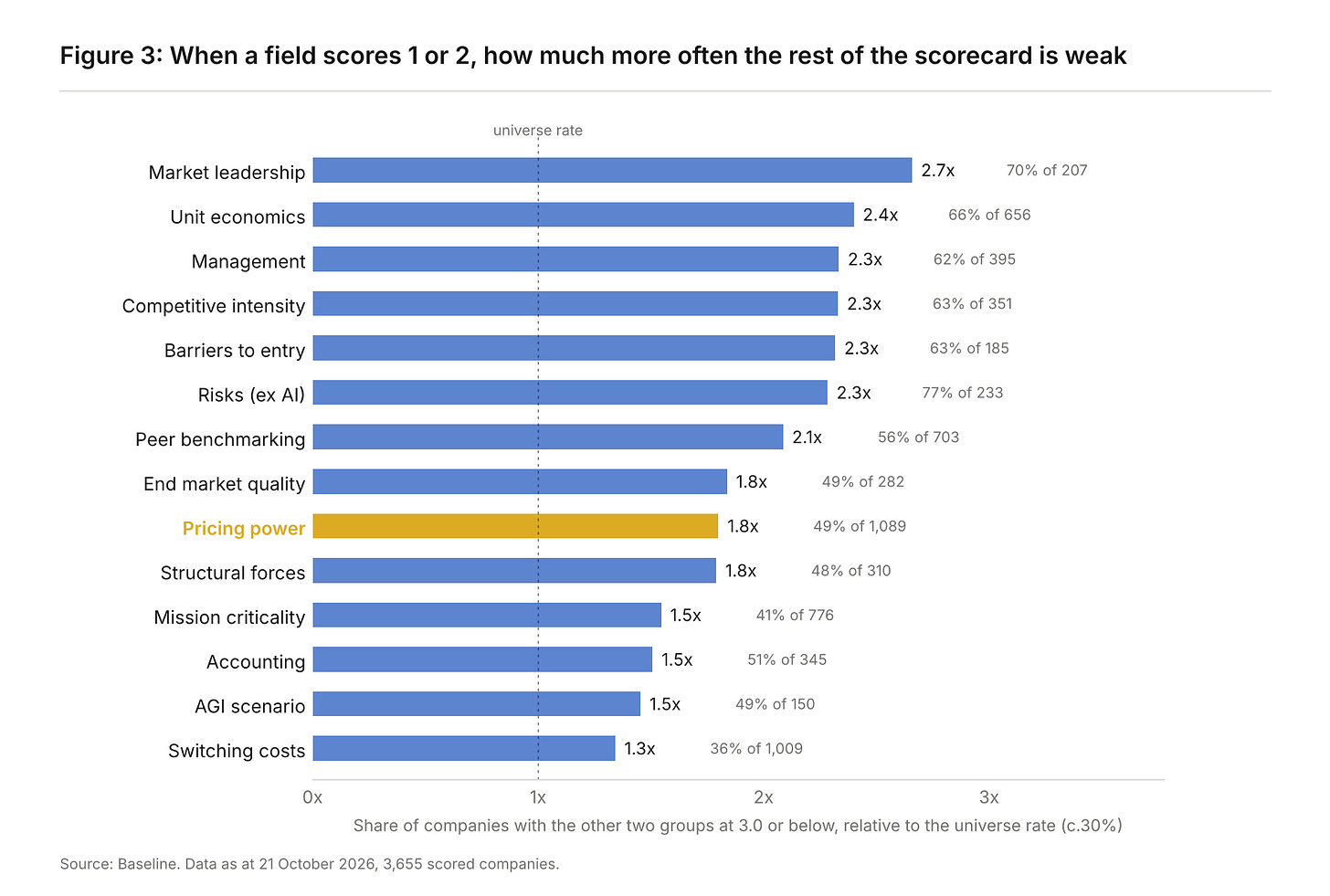
Weak pricing power is a weaker tell. Of 1,089 companies scoring 1 or 2, 66% have Competitive Dynamics at 3.0 or below and 32% have Risks at 3.0 or below. Relative to the universe that is 1.8 times. Weak market leadership (2.7 times), unit economics (2.4), competitive intensity, management, barriers to entry and risks ex AI (all 2.3) say more about the rest of the business than weak pricing power does.
The explanation is in who scores low. A 1 or 2 on pricing power covers 1,089 companies, nearly a third of the universe, and the bucket is full of price takers that are otherwise sound: regulated utilities, distributors, commodity producers in protected positions.
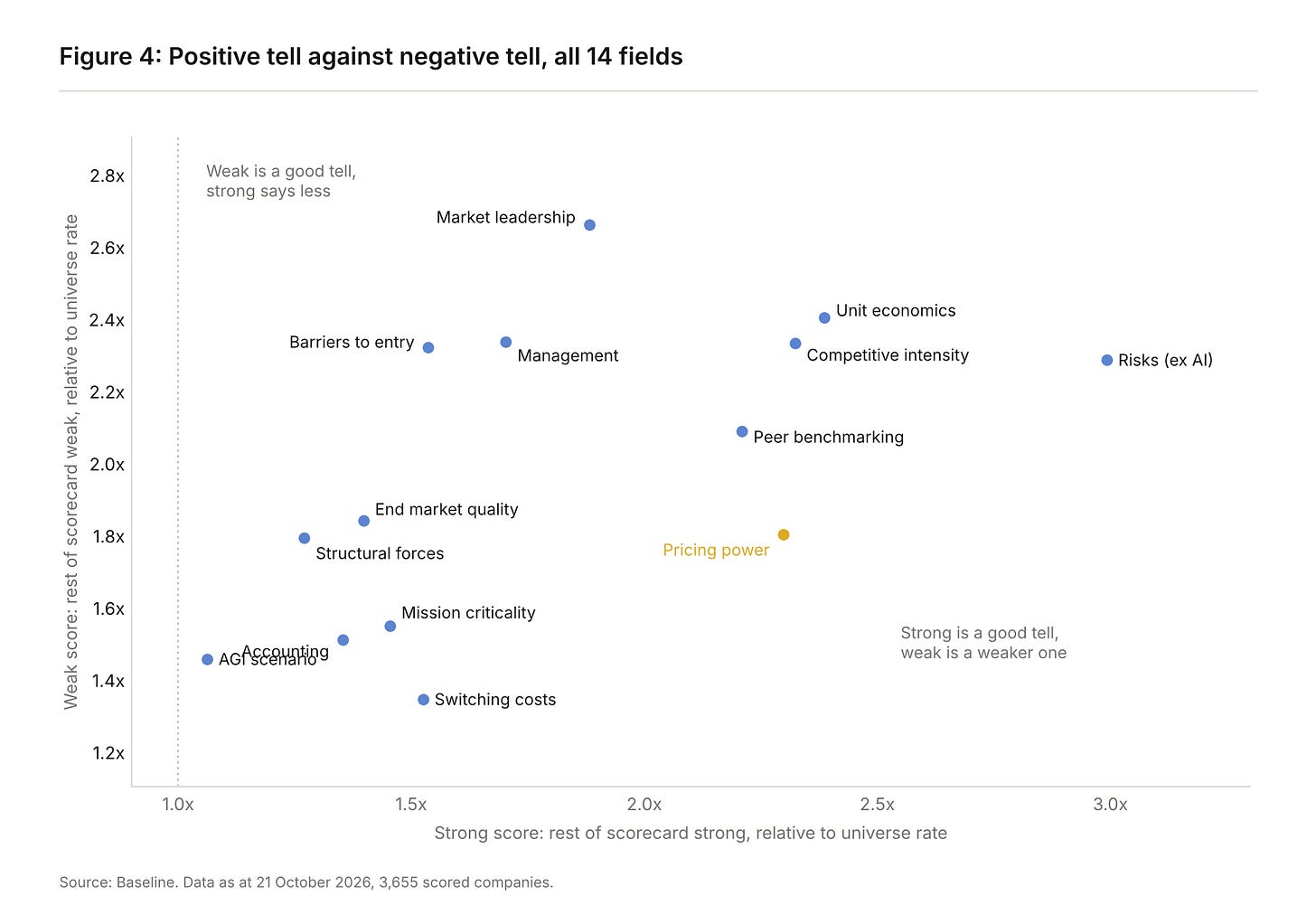
Plotting both together, pricing power sits in the bottom right. Strong says a lot, weak says less. Market leadership is the opposite case: a weak score is the most damaging in the set, a strong score is middling. Unit economics, competitive intensity and risks ex AI are the fields that work in both directions.
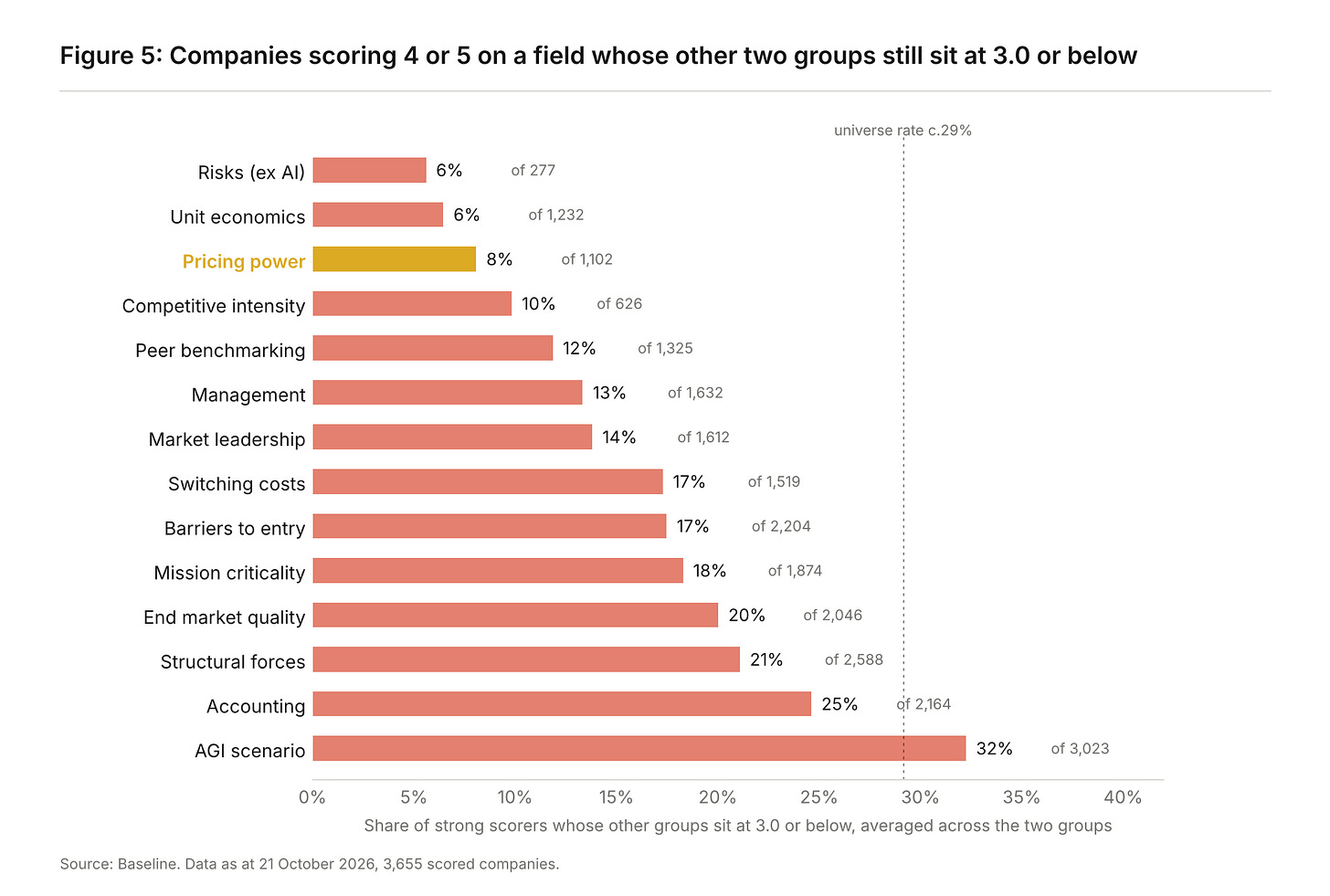
The last exercise is the one that matters most for a reader who uses pricing power as a filter. Of the 1,102 companies with strong pricing power, 8% have the rest of the scorecard at 3.0 or below, averaged across the two groups. Only risks ex AI and unit economics do better. A 4 or 5 on pricing power rarely sits on top of a weak business.
Four cases
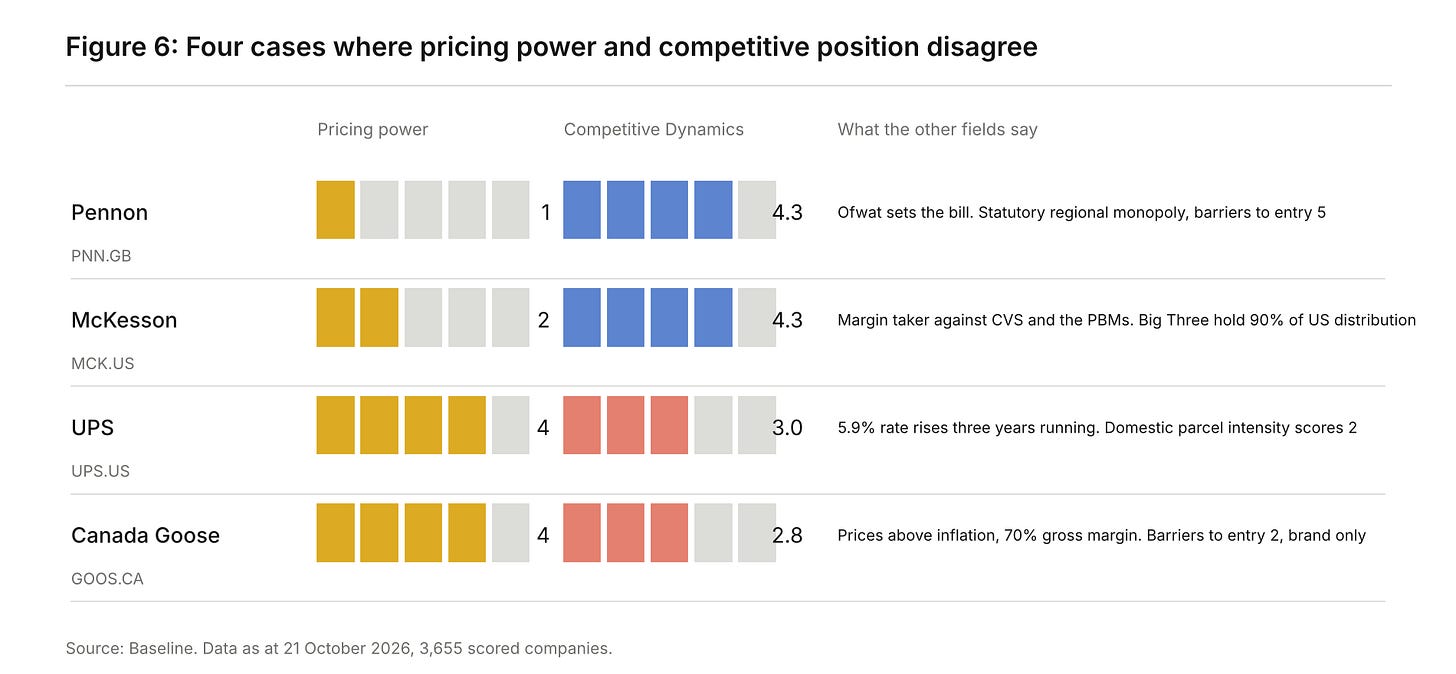
Pennon 
McKesson 
UPS 
Canada Goose 
In the first pair the price is set by someone else and the position is protected anyway. In the second the company sets its own price and the position is contested anyway. Pricing power and competitive position are related but they are not the same question, which is why pricing power is a good tell and not a complete one.
What to do with it
Buffett’s line holds up. Strong pricing power is the fourth best single tell for the rest of the scorecard, close behind the top three, and it rarely coexists with a weak business. Where it falls short is on the downside. Weak pricing power is tenth as a negative tell, because a third of the universe scores low on it and much of that third is sound. A reader who screens out weak pricing power loses the regulated utilities, the distributors and the commodity producers with low-cost assets, and some of those are among the best-protected businesses in the set.
It also fits with the September result. Management was the least decisive of the three fields in that test, and here it is seventh of 14 as a positive tell, behind pricing power, unit economics and competitive intensity. Two pieces on two different Buffett lines point the same way: the fields that describe the economics of what a company sells tell you more about the rest of the business than the field that describes who runs it.
If the question is which single score to read first, the data points at risks ex AI, unit economics or competitive intensity ahead of pricing power. If the question is whether a company with strong pricing power is likely to be a good business, the answer is yes about three times as often as a company picked at random, and almost never a weak one.
Sources
- Baseline, scores and rationales as at 21 October 2026. Counts from the Baseline screener across 3,655 companies with all three group scores assigned; NA scores excluded.
- Buffett’s answer to the FCIC, 26 May 2010: transcript.
- The September piece on management and end markets: Reputations that remain intact, Baseline, 16 September 2026.
- Company detail in the four cases is from the Baseline field analyses for Pennon (PNN.GB), McKesson (MCK.US), UPS (UPS.US) and Canada Goose (GOOS.CA), dated 2 to 14 October 2026.