Easy to leave, exposed to AI: 26 US stocks across two MCP servers
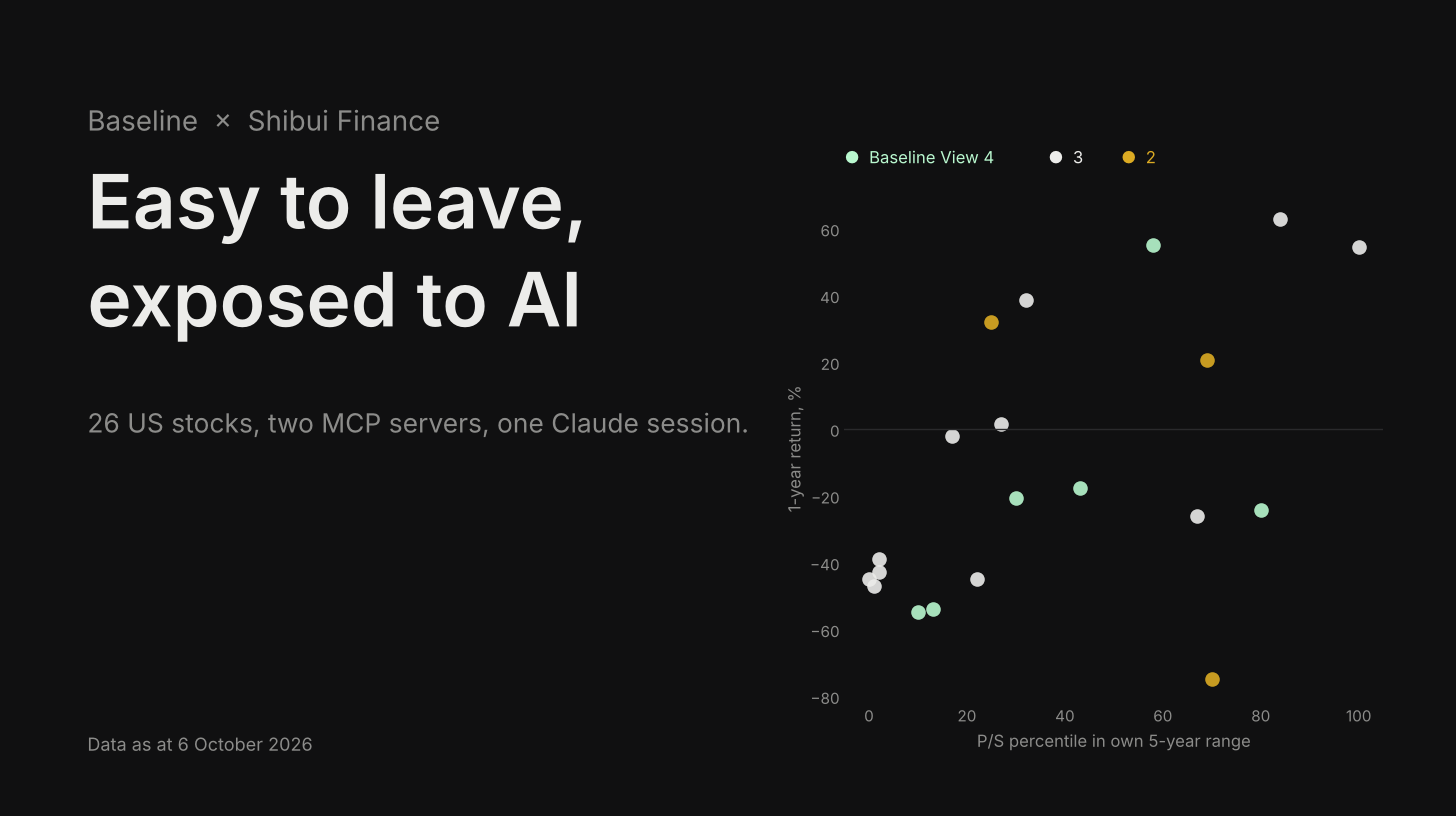
A joint worked example with Shibui Finance. Baseline scores the business, Shibui checks what the market has already priced in. Data as at 6 October 2026.
This article was written with Christian Richter, who runs Shibui Finance, a free MCP server that connects Claude to daily prices, financial statements, valuations, technical indicators and SEC filings on about 10,000 US stocks. We score companies 1 to 5 on the questions an analyst would ask, with a written rationale behind each score. With both servers connected, Claude calls whichever one the question needs, so a qualitative screen can go straight into a quantitative one in the same conversation.
We used our usual example screen: businesses whose customers can leave easily and whose product is exposed to capable, cheap AI. Part one is the Baseline screen, which I wrote. Part two is Christian's pass through Shibui. The same piece is also up on the Shibui site.
The five names it ends on are Duolingo, Upstart, Yelp, Robert Half and Opendoor. Duolingo and Upstart lost 54% and 55% over the year while revenue grew 29% and 46%.
Part one: the Baseline screen
On Baseline the screen is low Barriers to Switching and a low AGI Scenario score. We ran it on the Baseline MCP on 6 October 2026, restricted to US listings because that is the universe Shibui covers:
Barriers to Switching ≤ 2; AGI Scenario ≤ 2; Country = US
This returns 26 companies out of 1,374 US names scored on both fields, about 1.9%. Across the full Baseline universe the same two conditions return 37, so the US accounts for most of the set. All but one score 2 on AGI Scenario, which in Baseline terms means a business that is not existentially substitutable but where most of the current profit pool is exposed to fee compression. Six score 1 on Barriers to Switching, Evercore and Marcus & Millichap among them.
The set leans heavily to Communication Services (12 of 26), mostly online marketplaces, review sites and ad-tech. Staffing and labour intermediaries make up a second cluster (Robert Half, ManpowerGroup, RXO), with advisory boutiques a third (Evercore, Perella Weinberg). The rationales for Robert Half and Evercore make much the same point, that the product is cognitive labour sold by the hour or by the mandate, and clients can take the work in-house once the tools are good enough.
The more useful split is on Baseline View. Seven of the 26 still score 4, which means our read is that the business is improving despite both flags. Eleven score 3, six score 2 and two score 1. None score 5. That spread is why the screen was worth handing to a quantitative tool, since the qualitative flags on their own do not say which of these the market has already marked down.
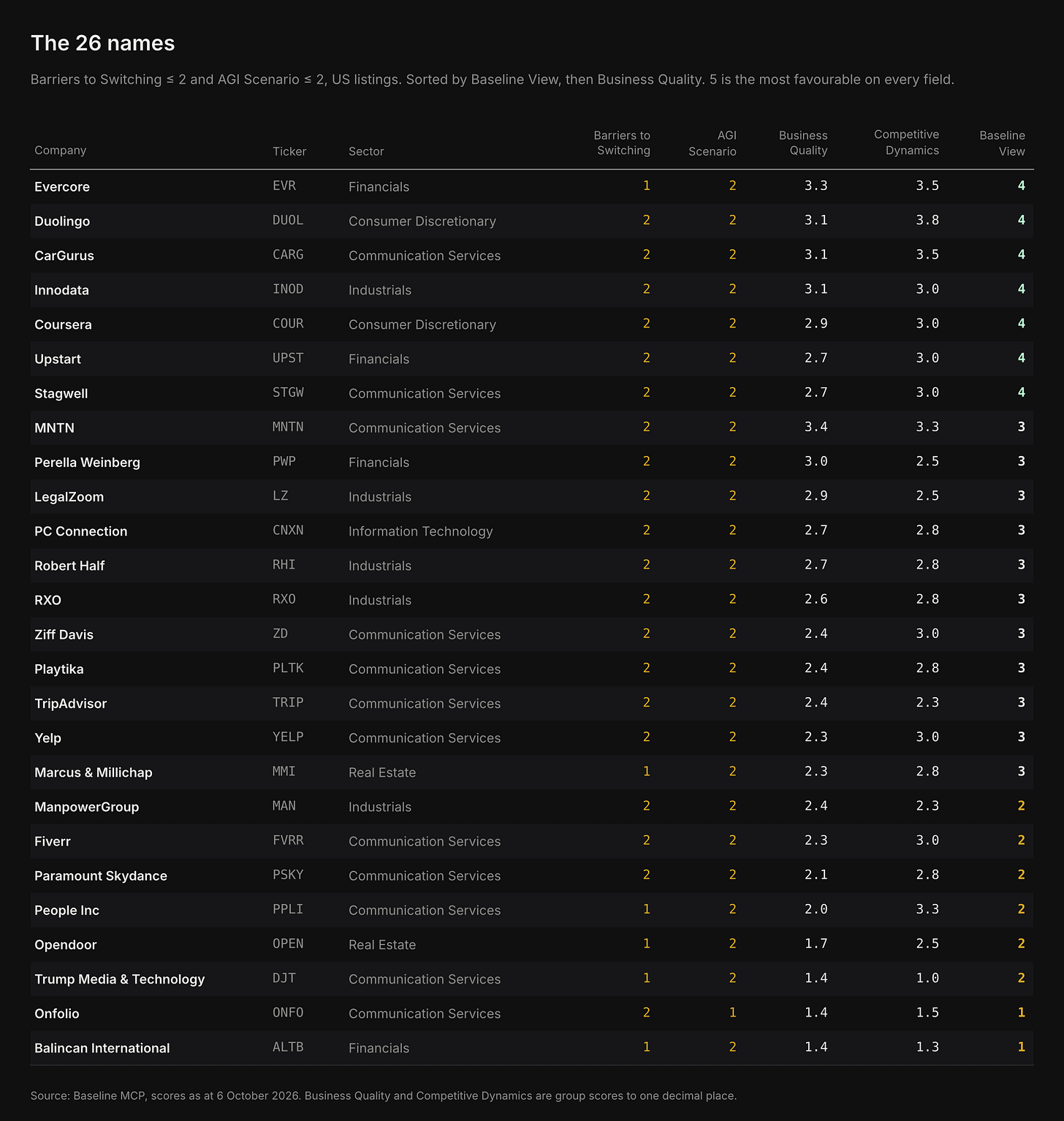
The bottom of the list includes some very small companies, and several drop out once Shibui applies a size floor.
One name in more detail
Duolingo (DUOL). Barriers to Switching scores 2. The rationale separates behavioural lock-in, which is strong (streaks, habit, social features), from structural lock-in, which is close to nil, since a user can leave with no downtime or data loss and can use a general AI tutor alongside the app at no cost. AGI Scenario scores 2 for a similar reason. Personalised instruction, practice generation and conversational tutoring are things a general model does directly, and subscriptions were around 84% of 2025 revenue. The Duolingo English Test is the more defensible piece because it is an accepted credential, but it is not large enough to offset the subscription exposure. Baseline View is 4.
Part two: the Shibui pass (by Christian Richter)
Christian took the 26 names through Shibui to see which of them the market has already marked down, with prices as at the 6 October 2026 close, the same day as our scores, and financial statements through the quarter ended 30 June 2026. Three prompts in Claude with Shibui connected produce the numbers:
"Here are 26 US tickers: EVR, DUOL, CARG, INOD, COUR, UPST, STGW, MNTN, PWP, LZ, CNXN, RHI, RXO, ZD, PLTK, TRIP, YELP, MMI, MAN, FVRR, PSKY, PPLI, OPEN, DJT, ONFO, ALTB. Show each one's exchange, market cap and average daily dollar volume over the last three months. Drop anything under $500M market cap."
"For the names left, show the 1-year and 3-year price return, today's price-to-sales ratio, its 5-year median, and where today's P/S sits in its own 5-year range as a percentile, where 0 is the lowest it has been in five years."
"Add revenue growth for the last four quarters against the four before, and operating margin for the same two periods."
Five names drop out before any valuation work, which leaves 21. Balincan International (ALTB) trades over the counter, outside Shibui's NYSE and NASDAQ coverage, and Fiverr and Onfolio fall below the $500 million market-cap floor. Paramount Skydance and Coursera have changed shape. Paramount Skydance became Skydance Corporation (SKYD) on 6 October alongside its takeover of Warner Bros. Discovery (8-K), and Coursera merged with Udemy in May (10-Q), so their five-year multiples compare different businesses. Trump Media & Technology stays in, but with trailing revenue of about $4.5 million its price-to-sales ratio means little, so it is marked n/m.
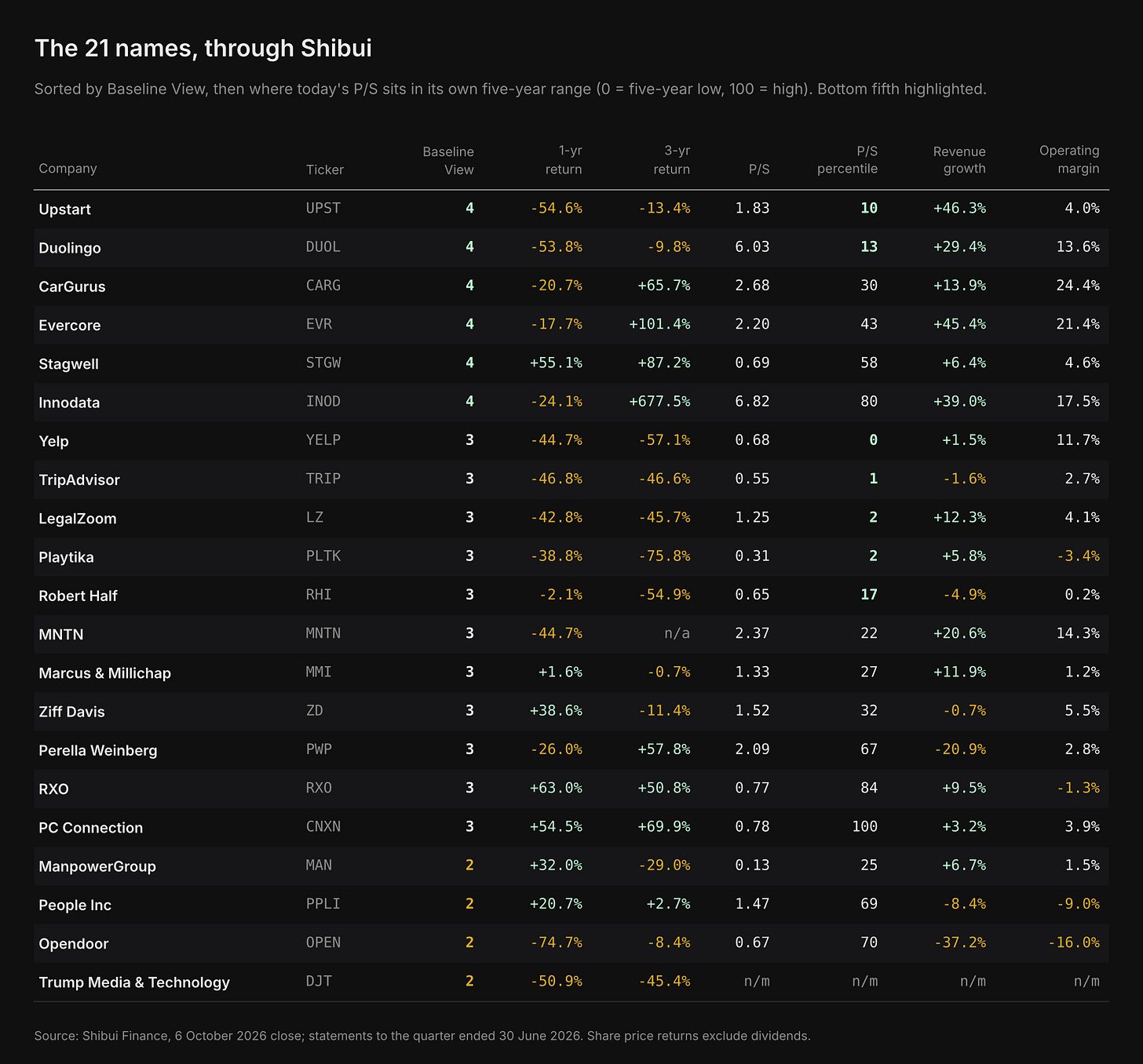
Where the market and Baseline View line up
As a group, the 21 names fell 13% over the past year, equal-weighted, against a 16% gain for SPY, the S&P 500 ETF, and only six of them beat it. Over three years the average is +36%, but Innodata accounts for almost all of that; without it the group is up 2%, against 81% for SPY.
The joint shortlist
The shortlist takes two names from each of the two groups above and Opendoor from the other end. None of this is a view on whether a share is cheap. It compares each price with the company's own history and its latest results.
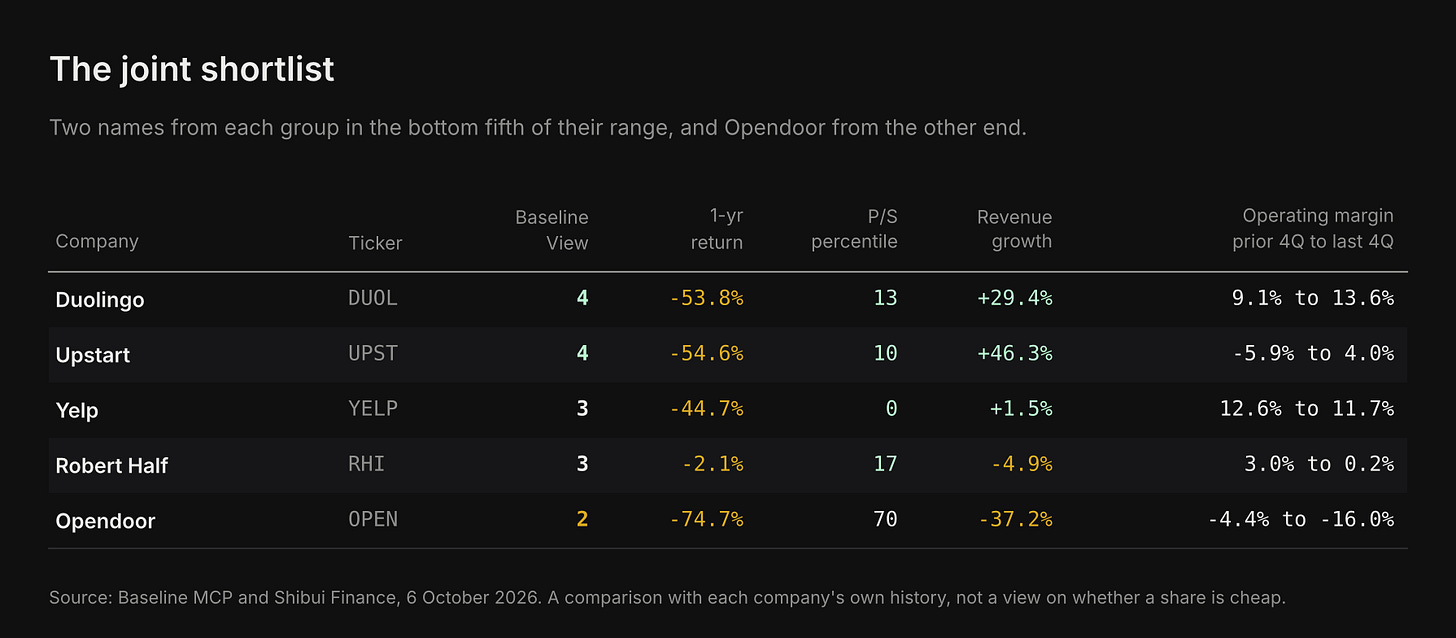
Duolingo (DUOL). At 6.0 times sales, the shares trade at less than half their five-year median of 13.9, on revenue of $1.1 billion over the last four quarters. Baseline View is 4: strong habit, weak structural lock-in, and a subscription line a general AI tutor competes with directly.
Upstart (UPST). The shares trade at 1.8 times sales against a five-year median of 4.4, and operating income over the last four quarters was positive after a loss in the four before. Baseline View is 4 despite both flags.
Yelp (YELP). At 0.68 times sales, the shares sit near their five-year low of 0.66 and well below the median of 1.80, while the operating margin has held near 12%. Baseline View is 3.
Robert Half (RHI). The shares are down 55% over three years, and the June 2026 quarter brought an operating loss of $62 million. Baseline View is 3, with the rationale pointing to a smaller, more senior business rather than an obsolete one.
Opendoor (OPEN). Revenue over the last four quarters, $3.3 billion, is about a fifth of its 2022 level, which keeps the multiple above its five-year median of 0.28 even after the fall in the shares. Baseline View is 2.
Running it yourself
Connect both servers in Claude, run the Baseline filter from part one, then paste the three prompts from part two. Shibui is free and Baseline has a free tier. Scores and prices change, so a new run will not match these tables exactly.
Sources
Scores, sub-scores and rationales from the Baseline MCP as at 6 October 2026. Prices, valuations and financial statements from Shibui Finance for the 6 October 2026 close, with revenue and most operating income figures checked against each company's 10-Q and 10-K filings on SEC EDGAR; Evercore's revenue is net revenue. Corporate actions from the Skydance Corporation 8-K and the Coursera 10-Q for the quarter ended 30 June 2026. Shibui's version of this piece: shibui.finance.
Baseline's scores describe the business, not the shares, and nothing here is investment advice.