Field notes: UK housebuilders
Taylor Wimpey cut its outlook on Wednesday and Persimmon held its own on Thursday. Seven of the eight builders we cover score 2 on Pricing Power, which is why who they sell to matters so much.
On Wednesday Taylor Wimpey 

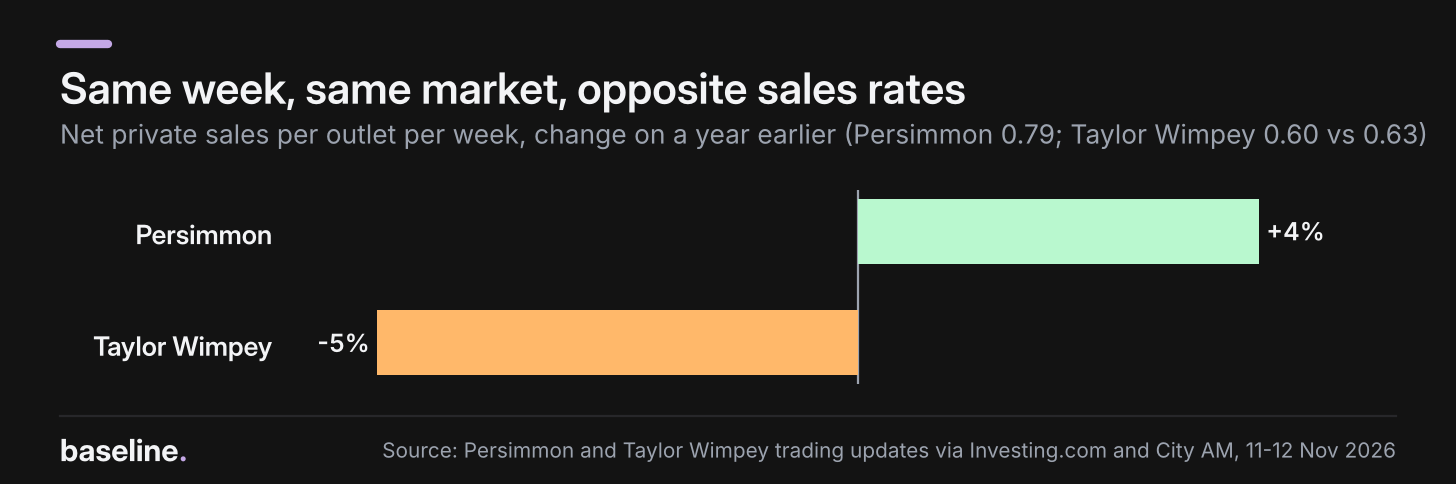
Both were selling into the same market, a week after the Bank of England raised Bank Rate to 4%, its first rise since 2023 (Tembo). Persimmon sells the cheapest homes of the large builders, and first-time buyers were 36% of its private completions in the first half. Taylor Wimpey has more of its business in the South, where saving a deposit is harder, and Goldman Sachs had already expected that to mean slower growth than peers (both from Baseline’s Key Debates).
The reason a difference in price point shows up so quickly is that housebuilders have very little say over their price. A builder controls its land and its costs. The price is set by the second-hand homes nearby, which are most of the market, and by what a bank will lend. In effect it is a manufacturer whose product is priced by the used stock around it.
So the margin is whatever is left over. Taylor Wimpey’s build costs rose 3-4% this year while underlying prices fell about 1.5%, and its adjusted operating margin fell to 7.7% in the first half from 9.7% (Baseline’s Pricing Power rationale and Key Debates). Barratt Redrow 
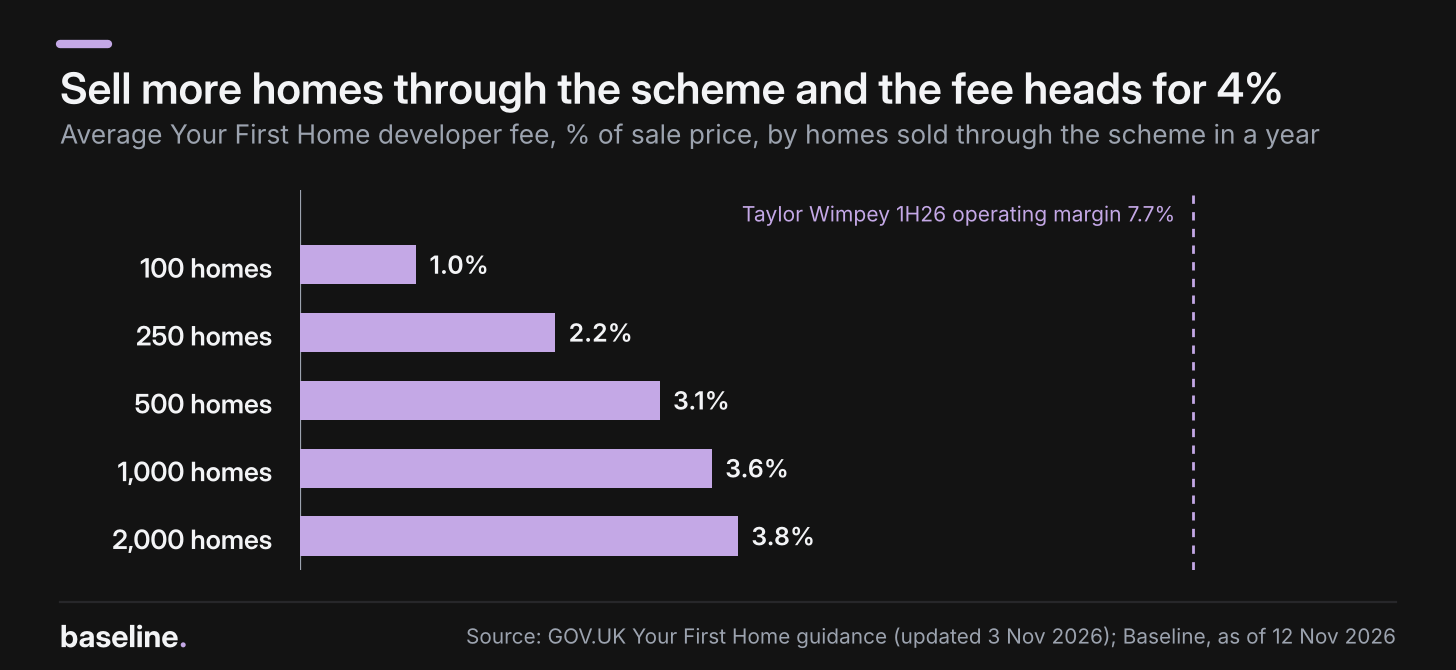
That is also why the Your First Home scheme, confirmed in the 28 October Budget, knocked the shares rather than lifting them. Buyers put down 2.5% and the government lends 20% of the price, interest free for five years (GOV.UK). Developers pay a fee on each scheme sale: 1% on the first 100 a year, 3% on the next 150 and 4% after that. Reuters reported the sector fell more than 6% that day, with Peel Hunt saying the market had expected about 1%. On a £300,000 home, 4% is £12,000. At Taylor Wimpey’s first-half margin, the operating profit on that home is about £23,000.
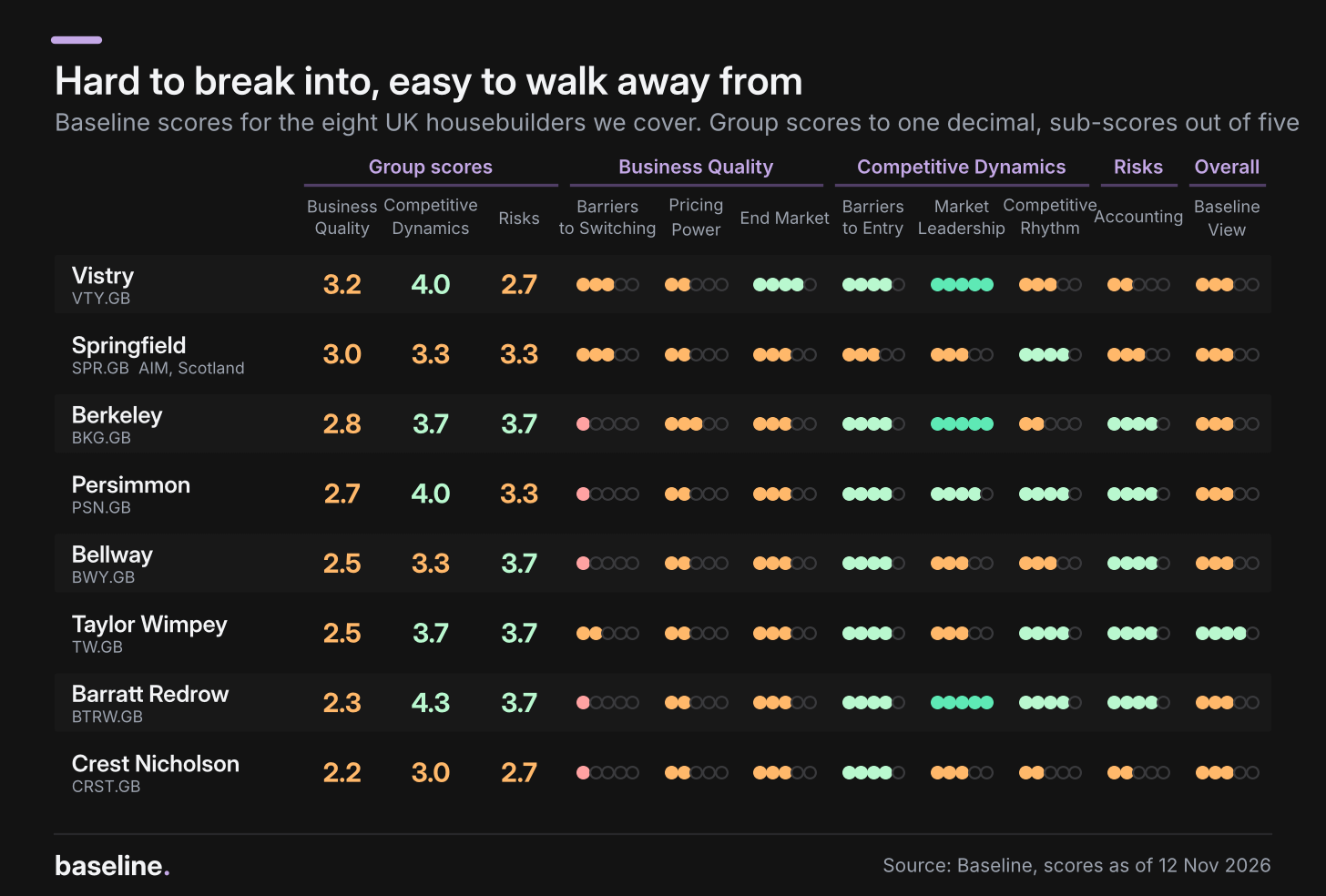
Across the eight, the scores read like one business under eight names. Seven score 4 on Barriers to Entry: consented land is scarce, planning takes years and the capital goes in long before the first sale. Persimmon’s rationale notes that small builders’ share of completions has fallen from about 40% in the 1980s to around 10%. Seven score 2 on Pricing Power, with Berkeley 
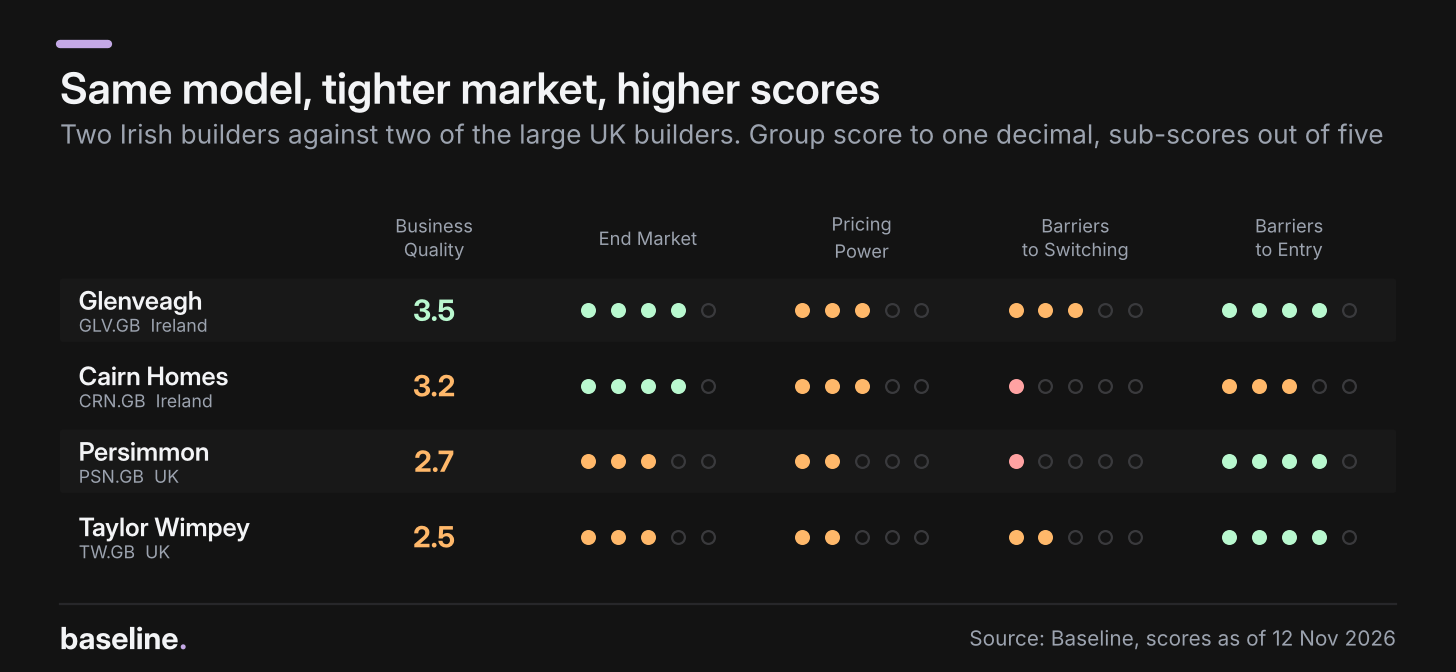
The market matters as much as the model. Every UK name scores 3 on End Market Quality except Vistry 


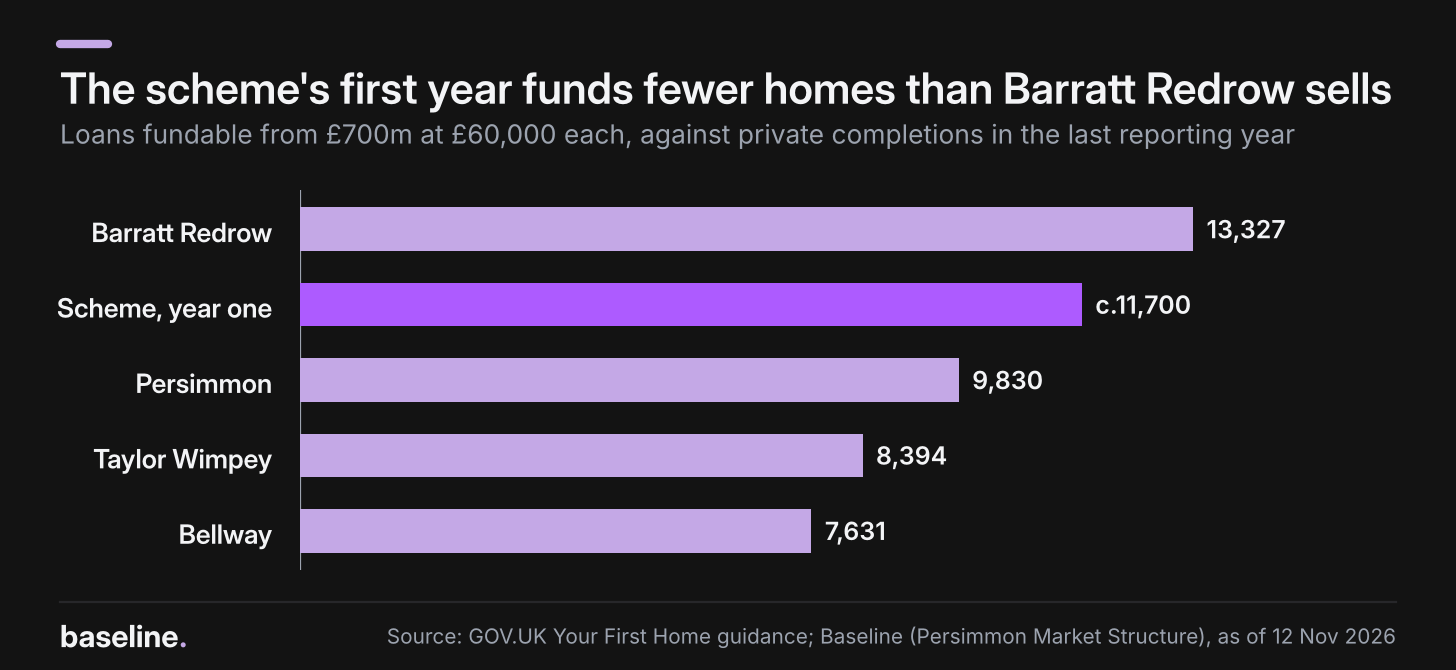
Whether the scheme adds sales or just pays for ones that would have happened anyway is the main argument in the Key Debates. The first year’s £700m funds about 11,700 equity loans at £60,000 each, fewer than the private homes Barratt Redrow sold on its own in its last reporting year, and the first scheme sales are not until April.
The other recurring arguments are margins and cash. The bull case on margins rests on older, expensive land running off: Taylor Wimpey expects most of that benefit in 2028 and 2029. On cash, the builders still carry building-safety provisions, £1,074.5m at Barratt Redrow alone, and Taylor Wimpey cut its payout from 7.5% of net assets to 4% in July.
Taylor Wimpey is the only one of the eight with a Baseline View of 4, our read on whether a business is likely to do better than investors expect, on the case that margins recover to the low teens by 2029-31. That view was written on 9 November, two days before Wednesday’s update. It is a call on margins several years out, which one weak autumn doesn’t settle, but lower volumes this year are not what the case needs.
Berkeley has the best Management Quality score, 4, and the worst Competitive Rhythm, 2: its London buyers have stopped committing to flats years ahead, and forward sales have fallen from £1.403bn to £1.006bn. Vistry has the highest Business Quality of the UK builders, 3.2, from its partnerships with housing associations and councils, but scores 2 on Accounting after £165m of cost forecasting errors and a Financial Reporting Council investigation into two former accountants. Its shares are down 62% over the year. Crest Nicholson 