Good market, wrong decade
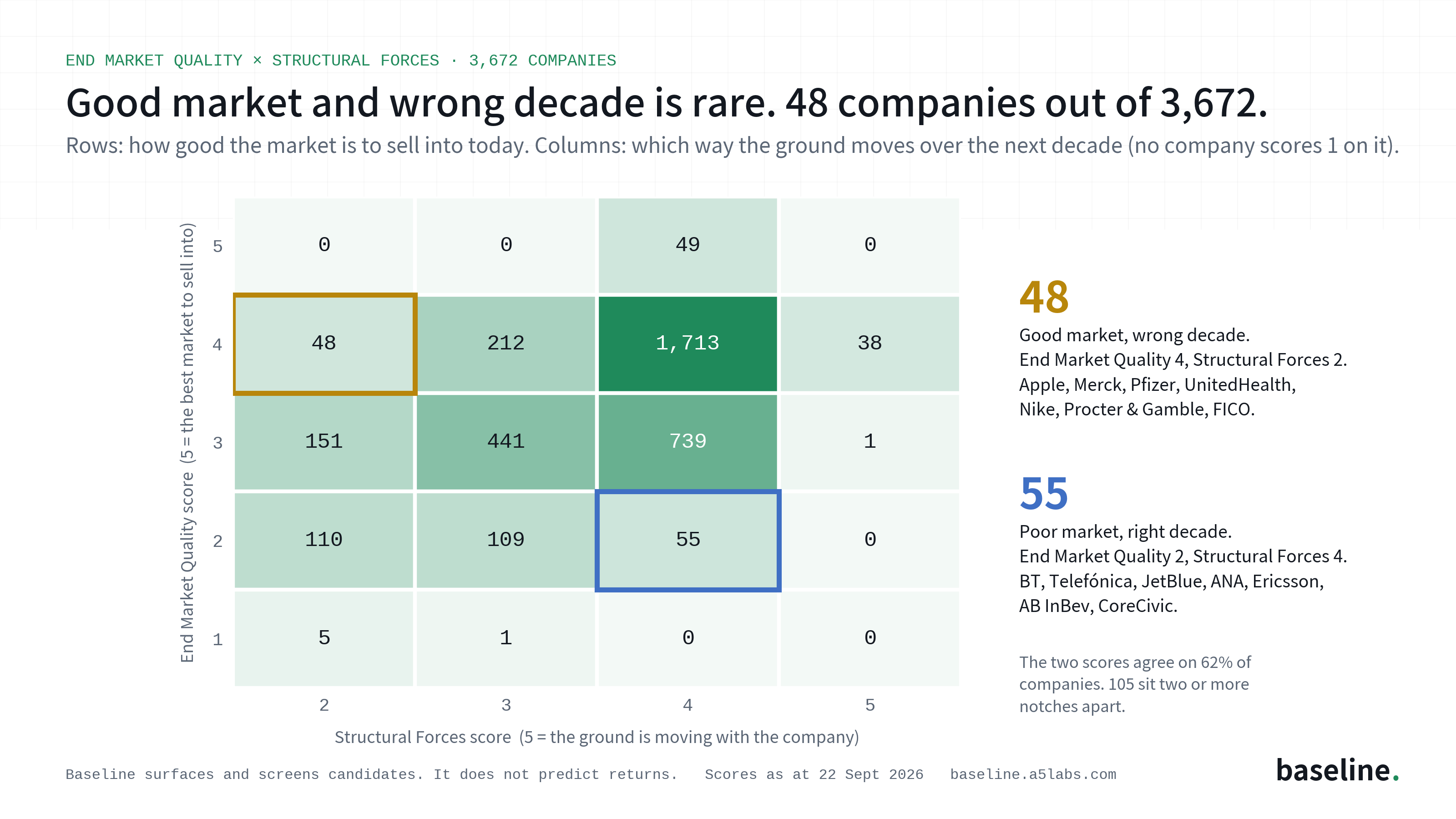
48 companies score 4 on End Market Quality and 2 on Structural Forces. Merck, UnitedHealth, Nike, Procter & Gamble and Apple are among them.
End Market Quality asks whether the market a company sells into is a good one: how large it is, whether it grows, whether the customers can pay and whether somebody else sets the price. Structural Forces asks whether the market is moving for it or against it over the next five to ten years. Both sit inside Business Quality and are scored separately, on separate evidence.
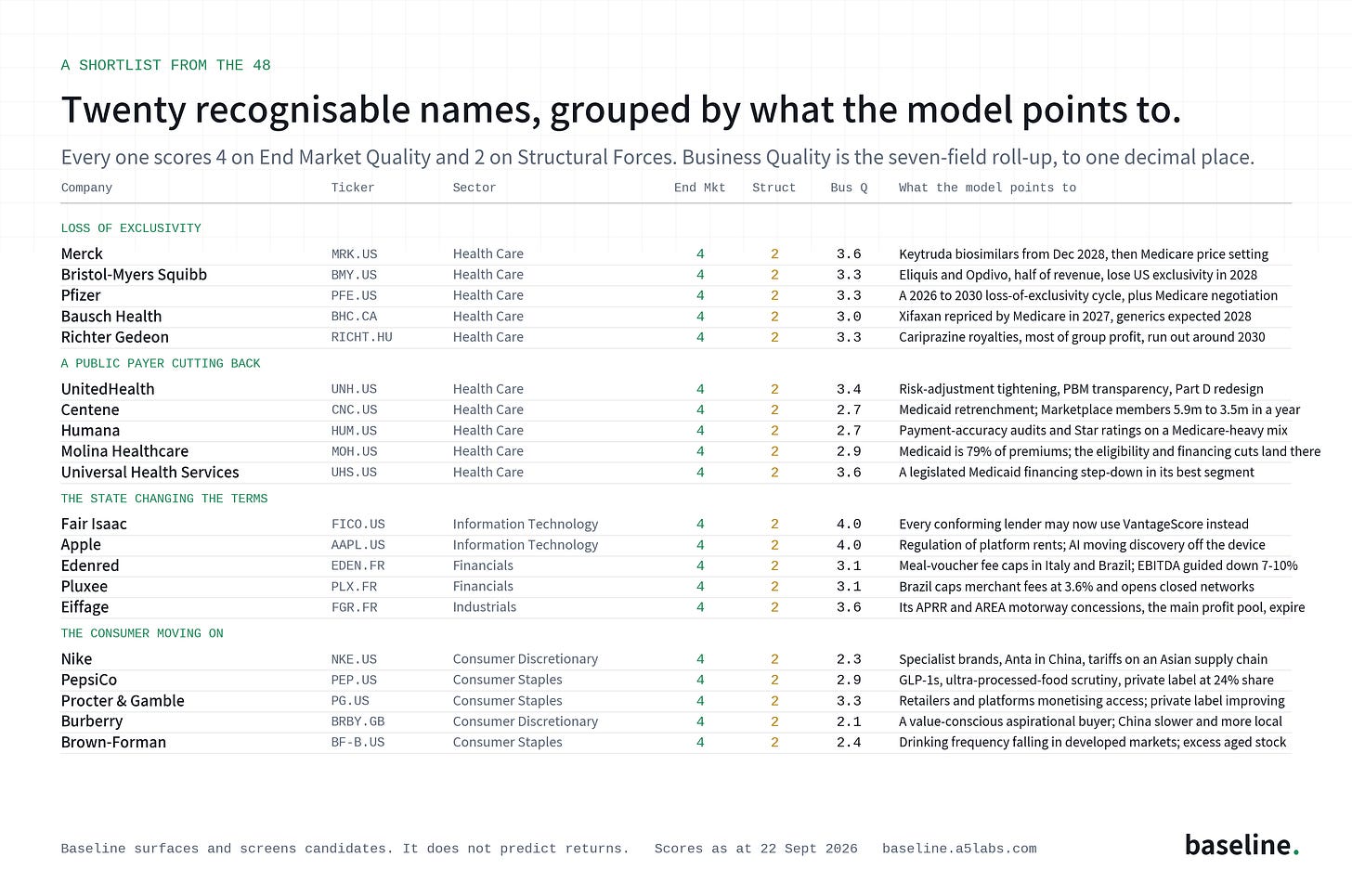
Across the 3,672 companies we score, the two agree on 62% of names and lean the same way on most of the rest. 48 companies score 4 on End Market Quality, and 2 on Structural Forces. Apple, Merck, Pfizer, Bristol-Myers Squibb, UnitedHealth, Elevance, Humana, Nike, PepsiCo, Procter & Gamble, Burberry, Brown-Forman and FICO included.
A 2 on Structural Forces is the floor in practice. The scoring scale keeps 1 for headwinds that could impair the business outright and no company in the universe has one. 314 score 2, which is 8.6% of coverage.
What the model points to
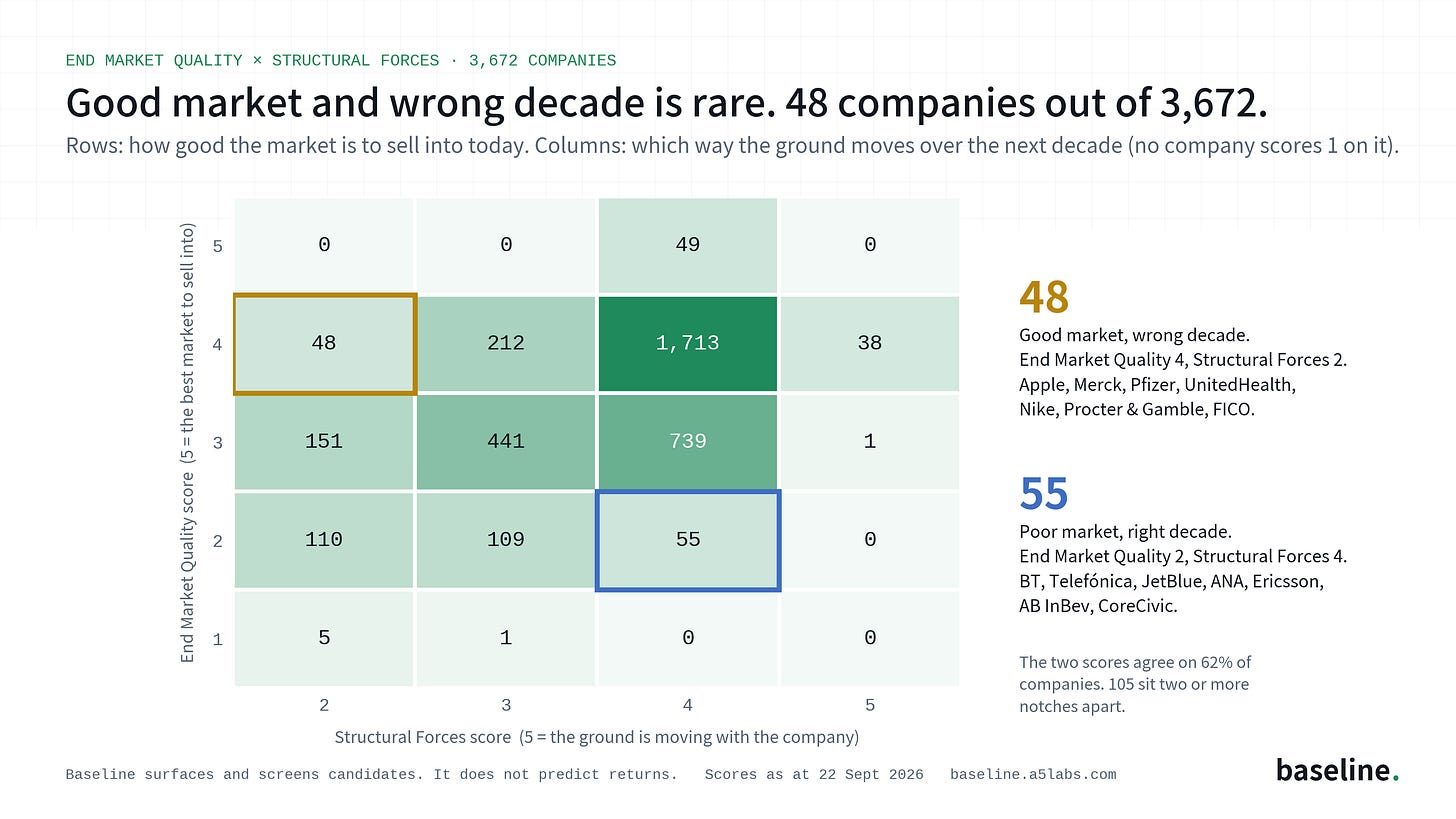
The written summary behind each score names the dominant force. Grouped by hand, the 48 split roughly in half. 27 carry a date, a statute or a regulator’s decision. Nine are drug companies with a patent, royalty or exclusivity date the model can name. Eleven sell to a public payer that is cutting back, which means Medicaid, Medicare Advantage or the Japanese fee schedule. Seven are on the wrong side of the state changing the terms of their market, whether a regulator, a legislature or an expiring concession, and this is where FICO, Apple, Edenred and Pluxee sit.
The other 21 have no statute behind them and, with one exception, no date. Eleven are consumer brands where the customer is moving on. Four have something substituting for the product or bypassing it: AI in advertising, AI search, and Swedish home sellers testing the market before they pay Hemnet to list. Three have a shrinking pool of demand, two of them in Japan. Three fit nowhere in particular. The exception is Ryoyo Ryosan, whose distribution agreement with Renesas ends in March 2027.
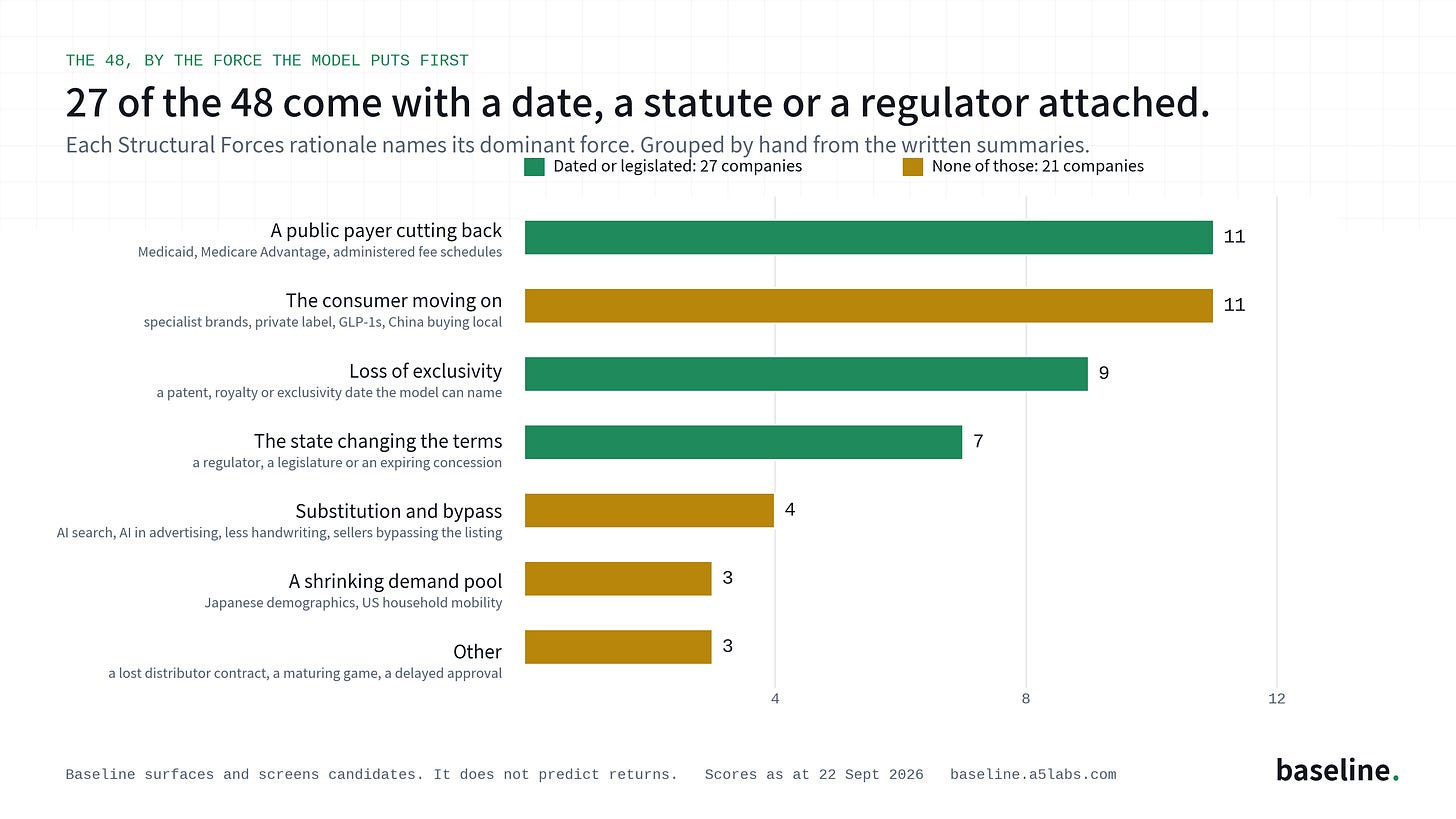
Health care is 21 of the 48, against a weight of about 10% in our coverage. The two fields come apart more easily there than anywhere else. Demand comes from ageing and is mostly non-deferrable, so the market scores well, and the price is set by a patent office or a public payer, both of which publish their dates.
Merck
Merck scores 4 on End Market Quality. The rationale gives oncology the demographic tailwind, calls cancer treatment “acute, life-threatening, and generally non-deferrable” and cites a projection of global oncology spending rising from $252 billion in 2024 to $441 billion by 2029. It then scores Structural Forces at 2, because Keytruda and Keytruda Qlex were $31.7 billion of Merck’s $65.0 billion of 2025 sales, US biosimilar competition is expected from December 2028, and Medicare price setting is expected to follow.
The rationale calls it an “unusually concentrated and durable earnings headwind as Keytruda encounters biosimilars and government price setting in close succession”. Rising cancer incidence is in the same document as a tailwind. However, after 2028 it lands on the class of drug rather than on Merck’s price for it. Three years ago, the model says, it would have scored Merck 3.
The payer passed a law
Centene’s market is the administration of public health cover, and the rationale scores it 4 on the strength of the demand. Structural Forces scores 2 and the evidence is legislative. Medicaid was about $90 billion of Centene’s 2025 premium and service revenue. The 2025 reconciliation law introduces work requirements and more frequent eligibility checks from 2027, then constraints on provider taxes and state-directed payments from 2028. CBO’s estimate is 10 million more uninsured people in 2034, 7.5 million of them from the Medicaid and CHIP provisions.
The Marketplace side has already moved. Enhanced premium subsidies expired at the end of 2025 and Centene’s Marketplace membership went from 5.86 million in June 2025 to 3.49 million in June 2026. Medicaid membership was 5.5% lower in June than a year earlier while Medicaid revenue in the quarter rose 5%. The rationale reads that as a smaller, sicker book on higher rates, which is why it says “Medicaid revenue will become a poorer proxy for franchise health”. Molina is the same case with less to offset it, since Medicaid is 79% of its premium mix.
FICO and the mortgage mandate
FICO is joint top of the list with Apple at 4.0 on Business Quality, with a 5 on both pricing power and mission criticality. The Structural Forces rationale scores 2, and would have scored 4 three years ago. What changed is the mortgage mandate. On 4 September the FHFA directed Fannie Mae and Freddie Mac to accept VantageScore 4.0 from every lender, which ends the practical requirement for a FICO score on every conforming loan. VantageScore says it has been the sole score on more than 9% of the loans the two agencies securitised since 1 May.
The rationale sets that against a Scores segment running a 91% operating margin, a wholesale mortgage royalty that in its account went from $0.60 to $10 in five years, and a competitor priced at $0.99 a score and owned by the three bureaus that distribute FICO’s. Its own wording is that “the pressure threatens excess economics more than the continued relevance of the entire business”. The market for credit decisions is not going anywhere and the software side is scored as a tailwind. The 2 is about the right to charge $10 a score, which is where most of the profit has been.
Nike, where nothing is dated
Nike is the other kind of 2. The rationale finds nothing scheduled. Its dominant forces are the fragmentation of performance footwear and the localisation of China, and its evidence is growth rates rather than statutes: Adidas up 14% in the first half, On up 24%, Hoka up 15.9% over its last financial year, Anta at 23% of the Chinese sportswear market ahead of Nike and Adidas, Nike’s own Greater China revenue down 13% in the year to May 2026. Tariffs on a supply chain that makes 52% of its footwear in Vietnam and 27% in Indonesia sit underneath all of it.
The summary’s own line is that “individual challenger brands may fade, but the system that produces new challengers is durable”. There is no date on which it gets worse, and none on which it stops, which also goes for PepsiCo, Procter & Gamble, Burberry and Brown-Forman. Nike scores 2.3 on Business Quality, level with Puma and a notch above Burberry and Under Armour, on a 2 for pricing power and a 1 for barriers to switching.
What the model says it would have scored in 2023
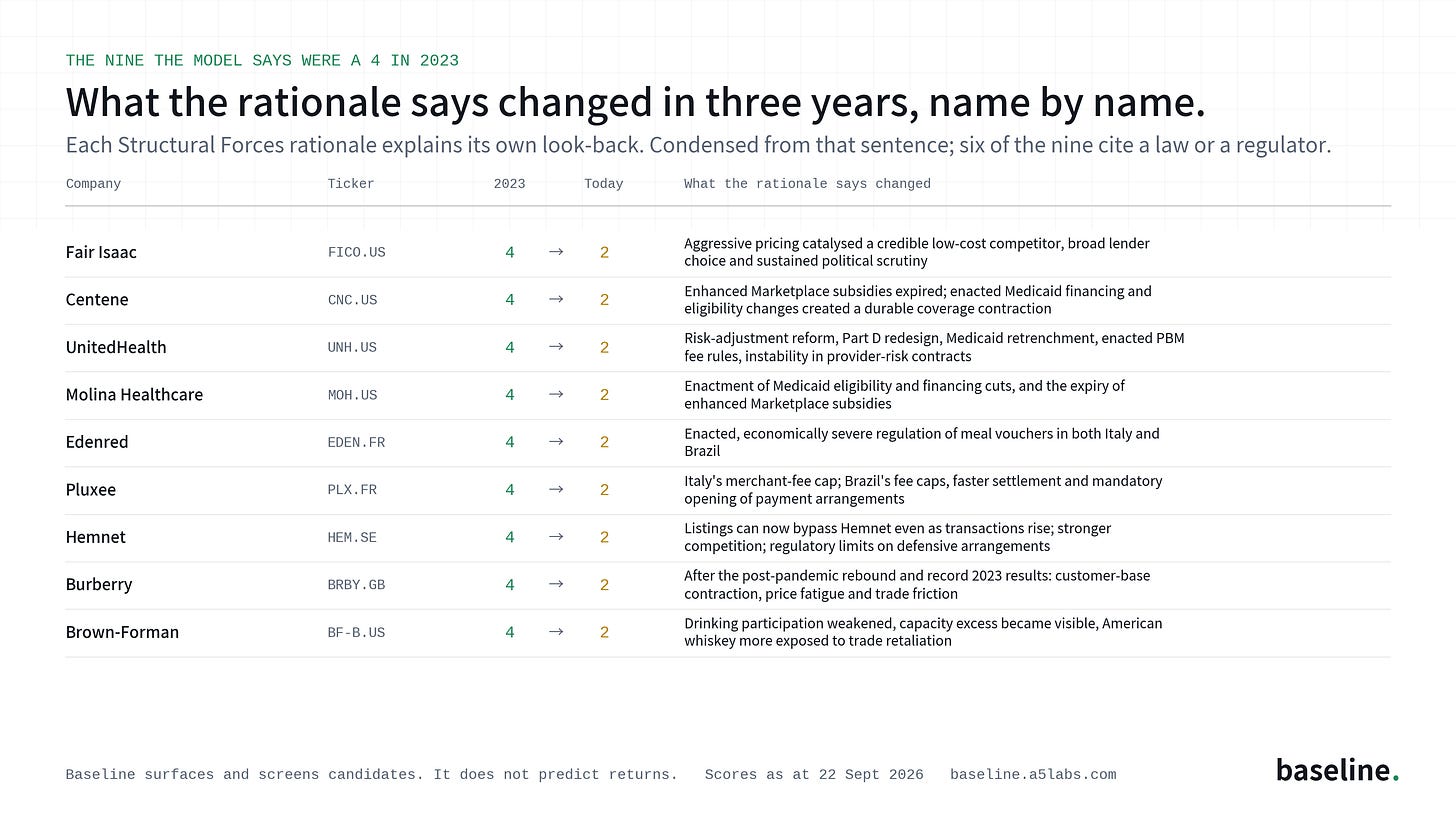
Every Structural Forces rationale is asked what score would have applied three years earlier. We pulled the answer for 28 of the 48, chosen by name recognition. Nine say 4, eighteen say 3 and one, Bristol-Myers, says 2. This is a judgement made now with the benefit of hindsight and it says nothing about whether anything was seen coming. It does establish that the 2 is a change of state rather than a permanent feature of these businesses, and it shows where the model thinks the ground moved furthest: FICO, Centene, UnitedHealth, Molina, Edenred, Pluxee, Hemnet, Burberry and Brown-Forman all from 4.
The other corner
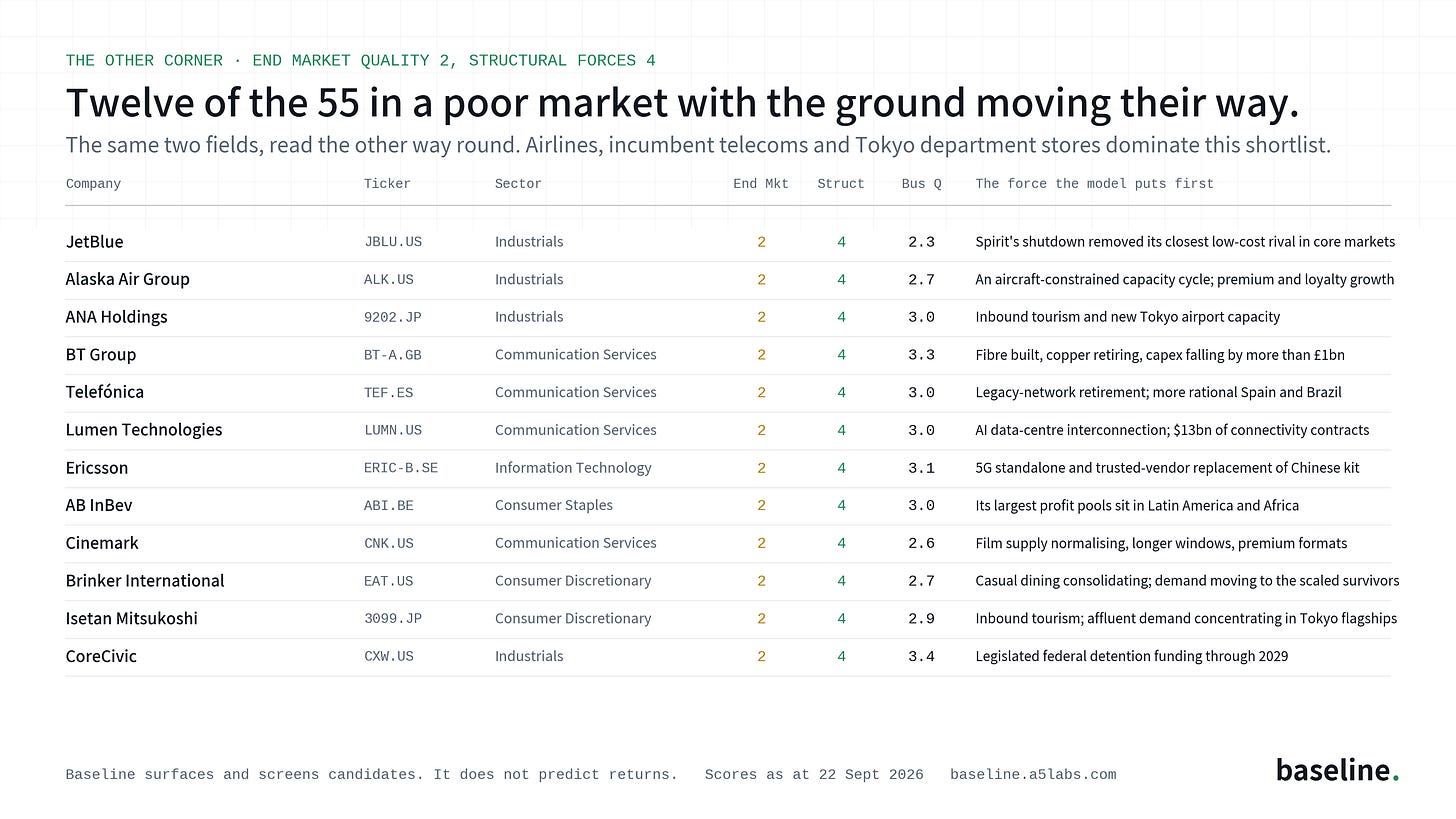
Read the other way round, 55 companies score 2 on the market and 4 on the forces. Airlines, telecoms, shipping, energy services, Korean and Japanese construction and department stores account for most of it. JetBlue’s tailwind is that Spirit stopped flying at the start of May and took the closest low-cost competitor out of Fort Lauderdale and the Caribbean. BT’s is that the fibre is largely built, 23 million premises passed, and capital expenditure is guided to fall by more than £1bn from this year’s £5.1bn by the end of the decade. Isetan Mitsukoshi and J. Front have inbound tourism concentrating in a handful of flagships. CoreCivic has federal detention funding written into law through 2029. None of these is a good market by the model’s reading. In each case the rationale is about why the poor market matters less than it did.
Caveats
The 48 is a small group and the categories are mine, drawn from the model’s summaries rather than produced by it. A 2 says nothing about price, and the names with dated cliffs are the ones the market has had longest to think about; nobody holding Pfizer is unaware of 2028. The scores for these names were generated on 21 and 22 September, so they are current, but one prompt library over one universe is a single observation, and the health care concentration could be telling you as much about how the prompts read legislation as about health care. The consumer names are where the model’s evidence is softest and also where it can point to nothing on a calendar.