Protected but powerless
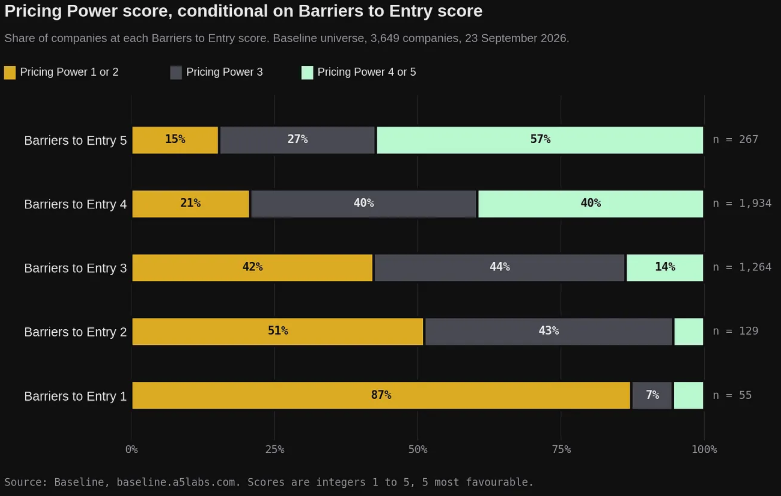
442 companies score 4 or 5 on Barriers to Entry and 2 or lower on Pricing Power. In most of them the barrier and the price belong to different people.
Barriers to entry are supposed to be where pricing power comes from. Across the 3,649 companies Baseline scores the two do move together, and the chart shows how far.
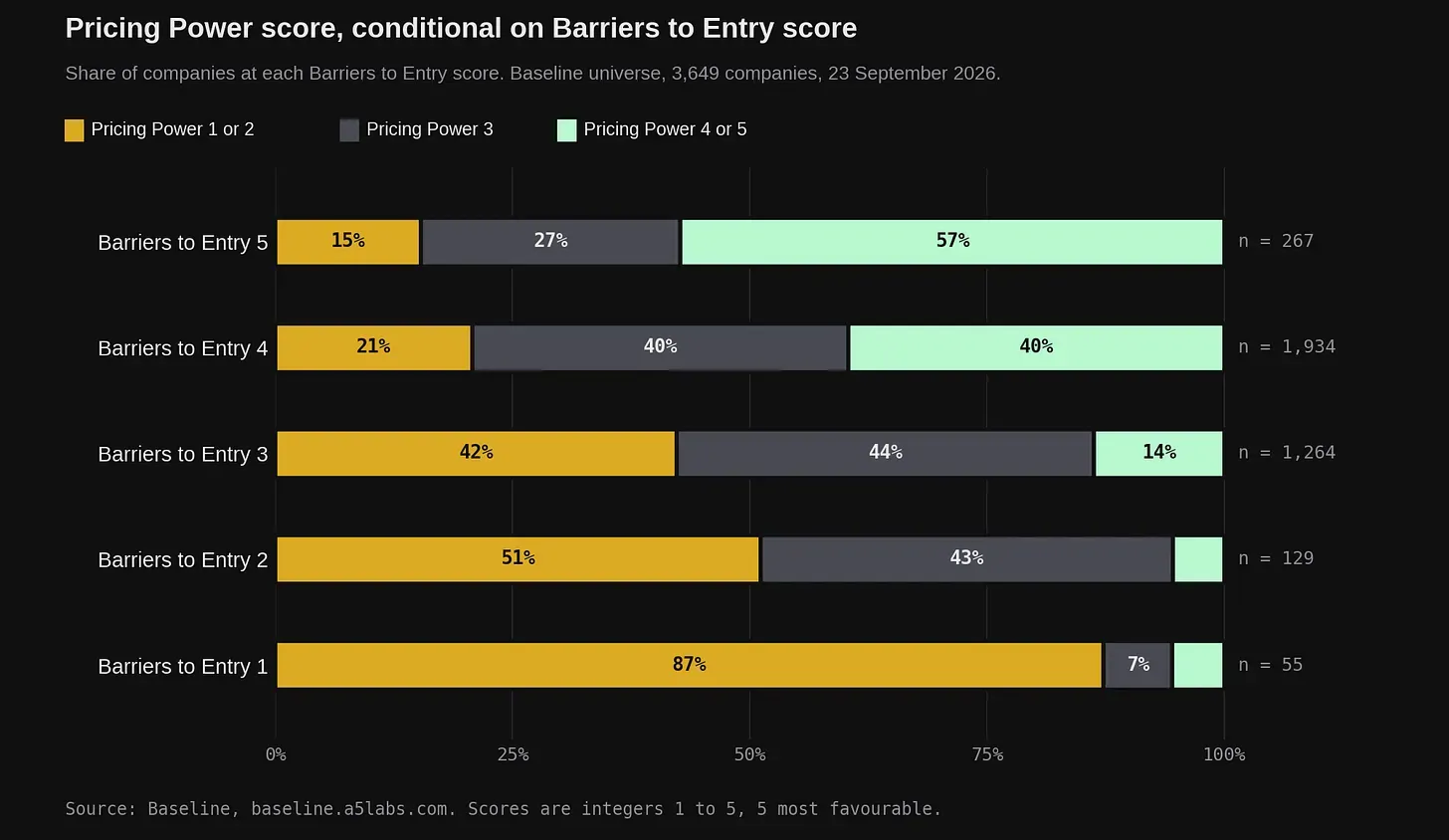
Where barriers are weak, there is almost certainly no pricing power. Where they are strongest, more than half the companies have it. However, the amber band never goes away. Of the 2,201 companies scoring 4 or 5 on Barriers to Entry, 442 score 2 or lower on Pricing Power, one in five.
Barriers to Entry is a Competitive Dynamics sub-score and asks whether a new entrant can get in. Pricing Power is a Business Quality sub-score and asks whether the company can raise prices without losing volume. They are scored separately, on separate evidence, so one does not feed the other.
What the 442 have in common
Reading down the list, the barrier is real in almost every case. What is missing is the right to set a price, and that right usually sits with someone else.
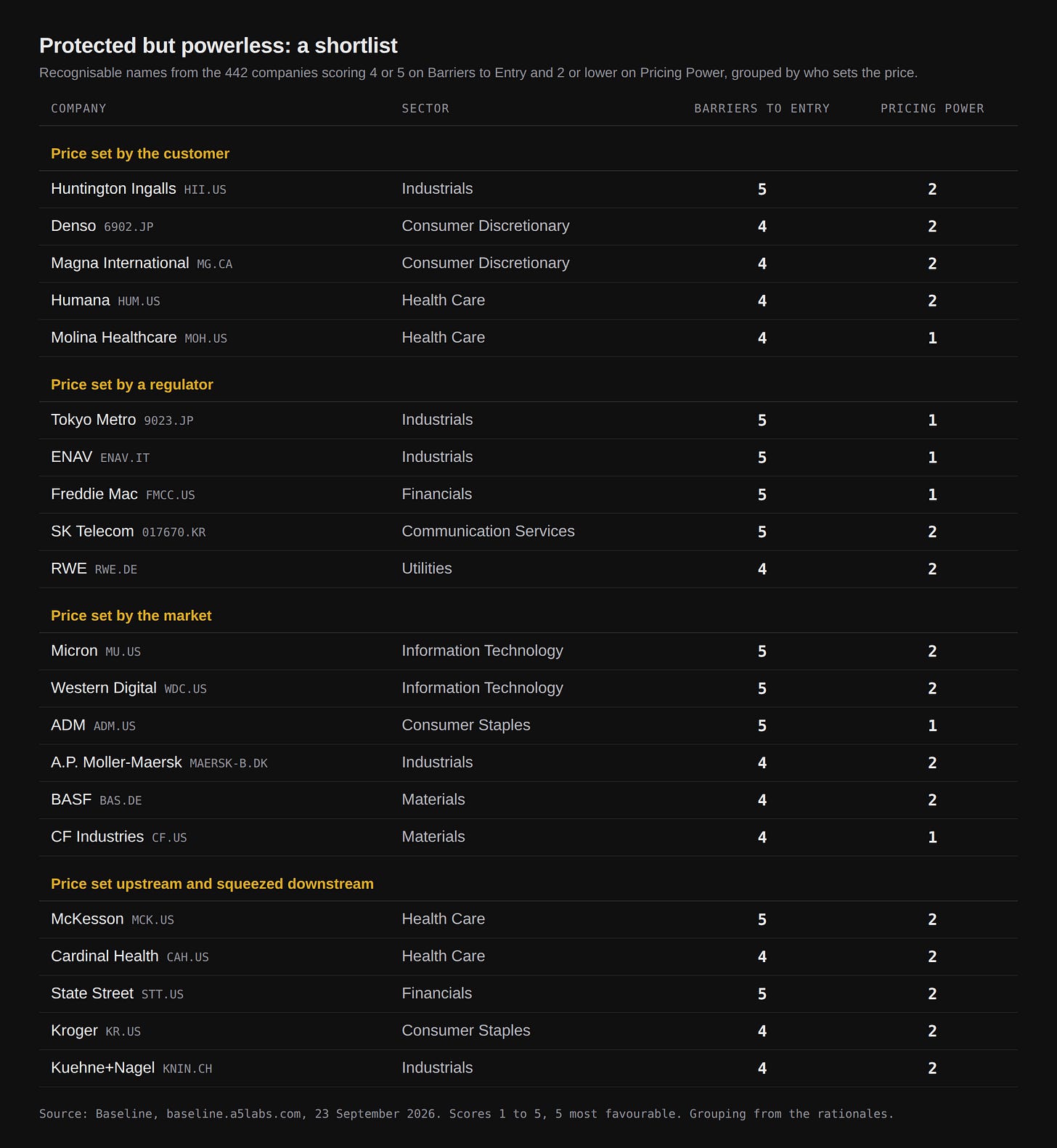
The largest group sells to a customer that sets the price. The auto suppliers cluster here: Denso, Magna, Lear, Adient, Forvia, Gestamp and Hanon Systems, plus the Toyota group suppliers Toyoda Gosei, Toyota Boshoku and Koito. The supply relationship keeps rivals out and keeps the supplier’s margin where the customer wants it. The defence primes have the same shape, Huntington Ingalls, L3Harris, Booz Allen and SAIC, and so do the businesses that bill a public payer: Humana, Centene and Molina in managed care, Fresenius Medical Care, Encompass Health, LabCorp and Quest. The licence keeps entrants out and the rate is set in Washington.
The second group is regulated networks. Tokyo Metro, West Japan Railway and Taiwan High Speed Rail, ENAV (Italian air traffic control), SK Telecom, KT and China Unicom, Fannie Mae and Freddie Mac, Adani Power and RWE. These are natural monopolies or close to it.
The third group makes a commodity behind a capital wall. Building the fab or the fleet is the barrier, and the price is whatever the exchange or the spot market says that day, so nobody in the industry sets it. Memory is here (Micron, Western Digital, Sandisk, Kioxia), and so are container shipping (Maersk, Hapag-Lloyd, HMM, Evergreen, Yang Ming), chemicals (BASF, Covestro, Westlake, LG Chem), fertiliser (CF Industries, Mosaic, Yara, ICL), pulp and paper (UPM, Stora Enso, SCA, Holmen), protein (Tyson, JBS, Pilgrim’s, and the salmon farmers Mowi, SalMar and Lerøy) and the grain traders ADM, Bunge and Wilmar.
The fourth group is the middlemen, where scale keeps entrants out but the price is set upstream by the supplier and squeezed downstream by the customer, and what is left is a spread. Drug distribution (McKesson, Cardinal Health, and in Japan Suzuken, Alfresa and Medipal), IT distribution (Arrow, TD Synnex, Ingram Micro, WPG, CDW), grocers (Kroger, Carrefour, Dollar General, Jerónimo Martins, Dino Polska), car dealers (AutoNation, Asbury, Sonic, Eagers) and freight forwarders (Kuehne+Nagel, C.H. Robinson).
Financials deserve a separate mention because the sector has the highest share of high-barrier names that cannot price, 43 of 116. The barrier is a licence or a balance sheet and the price is a spread that the market or a government-sponsored enterprise sets. Mortgage insurers (MGIC, Radian, Essent, Enact), title insurers (First American, Stewart), market makers (Virtu, Flow Traders, Tradegate) and custody (State Street) all sit on the screen.
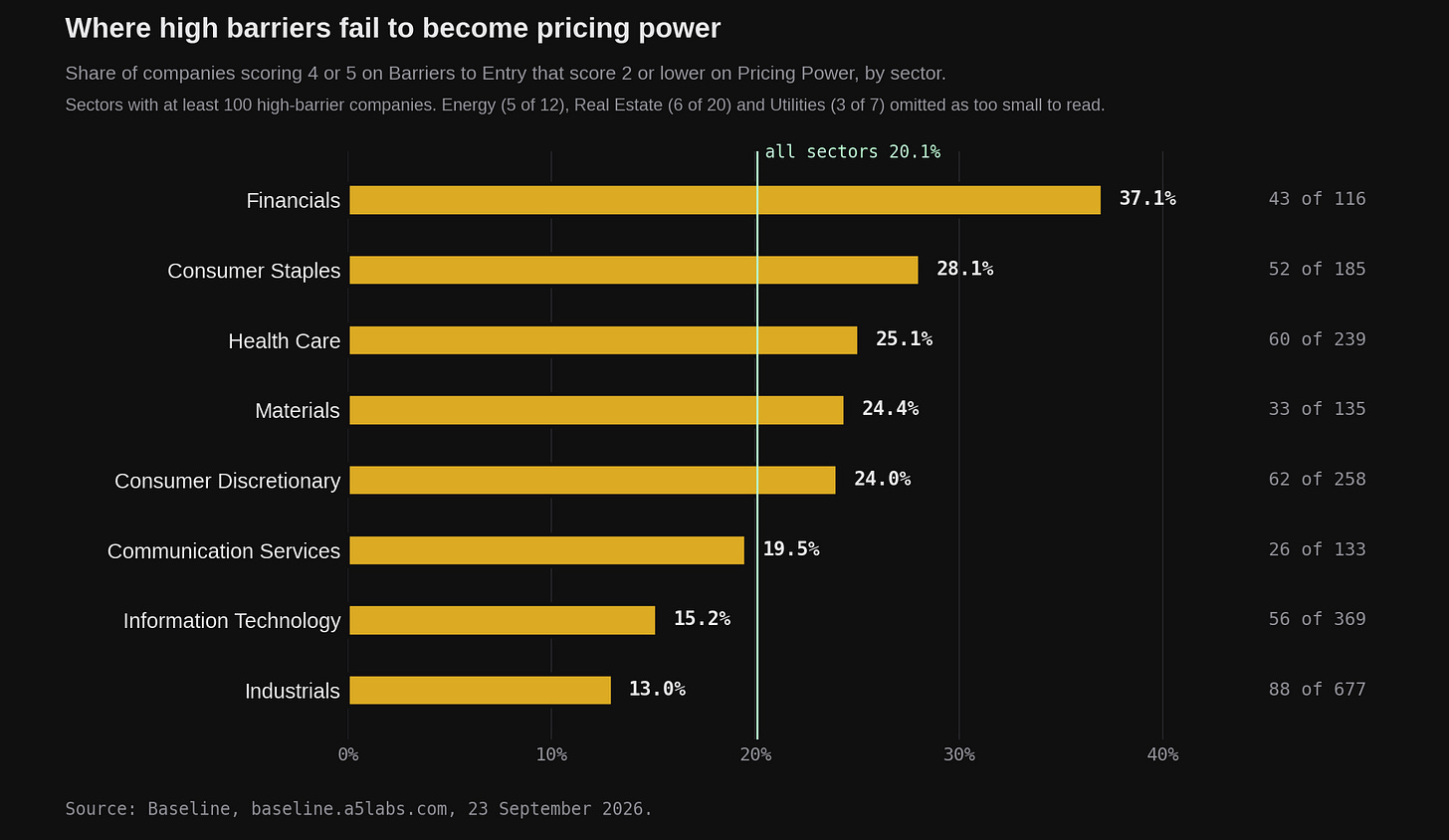
Industrials sit at the bottom of the sector chart at 13%, and the likely reason is that many industrial niches are small enough for the barrier and the price to belong to the same company. TransDigm, which scores 4 on Barriers to Entry and 5 on Pricing Power, for instance. Financials sit at the top at 37%, being the sector most likely to have its price set by a regulator or a spread. Energy, Utilities and Real Estate have too few high-barrier names in the universe to read anything from, so they are left off the chart.
The widest gaps, a 5 on barriers against a 1 on pricing, are twelve names: Tokyo Metro, ENAV, Freddie Mac, Adani Power, ADM, SCA, Suzuken, Alfresa, Ramsay Générale de Santé, China Resources Cement, SILEX Systems and the Icelandic fishing company Síldarvinnslan. Four are regulated networks, three sell into national health systems, and most of the rest sell a commodity.
Tokyo Metro (Barriers to Entry 5, Pricing Power 1)
Nobody is going to dig a second subway under central Tokyo. The rationale calls it a natural monopoly: 195 km of tunnel, a first line that opened in 1927, and a national government and a city government that between them still own half the company after the 2024 listing. The transport ministry, however, sets a ceiling on fares using a fully distributed cost method, and the base fare has not had a structural revision since 1995. The increases since then have been consumption tax pass-throughs and a ¥10 accessibility surcharge in 2023. Transport is roughly 90% of revenue.
So when labour and energy costs rose, the company absorbed them. Operating profit is guided down 9.1% for the year to March 2027, and in the June quarter revenue rose 2.8% while profit attributable to owners fell 24.7%. The rationale describes pricing power that has been “banked indefinitely rather than utilised”. Management said in June that it is considering a fare revision. The ministry would still have to approve it.
Huntington Ingalls (Barriers to Entry 5, Pricing Power 2)
Huntington Ingalls is the only builder of US nuclear-powered aircraft carriers and one of two yards that build nuclear submarines. The barrier is about as high as barriers get: nuclear certification, security clearances, a supplier base of around 16,000 firms and waterfront drydocks that could not be permitted today. There is also exactly one customer, and the customer writes the rules. Contracts run under the Federal Acquisition Regulation and the Truth in Negotiations Act, with open-book audit and negotiated target margins.
The rationale’s cost pass-through test is the useful part. Through the 2021 to 2023 inflation, cost-plus work passed the inflation through but held the profit dollars flat, and the fixed-price incentive contracts took negative estimate-at-completion adjustments. The rationale puts shipbuilding margin at roughly 8.5% in 2016 to 2018 and 5.2% in 2024, and 2026 guidance is 6.0% to 6.5%.
Micron (Barriers to Entry 5, Pricing Power 2)
This is the contentious score on the list, because Micron’s last reported quarter, to May, was the best in its history: revenue of $41.5bn, up 346% on the year, at a non-GAAP gross margin of 84.9%. The next print is due on 30 September. The barriers score is uncontroversial. A leading-edge fab costs $10bn to $20bn, three companies make roughly 95% of the world’s DRAM, and the last serious commercial entrant, Elpida, went bankrupt and was bought by Micron in 2013.
The pricing power score is where the argument is. The rationale’s position is that “a bit is a bit”: the customer pays no premium for Micron’s brand over the same specification from Samsung or SK Hynix, the buyers are a handful of hyperscalers who track spot prices daily, and the current margin is what a shortage looks like. Its evidence is the last downcycle, when prices compressed in 2022 and 2023 regardless of input costs, and the supply response now under way at all three producers.
In the May quarter DRAM prices rose by more than 60% on the previous quarter while bit shipments grew in the low single digits. Micron seems to agree in part. It has signed 16 Strategic Customer Agreements, most of them running to 2030, that are expected to cover roughly 40% of revenue with a ceiling at the second-quarter 2026 market price and a floor beneath it, which is a trade of upside for protection. The rationale’s own stated risk to its rating is that HBM de-commoditises enough of the book to change this.
McKesson (Barriers to Entry 5, Pricing Power 2)
Three companies distribute more than 90% of prescription drugs in the United States. McKesson handles about a third of North American medicines, return on invested capital runs above 30%, and the last plausible entrant, Amazon, took out wholesale licences in 2017 and then withdrew and bought a pharmacy instead. None of that is pricing power, because McKesson’s revenue is a percentage of a price someone else sets.
Branded drug economics are tied to the manufacturer’s wholesale acquisition cost, and on the other side CVS, Walgreens, the PBMs and the hospital purchasing groups benchmark every basis point against Cencora and Cardinal Health. Gross margin is around 4%. When manufacturers cut list prices in January 2026, revenue growth slowed and the company leaned on oncology and new launches to hold profit. The rationale’s description is “a margin-taking operation rather than a price-making one”. Cardinal Health scores the same, and the rationale says Cencora would too.
What the screen is for
The screen does not say these are bad businesses. McKesson’s returns on capital are excellent, Tokyo Metro is a fine asset, a Micron shareholder has had a very good year, and all four worked examples score between 3.3 and 3.6 on Business Quality. What the 442 share is that the price of what they sell is decided somewhere else: in a ministry, a procurement office, a spot market or a manufacturer’s price list. A barrier without pricing power protects the volume and not the margin. The margin is set by whoever holds the price, and in these 442 cases that is somebody other than management.