Reputations that remain intact
Buffett's quote about brilliant managers and bad businesses, tested on Baseline
Many investors can recall Warren Buffett’s management quote. “When a management with a reputation for brilliance tackles a business with a reputation for bad economics, it is the reputation of the business that remains intact.” It gets used in investment committees as a way of ending an argument rather than settling one.
We tested this famous quote on Baseline.
Baseline scores every company in its universe on seven components of business quality. Management is one of them, separately from the market the company sells into (End Market Quality) and separately from the economics of the unit it sells (Unit Economics). That separation is the whole point of the quote. It raises the question “can good management teams rescue a bad business?”
Good management is not rare
Starting with the universe. Of 3,682 companies, 1,634 score 4 or better for management quality, which is 44%. Only 393, a little under 11%, score 2 or worse. This reflects the bias of the universe, large listed stocks, that have enjoyed some success to reach this size. Baseline is not bell curve distributed, and users should begin from the assumption that competent management is the base case rather than the edge.
If you set two scores against each other the universe sorts itself into nine boxes. Most companies sit on the diagonal, where the quality of the operator and the quality of the market broadly agree. The interesting cases are the two corners.
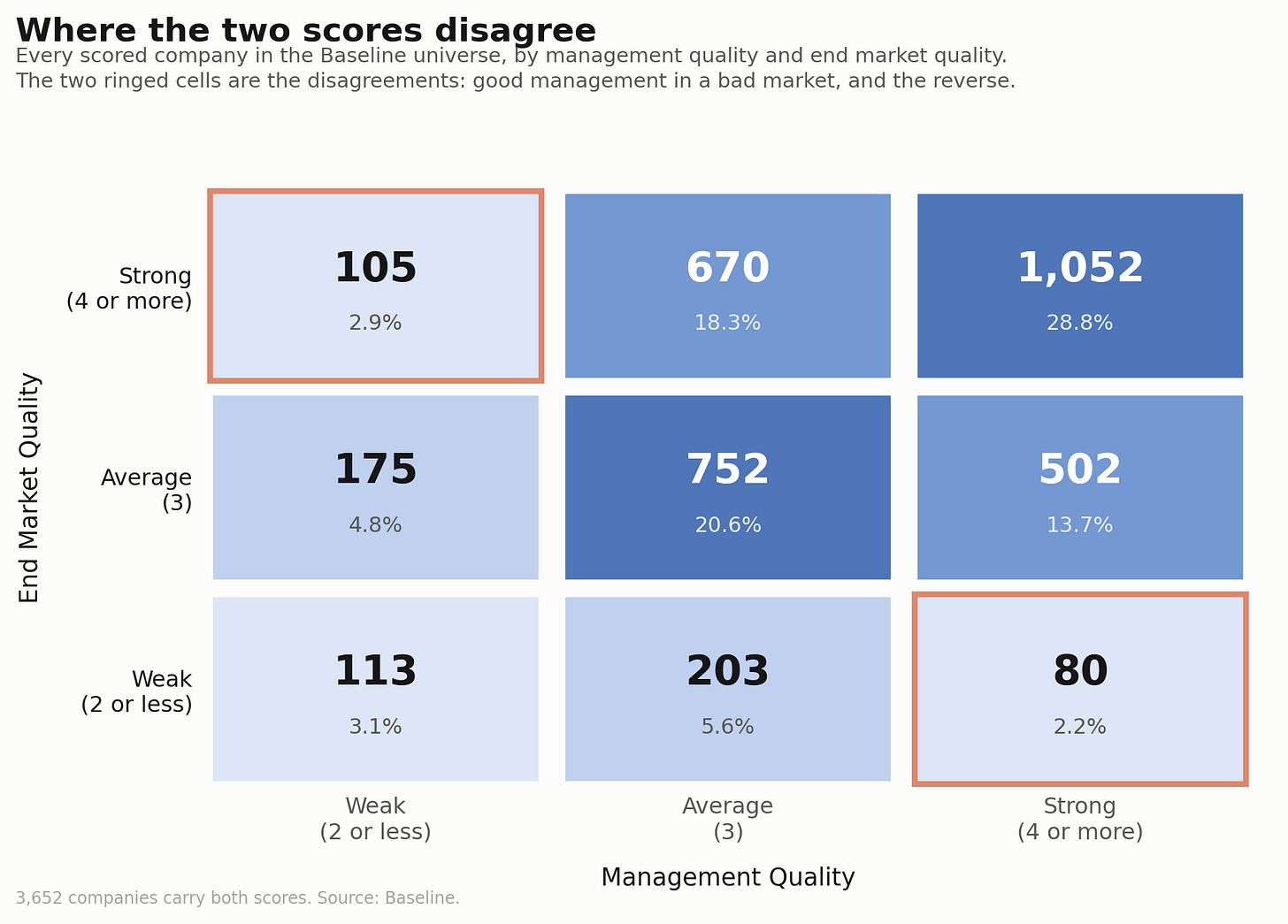
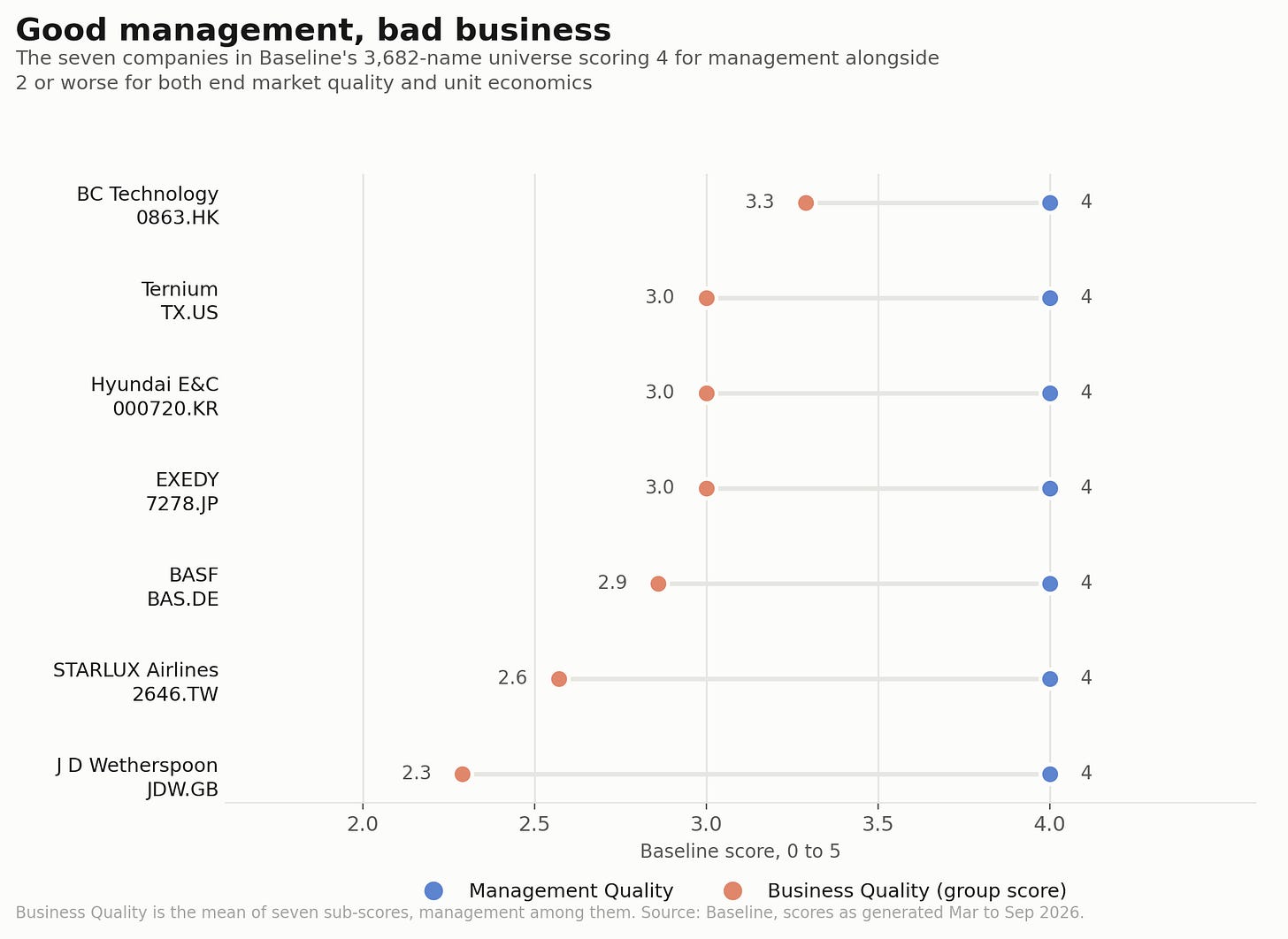
The bottom right corner holds 80 companies: good management, bad market. That is the Buffett case. If you tighten it further and require that unit economics also score 2 or worse, only seven names remain. They are, in ascending order of business quality: J D Wetherspoon, STARLUX Airlines, BASF, EXEDY, Hyundai Engineering and Construction, Ternium, and BC Technology Group.
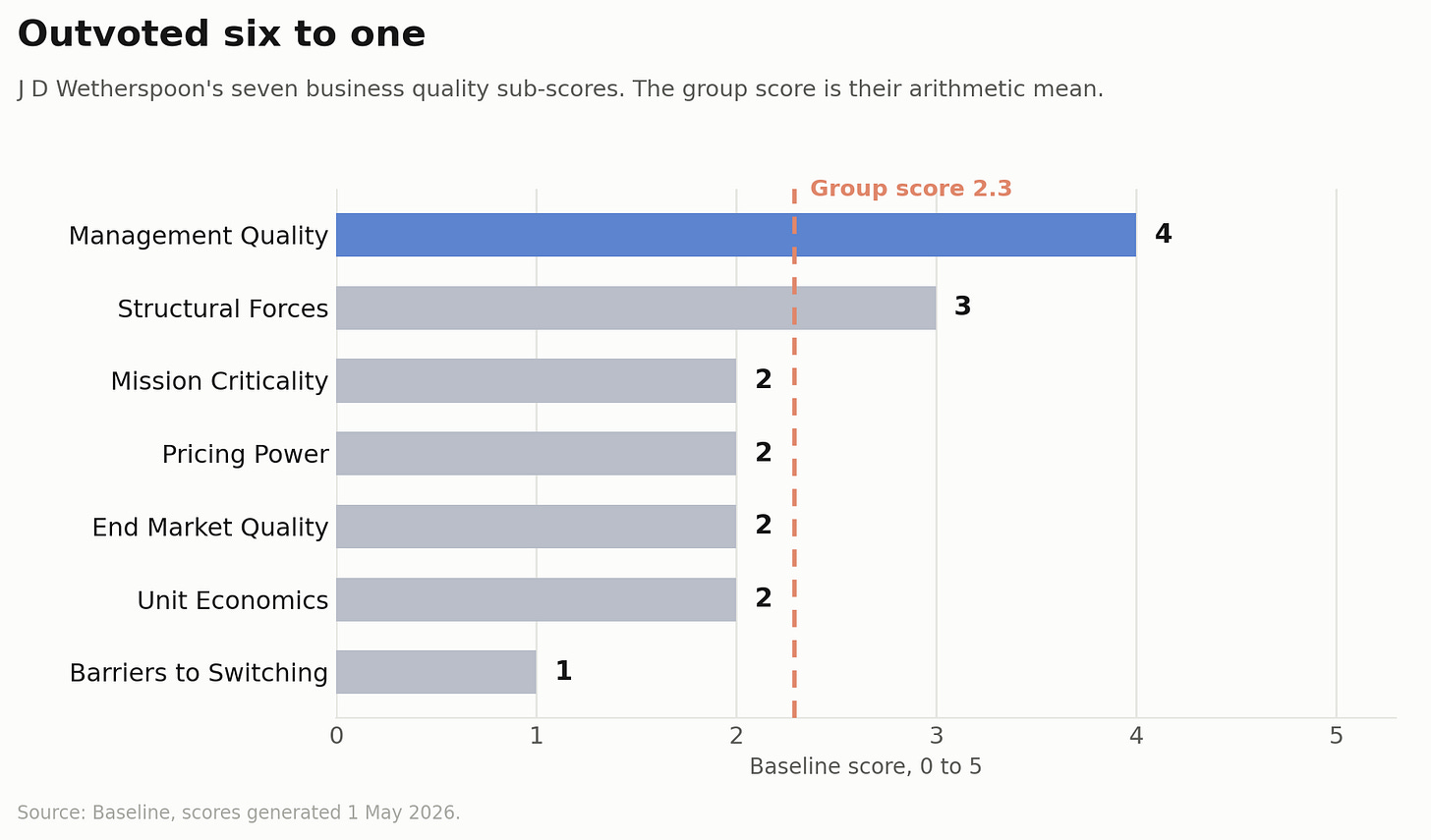
The best scorer is 3.3 on business quality. Wetherspoon is 2.3, with a management score of 4.
The Wetherspoon case
Baseline’s management rationale on Wetherspoon describes Sir Tim Martin as “one of the most distinctive and genuine founder-operators in UK public markets” and credits the post-pandemic recovery, the reinstated dividend and the franchise strategy.
FY2025 sales were £2,127.5m, up 4.5%, on an estate 85 pubs smaller than in FY19, which puts sales per pub 29% above pre-pandemic levels. Freehold ownership has gone from 41% of the estate in 2010 to 72%. Average pub manager tenure is 14.6 years. In February 2026 the CGA RSM Hospitality Business Tracker had industry like-for-like sales at minus 0.2%; Wetherspoon was at plus 3.2%, the forty-second consecutive month of outperformance.
The scorecard shows what that is worth, where management is the lone 4. Structural forces get a 3, on the view that industry attrition and trade-down roughly offset the regulatory cost ratchet. Everything else is a 2 or lower, and barriers to switching score a 1, which Baseline defines as “zero structural switching costs” where “substitution is instantaneous and financially painless”.
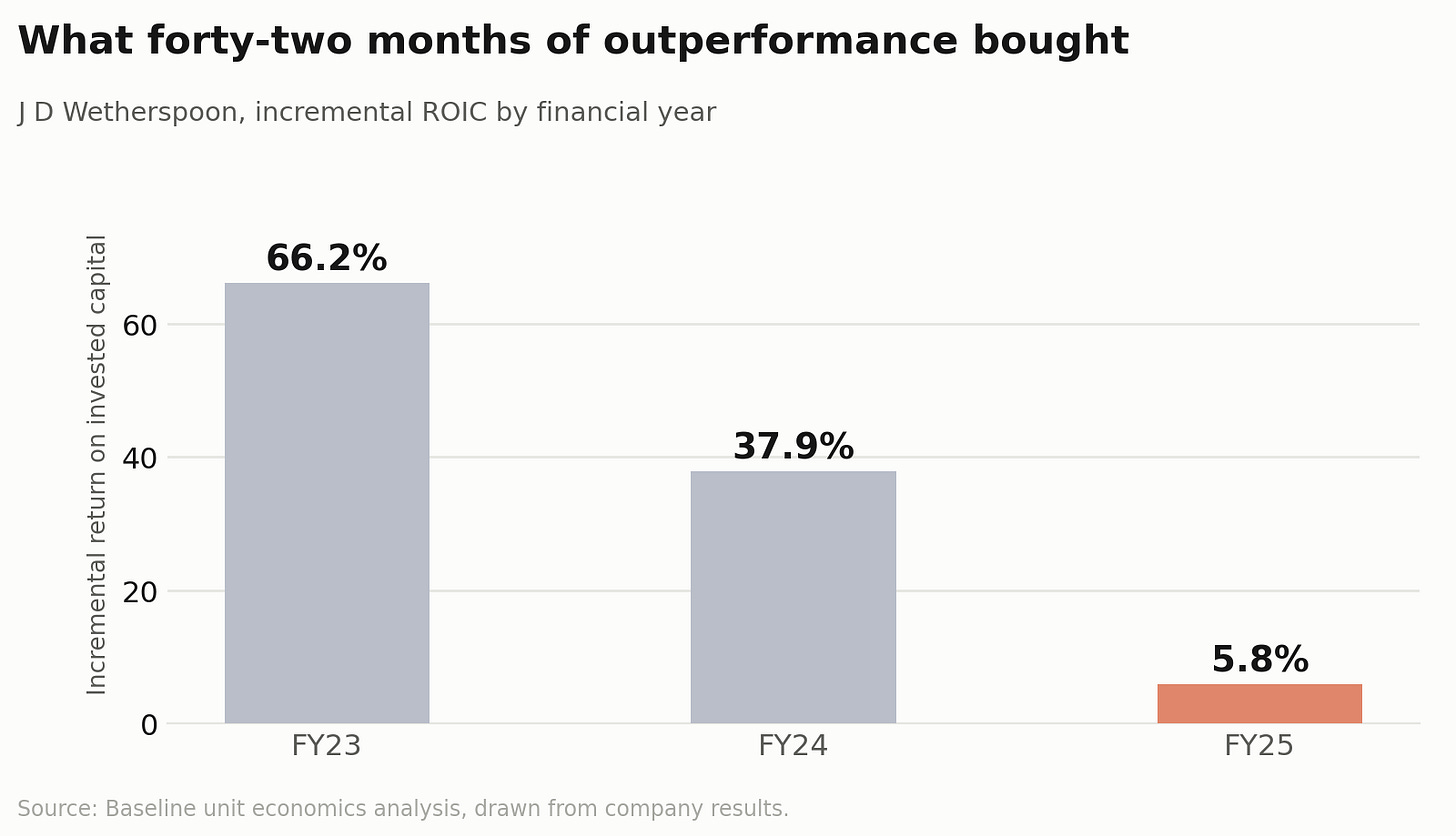
FY2025 operating margin was 6.88%, against 6.85% the year before. Operating costs consumed 93.1% of revenue. Levered free cash flow margin was 2.7%. FY25 shareholder returns of roughly £81m, being £66.8m of buybacks and about £14m of dividends, exceeded free cash flow of £56.6m, which means the balance sheet funded the difference. The incremental return on invested capital did this.
For 1H26, revenue rose 5.7% to £1,087.8m and profit before tax fell 31.9% to £22.4m. Wages were up £28m, repairs £10m, business rates £9m. The National Living Wage rose 4.1% in April 2026 to £12.71 and the Low Pay Commission’s central estimate for April 2027 is £13.18. Net debt is £773m, which Baseline puts at 4.5 to 4.7 times adjusted EBITDA on an IFRS 16 basis, the heaviest in the peer group. More than 300 licensed venues closed in the UK in the first quarter of 2026 alone, on top of more than 4,000 lost since 2019. Gen Z drinks around 20% less than Millennials.
Wetherspoon’s own value proposition is the trap. Drinks priced at roughly 35% below the industry average is what wins share, and also what prevents the margin from ever recovering. Baseline’s summary judgement on the stock is “resilient stagnation”, and it scores the Baseline View a 3. The reputation of the business remained intact.
The other half of the quote
Buffett’s line has a second implication that gets quoted less often. If the business reputation survives brilliance, it should also survive incompetence.
Samsung Electronics is the test case. Baseline scores its management a 2, and the rationale is unsparing: the company “critically stumbled in the high-bandwidth memory race, ceding leadership to SK Hynix”, ran persistent foundry losses while spending at TSMC-comparable levels on lower yields, and responded with a dual-CEO restructure and a ₩10tn buyback that the analysis calls reactive rather than systematic. This is an execution failure at the exact moment that mattered most, in the single product line where the industry’s profits were about to concentrate.
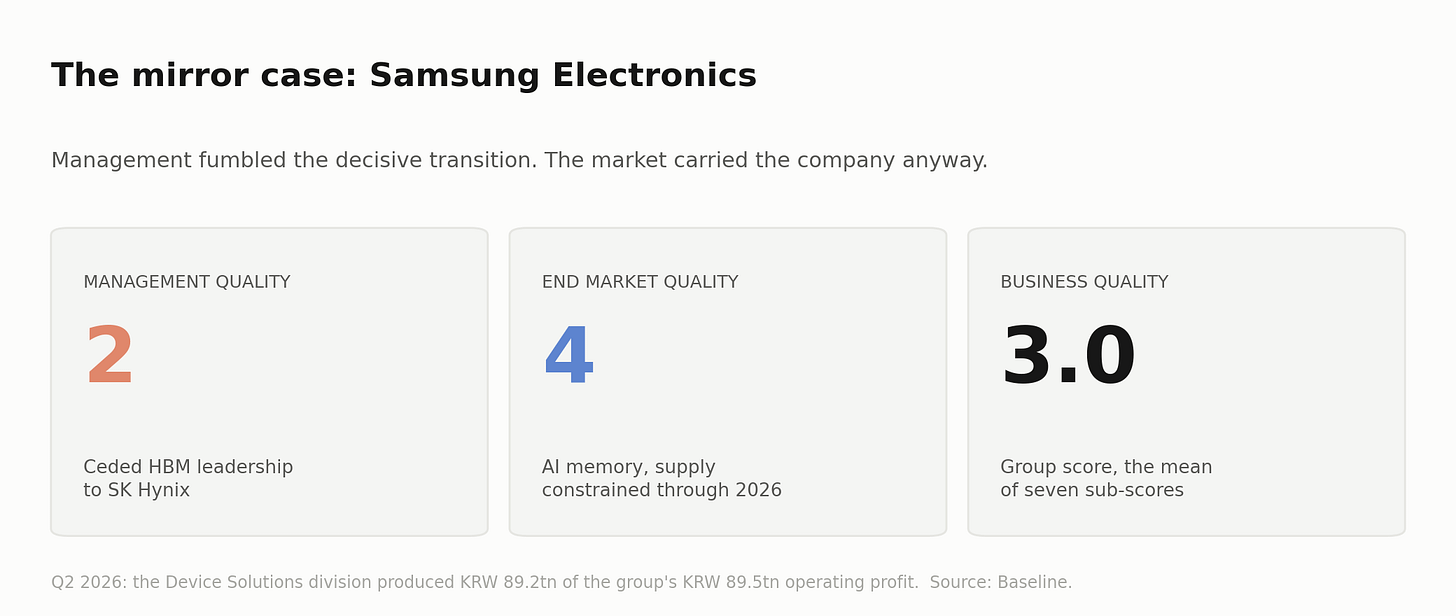
It scores a 4 for end market quality. In the second quarter of 2026, the Device Solutions division produced KRW 89.2tn of the group’s KRW 89.5tn of operating profit. Memory earnings went from KRW 6.6tn in 2023 to KRW 43.6tn in 2025. Business quality comes out at 3.0 and the Baseline View at 4. Management fumbled the decisive transition and the market carried the company anyway.
How often it actually works
Anecdotes are fine but the useful version is the symmetric count, and the population sizes happen to make it fair: 393 companies score 2 or worse for management, 396 score 2 or worse for end market quality.
Of the 80 companies with good management in a bad end market, 44 still reach a business quality score of 3 or better, or 55%. Of the 105 companies with bad management in a good end market, 70 reach 3 or better, or 67%.
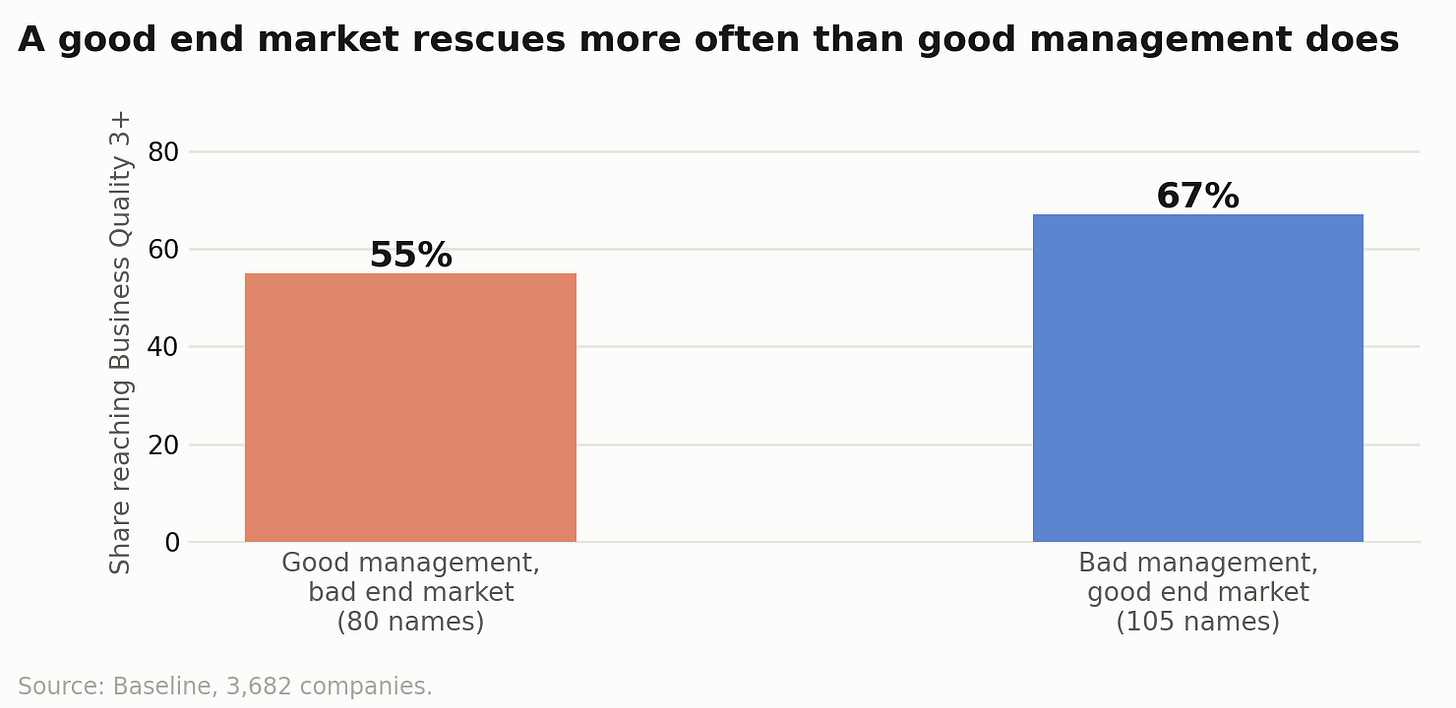
So Buffett is right, and the honest way to say it is that he is right by twelve percentage points. A good end market rescues bad management more reliably than good management rescues a bad end market, but both rescue rates are above half, and anyone who reads the quote as saying management does not matter has read it wrong.
Management quality and end market quality are each one of seven equally weighted components, and each is similarly correlated with the rest of the scorecard: 35.7% of the universe scores 4 or better for pricing power, rising to 52.7% among the well-managed and 54.8% among those in good end markets. The two variables lift their neighbours by almost exactly the same amount. The asymmetry in outcomes is in the data, not in the arithmetic.
What we take from it
The first is a matter of where diligence gets spent. Management assessment is the most time-consuming part of qualitative research and, on this evidence, the least decisive. If the end market and the unit economics are both scored 2, the probability that a company clears a respectable business quality bar is materially below even.
The second is that management quality and business quality are different questions with different half-lives. A management score describes a rate of change and can reverse within two years, as Samsung’s may. An end market score describes a level and usually does not. Investors routinely treat the first as though it had the durability of the second.
The third is a caution about our own screen. These seven names are not a short list. Wetherspoon is a well-run company with a defensible niche; a score of 2.3 for business quality says nothing about whether the shares are cheap. Baseline deliberately excludes valuation from quality scoring, and this piece inherits that exclusion. What the screen identifies is where operating excellence is being spent against a headwind, which is a place to look carefully rather than a place to avoid.
Scores in this piece were generated between March and September 2026 and are stated as of their generation dates rather than live. Business quality is the arithmetic mean of seven sub-scores, management quality among them. Of the 3,682 companies in the universe, 3,652 carry both a management and an end market score. Financial figures are as reported by the companies and as cited in the underlying Baseline research.