The billable hour
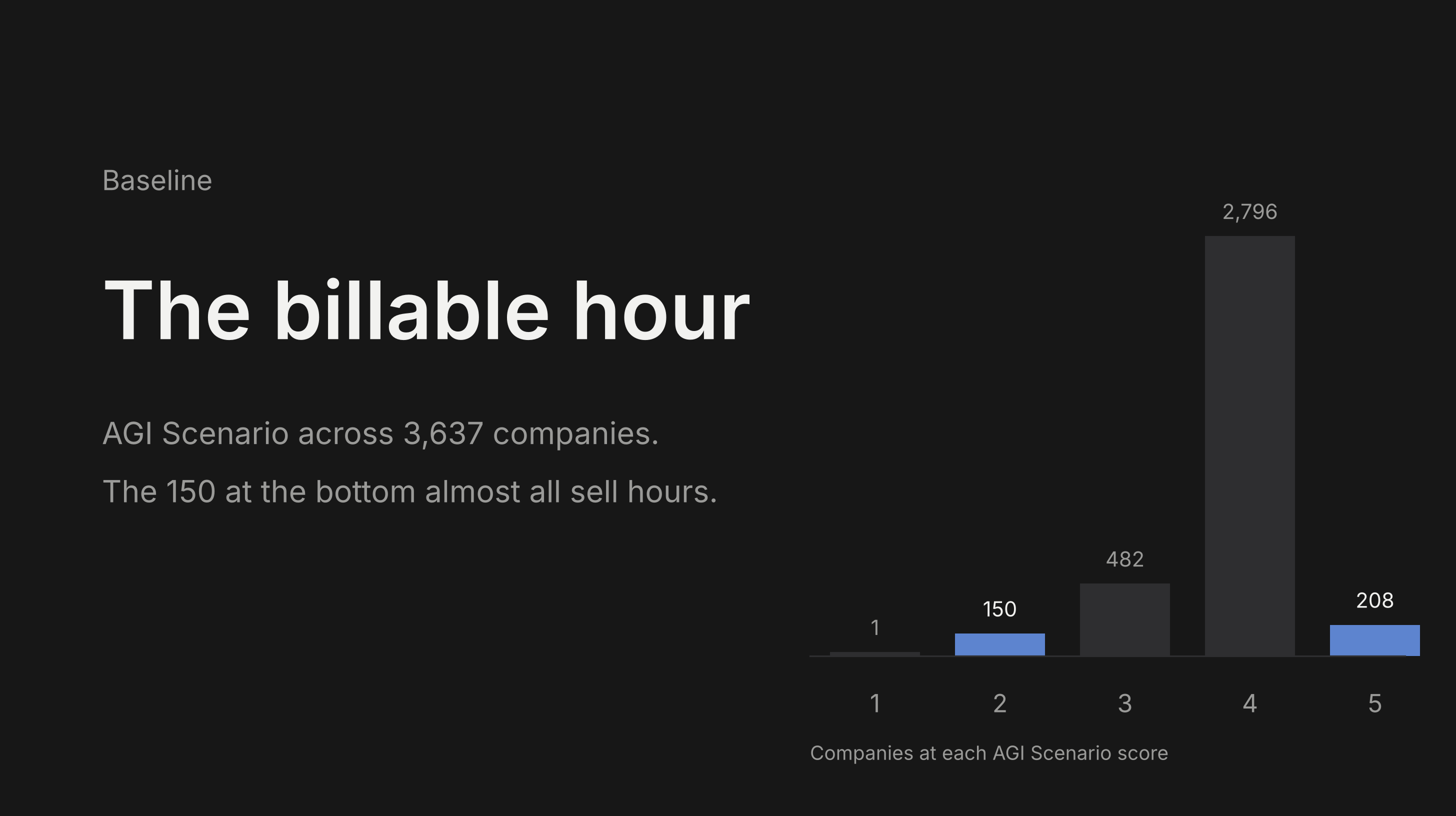
AGI Scenario asks what happens to a company's profit pool if intelligence becomes a commodity. The 150 names at 2 are almost all firms that sell hours.
Most of what Baseline scores is about the business as it is: whether customers can leave, whether the price can go up, whether the market it sells into is growing. AGI Scenario is different. It sets a scenario, commodity AGI available to every company and every competitor at low cost, and scores how much of the profit pool survives it. The rationale works through six questions: whether the moat survives when cognitive labour is commoditised, how much revenue is open to substitution or to being bypassed by an agent, whether barriers to entry fall, whether the company can keep any of its own productivity gains, whether demand for what it sells goes up or down, and how dependent it is on compute. The horizon is split into the first three years and three to seven years out.
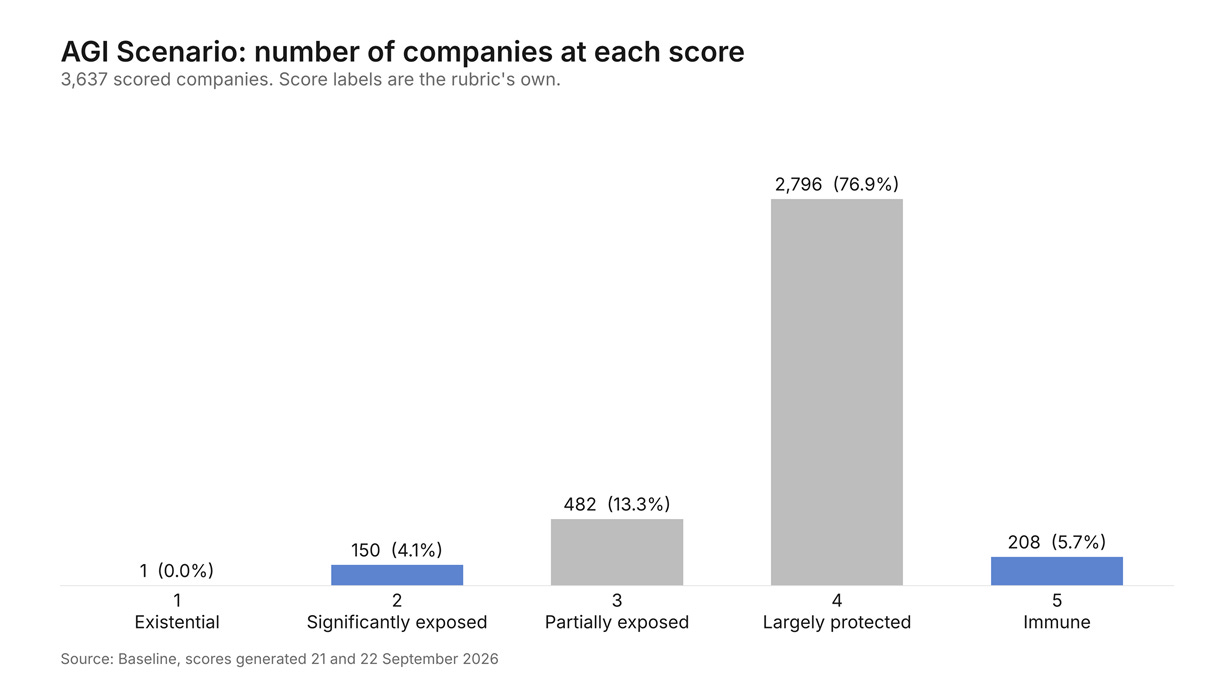
The overall score is a judgement on the profit pool rather than an average of the six. The scorecard’s own labels are 5 immune, 4 largely protected, 3 partially exposed, 2 significantly exposed and 1 existential. A 4 is defined as most of the profit pool protected, with the exposure at the margins, in a minor line, or through a slow channel such as pricing pressure at renewal. That definition covers most companies that make or move physical things, hold a licence, or sell embedded software, so across 3,637 scored companies 2,796 are there, with 482 at 3, 208 at 5, 150 at 2 and one at 1. The prompt also tells the model to take the lower score when it is torn between two, so a 4 is where a company ends up when the model could not make the case for exposure, not a vote of confidence.
Who is in the 150
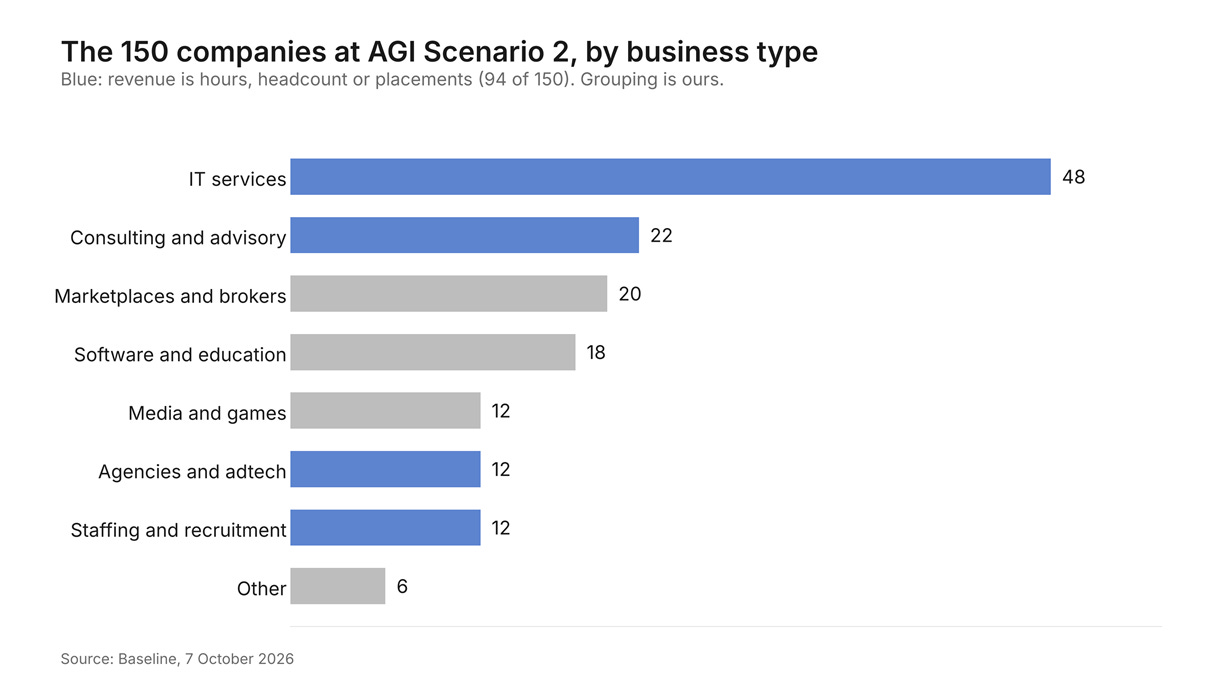
Grouped by hand, 48 of the 150 are IT services and systems integration: Accenture, Capgemini, Cognizant, Infosys, TCS, EPAM, CGI, Kyndryl, DXC, Sopra Steria, Netcompany, Kainos, Booz Allen, Genpact, and most of Japan’s listed integrators. 22 are consultancies and advisers, which covers engineering consultants such as Stantec, Sweco, Afry and Arcadis, FTI, Huron and CRA, Gartner, and the M&A boutiques Evercore and Perella Weinberg. Twelve are staffing and recruitment, including Randstad, Adecco, ManpowerGroup, Robert Half and Korn Ferry, with Upwork and Fiverr alongside. Twelve are advertising groups: WPP, Publicis, Omnicom, Havas, Dentsu, Hakuhodo and Cheil. Those four groups are 94 of the 150. The rest are per-seat or creation software (Zoom, Wix, Duolingo, Coursera, monday.com, Asana), marketplaces and brokers (Yelp, Tripadvisor, CarGurus, Cushman & Wakefield, Newmark, Landstar, RXO) and media.
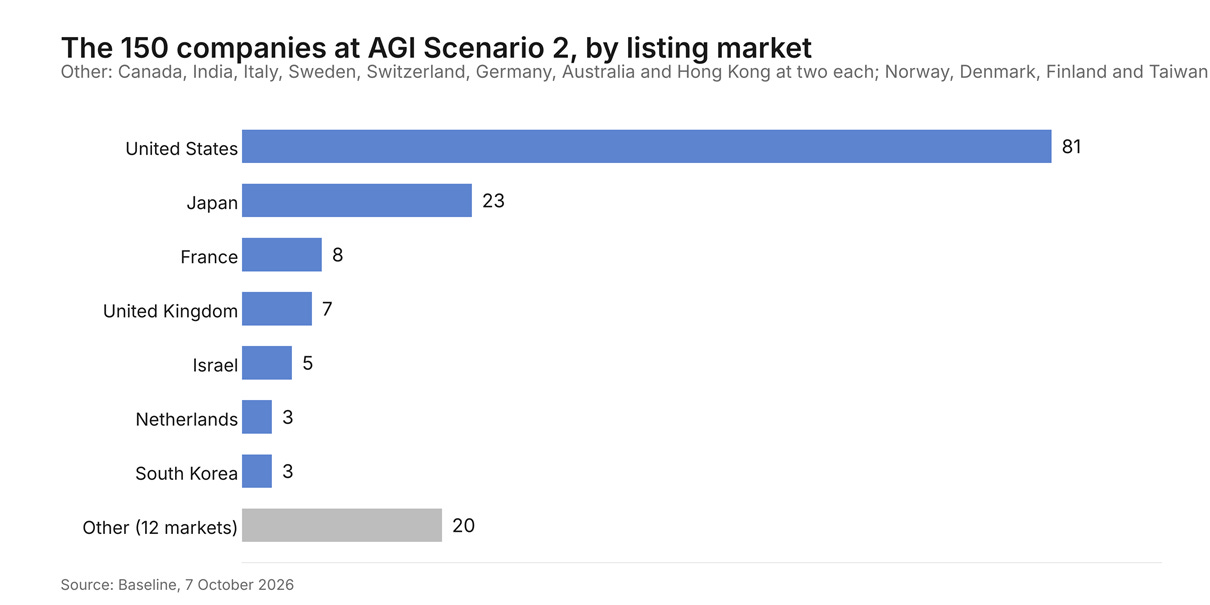
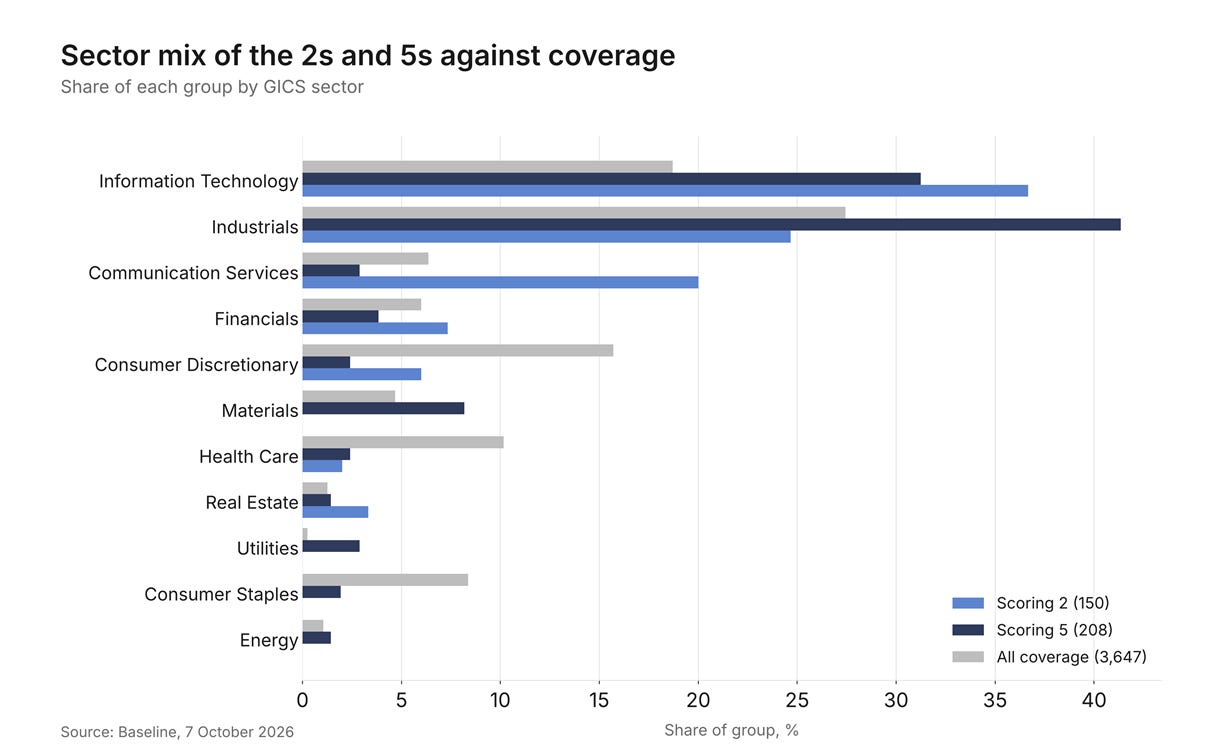
There are no Materials, Consumer Staples, Energy or Utilities names at 2 at all. The 208 at 5 are 86 Industrials and 65 Information Technology, with Materials well above its weight, and the IT names at 5 are the equipment and components companies rather than the services ones. The two tails are drawn from the same two sectors, so the sector label tells you almost nothing about which tail a company is in.
What the rationales say
The rationales share a structure. Each one classifies the business as cognitive labour, cognitive product or non-cognitive, and for the labour businesses the argument runs the same way every time: the moat is real but it protects the right to be the accountable contractor, not the number of people needed to do the work.
Accenture had approximately 799,000 people at 31 May 2026 and 195 of its top 200 clients have been clients for at least a decade, and the rationale still scores it 2, because expertise, process knowledge and access to large pools of skilled labour “are precisely what commodity AGI devalues”. Relationships and switching costs “should slow displacement over three to seven years”, and the AI implementation boom “provides a bridge, but these protections are unlikely to preserve historical labor volumes or pricing”.
IT services was my sector on the sell side, and I agreed with that reading at the time and was bearish on the large integrators for the same reason: in a time-and-materials model the productivity gain goes to the client at the next rate card, and the fixed-price book only delays it.
Sweco is the engineering version. The rationale puts 2025 personnel costs at SEK 20.84bn against net sales of SEK 31.59bn, and its point is that demand for completed infrastructure can rise while demand for engineering hours falls: “Sweco can therefore gain project volume while losing revenue per project and headcount intensity.”
Evercore is the banking version. Investment Banking & Equities was $770.9m of $789.9m of 2025 operating income, the compensation ratio was 64.9%, and the model’s view is that boards will still want a named human adviser on an irreversible transaction but will need far fewer people underneath that adviser. Gartner is the cognitive product version: Insights and Consulting were 87.9% of second-quarter segment gross contribution, client retention is in the mid-80s and wallet retention is below 100%, which the rationale reads as a customer base that can cut spending without a migration project.
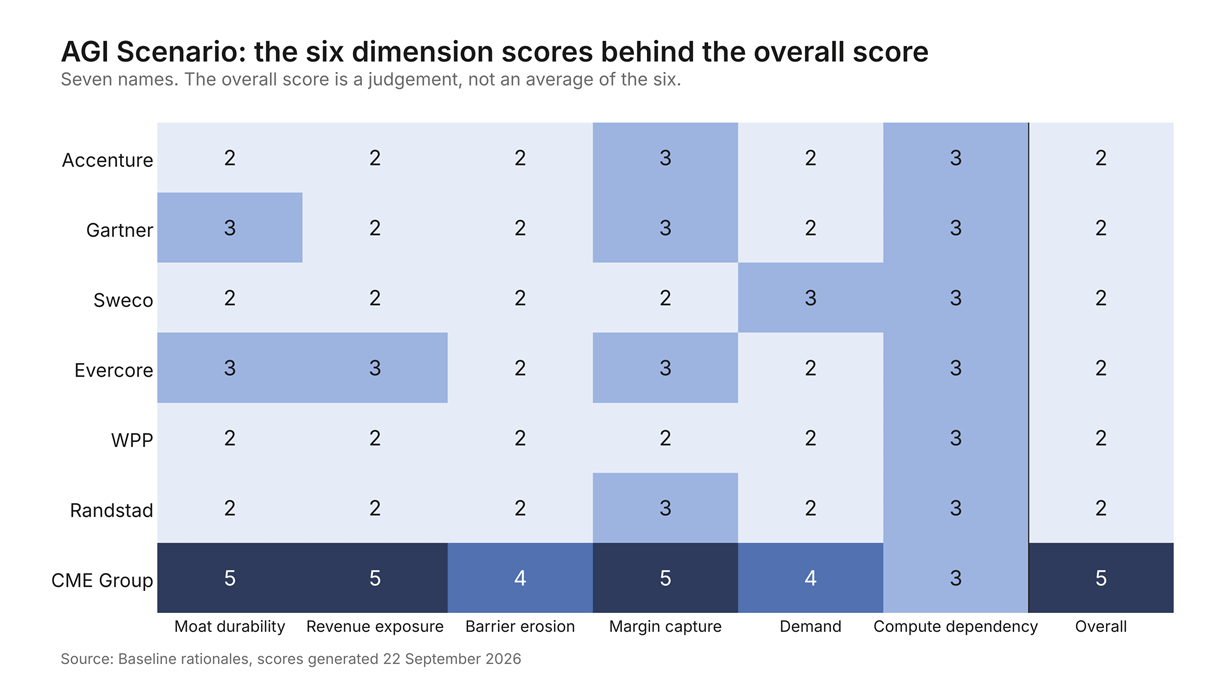
The six dimension scores show how uniform the argument is. For the six 2s below, every dimension sits at 2 or 3. Compute dependency is 3 for all of them, since none is an infrastructure owner and none is squeezed. The only dimension that reaches 3 with any regularity is margin capture, which is the model saying the firm can take cost out before its clients notice, and demand is a 2 for everyone except Sweco, whose end markets are grids and water. CME is included for contrast.
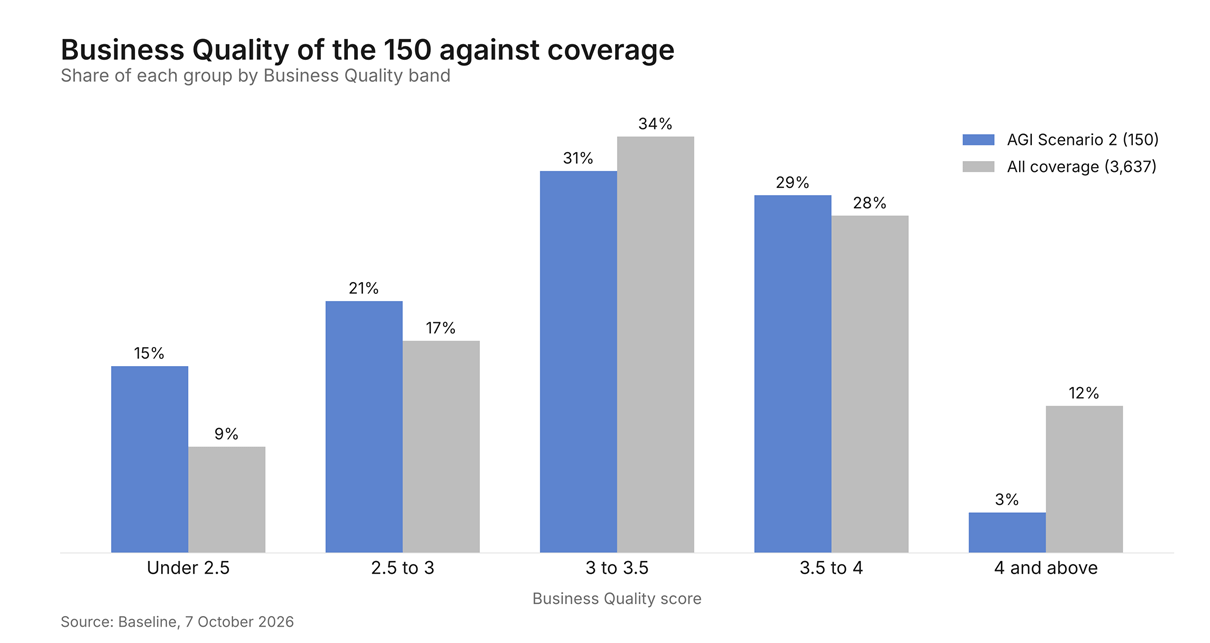
The score is not a quality judgement. Accenture scores 3.9 on Business Quality and 2 here. 96 of the 150 score 3 or better on Business Quality and 49 score 3.5 or better, against 74% and 40% of coverage. The 150 skew a little lower than the universe, with 15% under 2.5 against 9%, and they are thin at the top, with five at 4 or above against 12% of coverage, but the bulk of them sit in the same 3 to 4 range as everything else.
Against Structural Forces
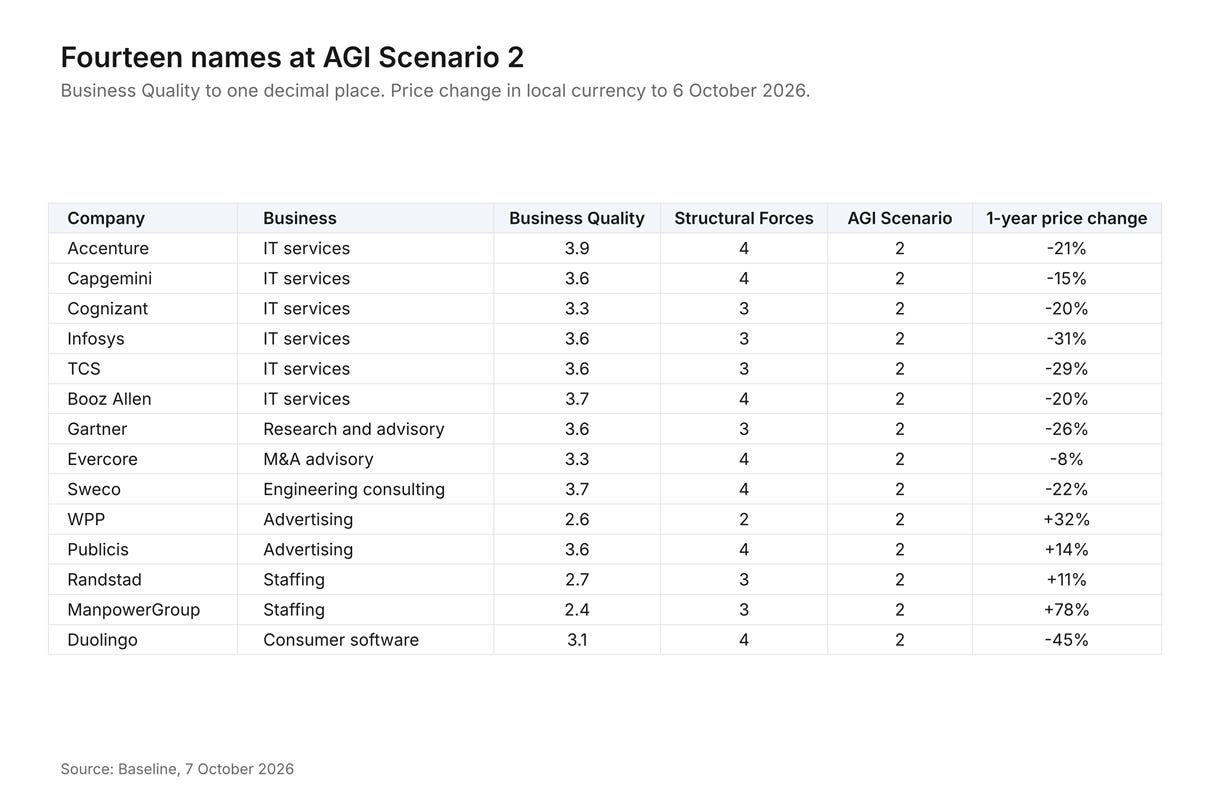
Crossing AGI Scenario with Structural Forces, which asks whether the next five to ten years are moving for or against the company, puts 1,951 of 3,637 companies in the 4-and-4 cell. The 150 at AGI 2 split 16, 47 and 87 across Structural Forces 2, 3 and 4. Accenture, Capgemini, CGI, Sopra Steria, Kainos, Sweco, Evercore and Booz Allen all score 4 on Structural Forces and 2 on AGI Scenario. The reverse corner is nearly empty: two companies score 5 on AGI and 2 on Structural Forces, ICL and the Icelandic fishing company Sildarvinnslan, and nothing scores 2 on AGI with a 5 on Structural Forces.
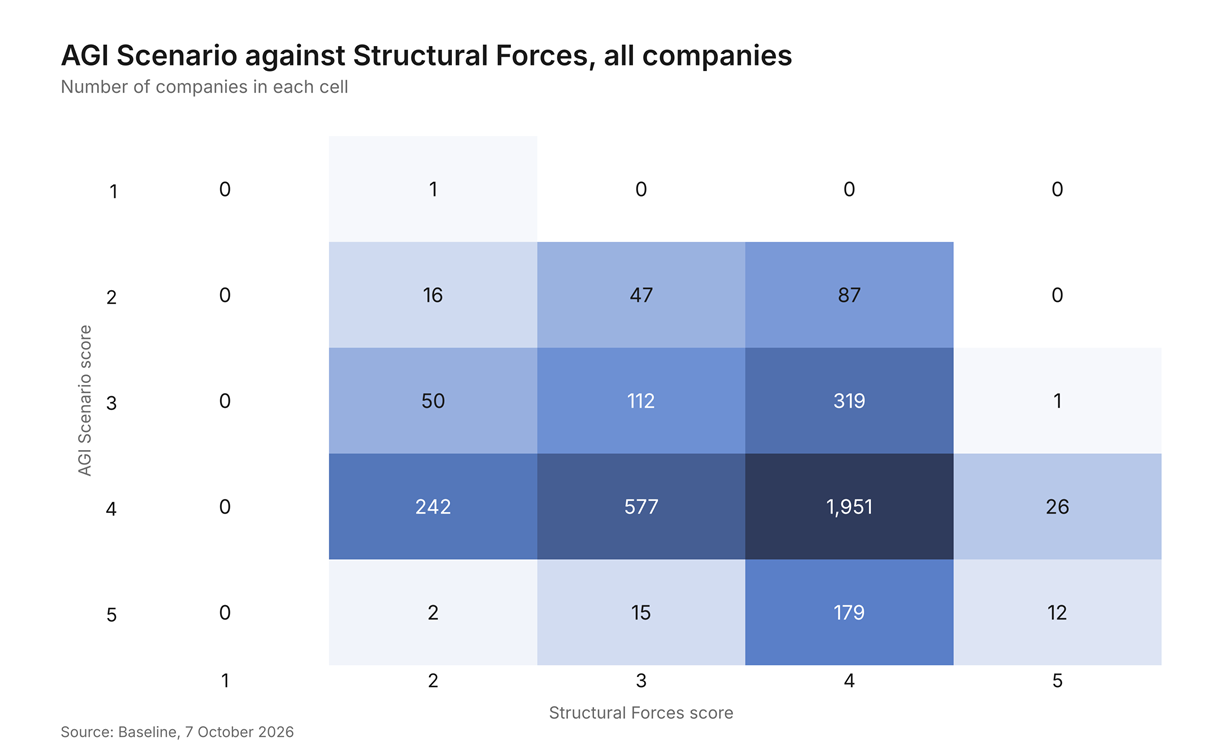
The two fields are not contradicting each other, since they are asking different questions. Structural Forces takes the world as it is forecast: legacy modernisation, regulated AI deployment, European rearmament, grid and water spending, the Treasury clearing mandate. On that reading demand for the work is going up.
AGI Scenario holds a different world fixed and asks what the hours are worth in it. The Capgemini Structural Forces rationale says “AI may reduce billable labor and contract values faster than Capgemini can replace them with modernization, managed-agent and outcome-based revenue”, and the AGI rationale is the same sentence with the condition removed. The model’s position across both fields is that the services firms get more work and get paid less per unit of it, and that the first of those shows up before the second.
What the market has done with it
One-year share price moves across 36 of the 150 split into two groups, and the split is not quite the one the score implies. The large IT services and consulting names are mostly down between 15% and 38%: Accenture 21%, Cognizant 20%, Capgemini 15%, CGI 18%, Infosys 31%, TCS 29%, EPAM 33%, Gartner 26%, Stantec 38%, Sweco 22%, Booz Allen 20%. Kyndryl is down 60%. The creation tools and marketplaces are down further: Wix 49%, Duolingo 45%, Yelp 45%, Upwork 48%, Fiverr 63%, Coursera 39%, LegalZoom 42%.
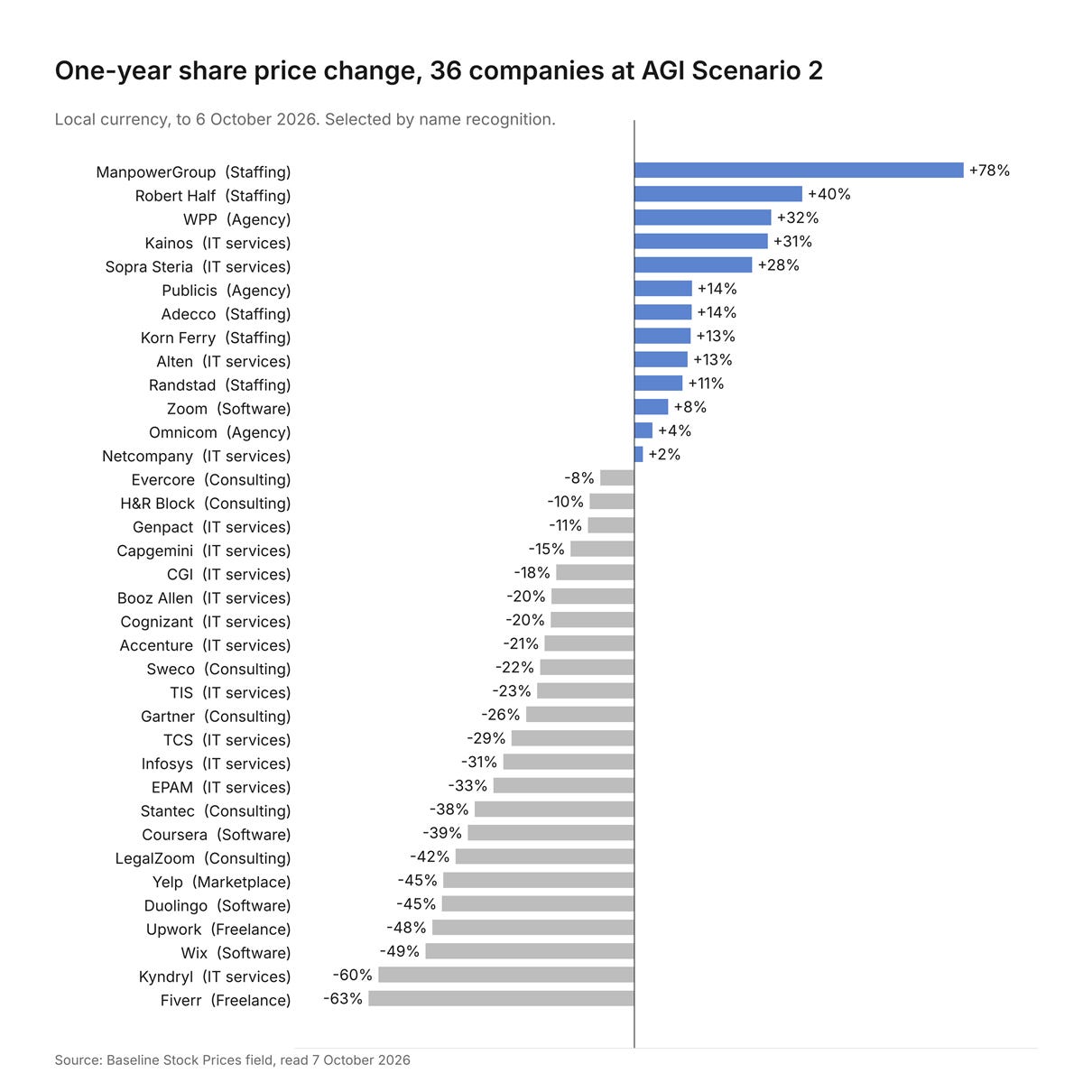
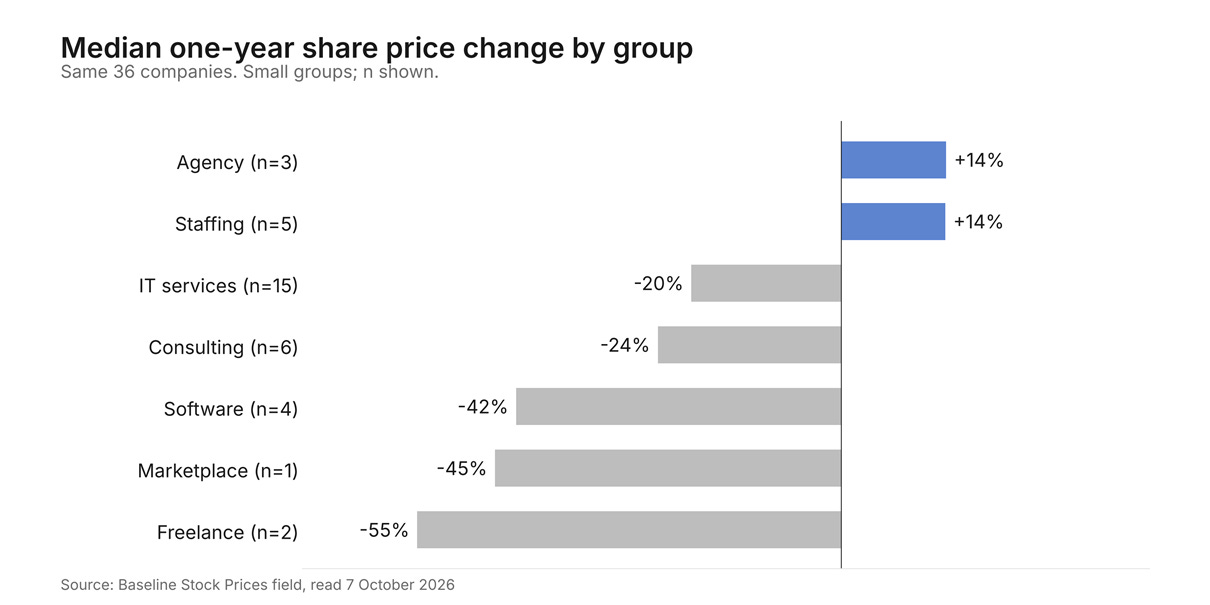
The staffing firms and the agencies have gone the other way. ManpowerGroup is up 78%, Robert Half 40%, Adecco and Korn Ferry 13%, Randstad 11%, WPP 32%, Publicis 14%, Omnicom 4%. Kainos and Sopra Steria are up 31% and 28% on UK public sector and European defence exposure respectively. By group, the median move is minus 20% for the 15 IT services names and minus 24% for the six consultants, against plus 14% for the five staffing firms and plus 14% for the three agencies.
The pattern is that the market has sold the firms where AI replaces the output directly, coders and website builders and freelance copywriters, and bought the firms where the AI question sits behind something nearer: a hiring cycle turning, a merger, a new chief executive. The model scores all of them 2. It has no view on timing beyond “within three years” and “three to seven years”, and it says nothing about price. A score does not tell you whether a 60% fall is enough, and the staffing rally is consistent with the model if the cycle matters more than the scenario for the next couple of years, which the rationales themselves allow for.
The 208 at the other end
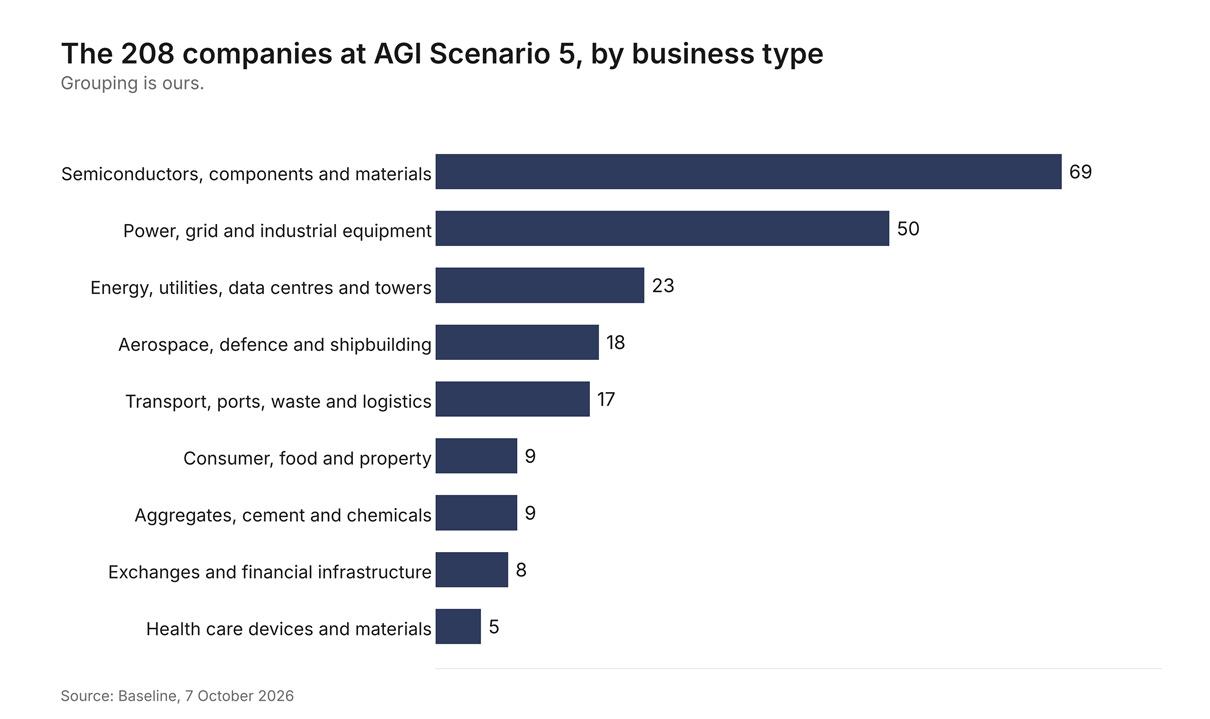
The 5s are what you would expect once you have read the 2s. Grouped the same way, 69 are semiconductor equipment, components and materials (ASML, KLA, Applied Materials, Lam, Tokyo Electron, DISCO, BESI, TSMC, Micron, SK Hynix, Kioxia), 50 are power, grid and industrial equipment (Prysmian, Nexans, NKT, Hubbell, Vertiv, Eaton, Schneider, Siemens Energy, GE Vernova, Caterpillar), 23 are energy, utilities, data centres and towers (Constellation, NextEra, RWE, EQT, Cheniere, American Tower, Cellnex, Linde, Air Products), 18 are aerospace, defence and shipbuilding (TransDigm, Safran, Rolls-Royce, Howmet, RTX, Airbus, Saab, the Korean yards), 17 are transport, ports and waste (CP, CN, Norfolk Southern, MTR, Waste Management, Republic Services) and eight are exchanges and financial infrastructure (CME, ASX, Japan Exchange, HKEX, Visa).
The rationale structure is the inverse of the services case: the moat is a scarce legal right, a physical bottleneck or a liquidity pool, and AGI increases demand for it without being able to reproduce it.
CME’s clearing and transaction fees were $5.28bn in 2025 and the rationale’s line is that AGI “cannot instantly recreate a multilateral pool of counterparties, established liquidity, legally recognized contracts, collateral efficiency or neutral central clearing”. The Lottery Corporation scores 5 because its Victorian licence runs to 30 June 2068 and the next major renewal is New South Wales in 2050. Ferrari scores 5 on the grounds that “AGI cannot bypass Ferrari to obtain an authentic new Ferrari”.