The rat doesn't know who it works for
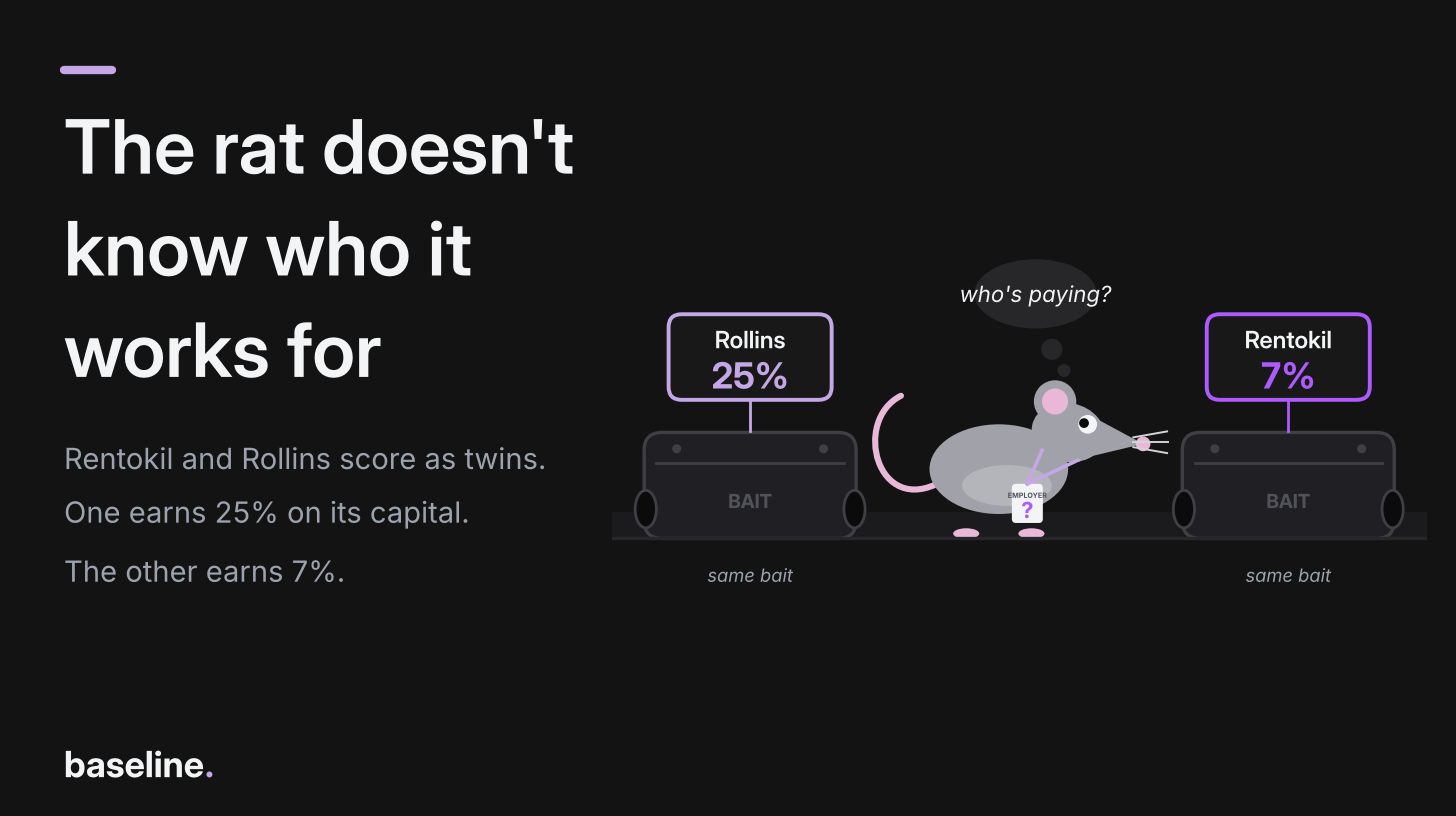
Baseline scores Rentokil and Rollins as near twins, but Rollins earns 25% on its capital and Rentokil 7%.
Next time you are in a supermarket, look along the bottom of the wall by the stockroom door. There is usually a squat black plastic box with a slot at each end and a block of bait inside. Every few weeks someone in a van comes to check it, notes whether anything has been eating, and drives on to the next one.
That is most of the pest control industry. Rentokil Initial 

It is also one of the best end markets we score. Baseline gives both Rentokil and Rollins a 5 on End Market Quality, a mark only 49 of the 3,781 companies we cover get. The reasons are not complicated. Rats breed whatever the economy is doing, a restaurant that cancels its contract can be shut by an inspector, and Baseline’s Rollins analysis puts US termite damage at more than $5bn a year. About 75% of Rollins’s revenue comes from contracts that renew themselves. Both companies put their prices up every year and both score 4 on Pricing Power. Rollins has historically raised prices 3% to 5% a year against cost inflation of 2% to 3%.
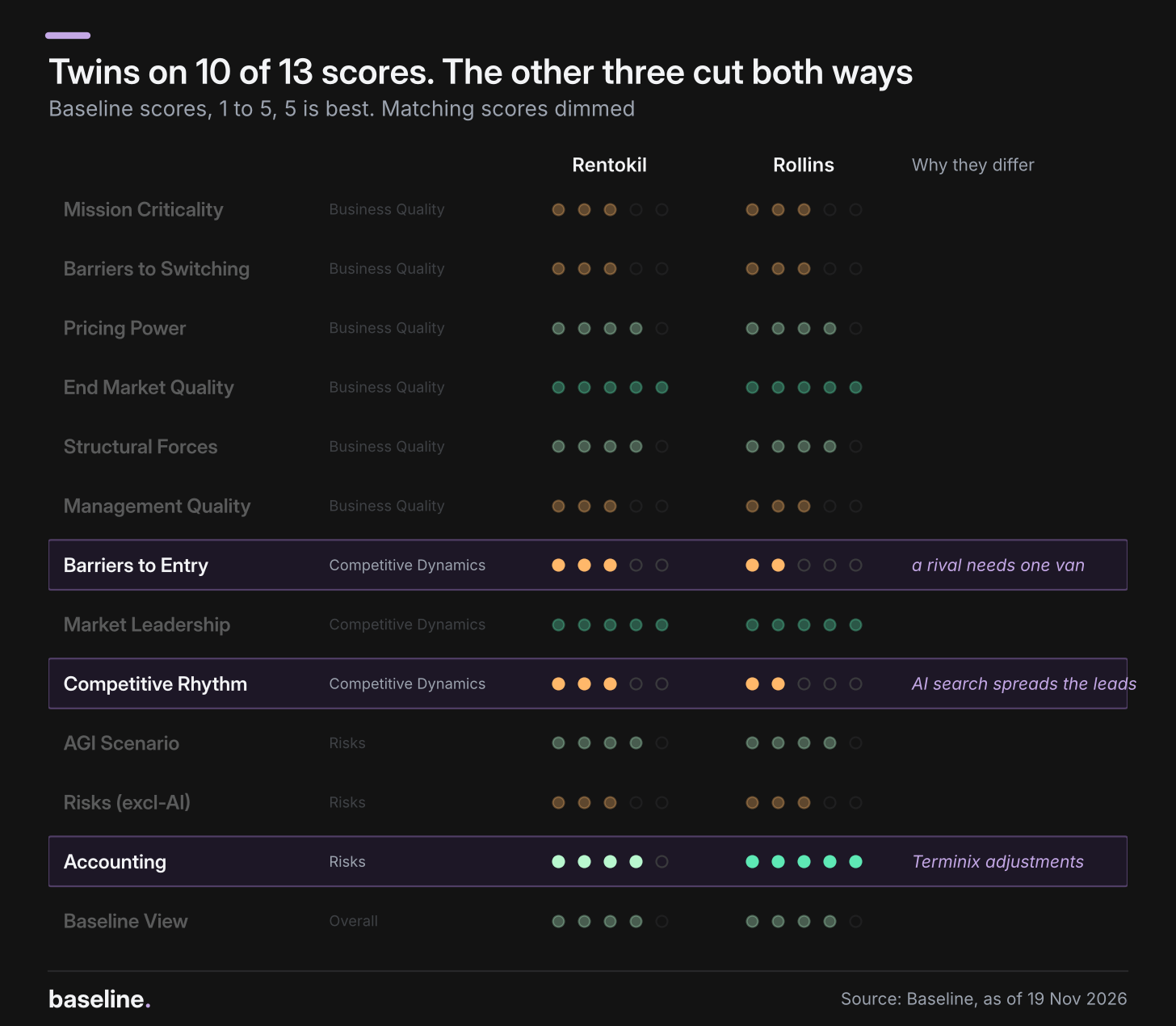
So the two largest listed pest controllers sell the same thing into the same market, and when Baseline scores them they come out almost the same. They match on 10 of our 13 measures, with Business Quality at 3.7 each and a Baseline View of 4 each.
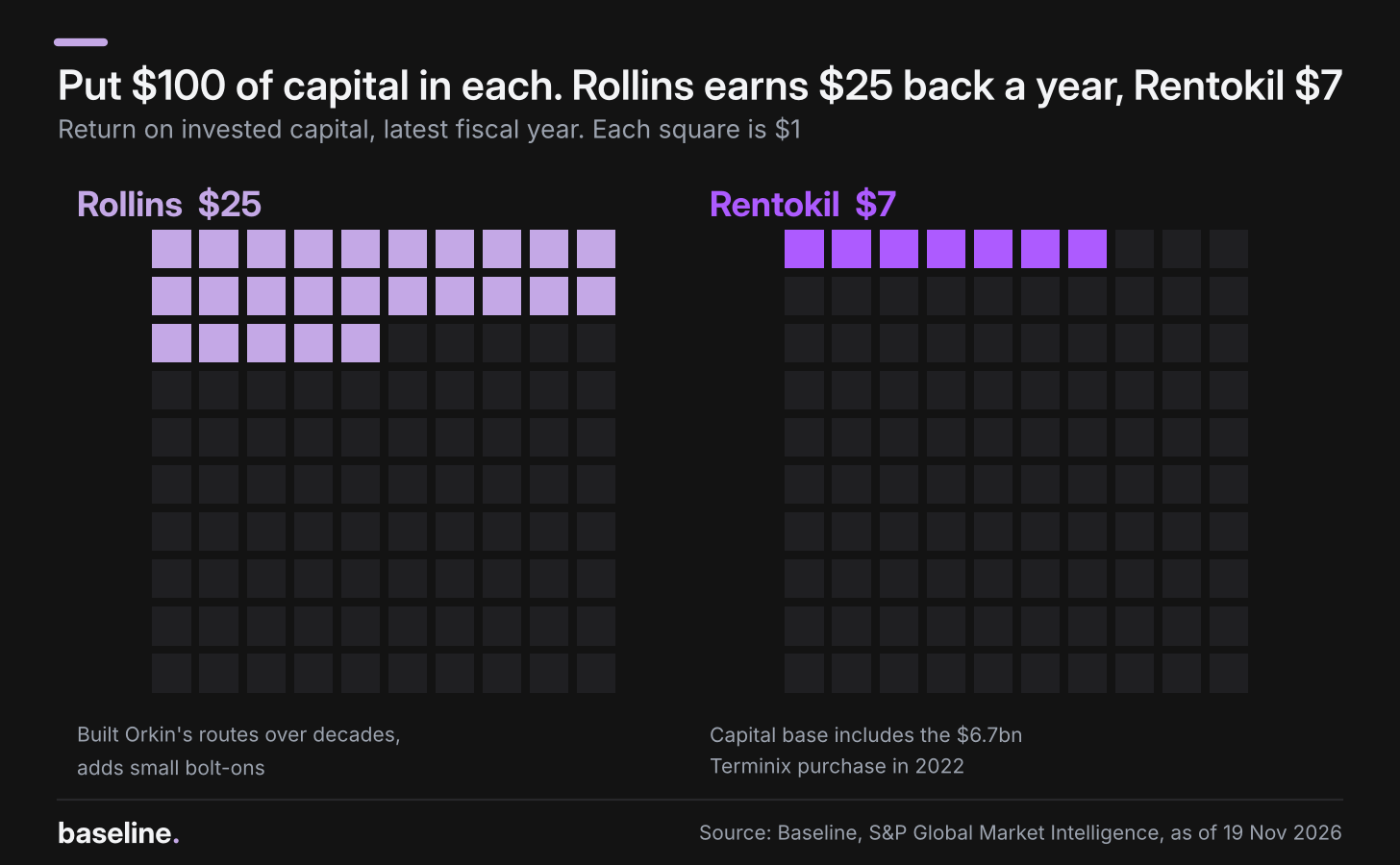
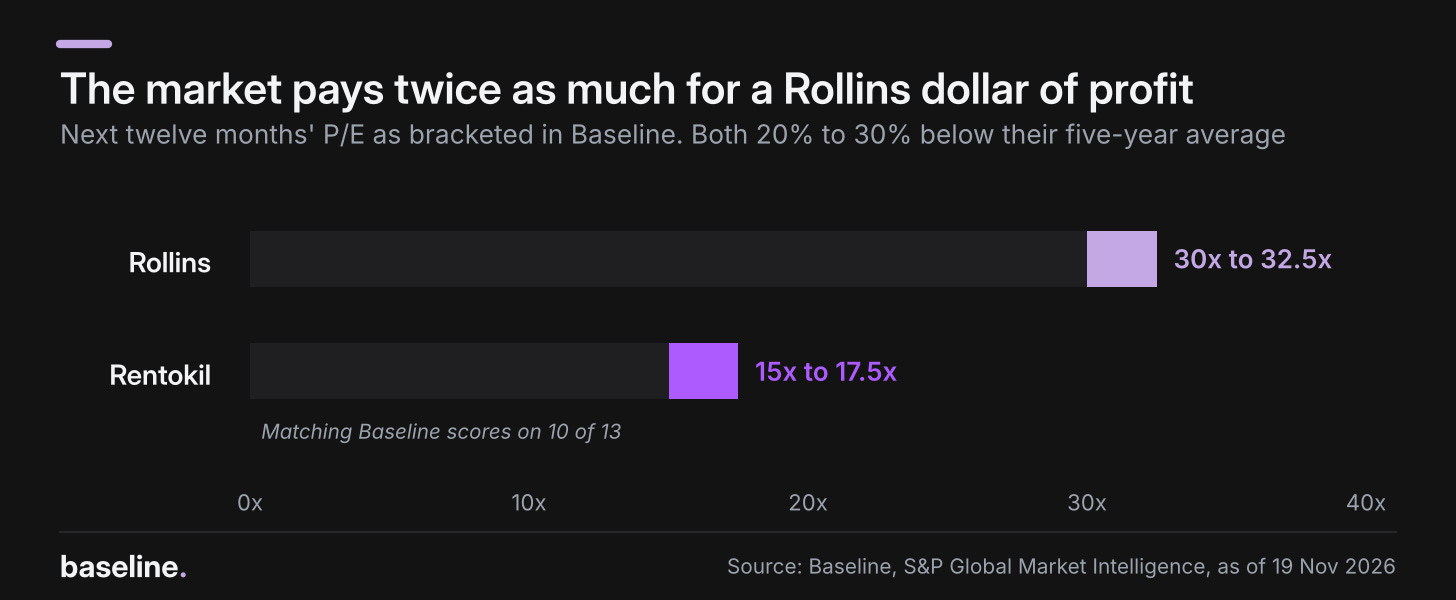
The numbers underneath do not match at all. On S&P data, Rollins earned a 25.1% return on its invested capital in its latest year and Rentokil 7.0%. Rollins’s EBITDA margin was 22.7% against 17.9%. The market has noticed. Rollins trades on a little over 30 times next year’s earnings and Rentokil on between 15 and 17.5 times, though both sit 20% to 30% below their own five-year averages.
The way the money is made explains part of it. A pest controller’s cost is mostly a technician’s day: the wage, the van, the fuel. The bait is cheap. What matters is how many paying boxes sit on one route. A technician who gets round, say, twenty sites on one industrial estate earns the firm far more than one driving between eight spread across a county, for the same wage. Baseline’s Barriers to Entry analysis of Rentokil calls route density “the primary hurdle” for a competitor, because a newcomer without clustered customers spends more on travel to earn the same visit.
That is why the number Rentokil watches most closely is retention. It measures how much of last year’s contract value the company still has, and in North America it has sat at about 80% for two years. Put the other way round, the business loses roughly a fifth of its American book each year and has to sell that much again just to stand still. The target is 85%, which the then chief executive told analysts last year was an aspiration rather than a promise.
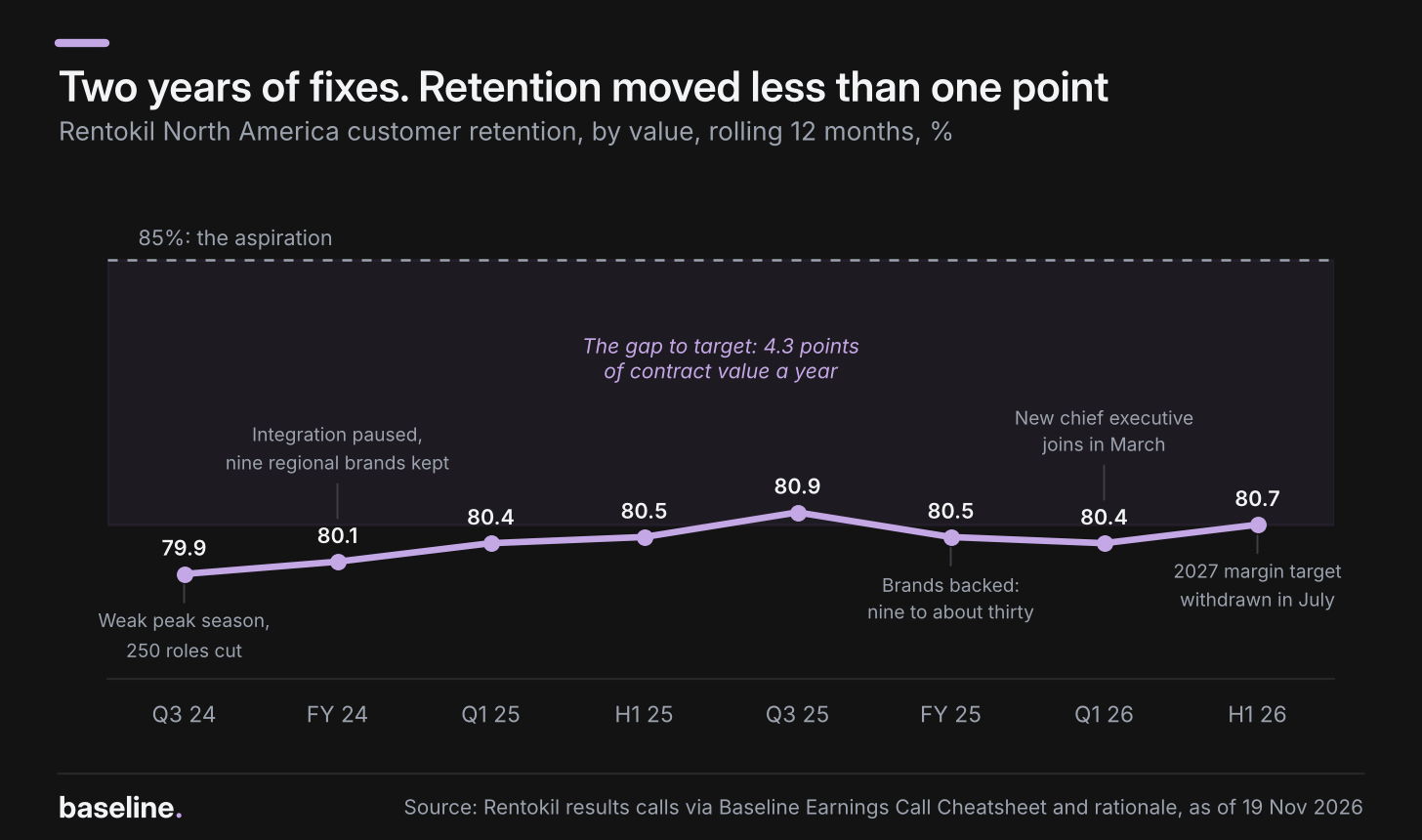
Retention is measured by value, so a customer who stays and pays 4% more counts for more than one who stays at the old price. Rentokil’s finance director told analysts in April that all of the North American growth in the first quarter came from price, with volumes still falling. Baseline’s Pricing Power rationale for Rentokil says much the same thing, a little more kindly: prices go up above inflation and most customers stay, even in quarters with no volume growth. In October we tested Buffett’s line on pricing power across the universe and found a strong score a good sign. This is roughly what it looks like from the inside, with price holding the revenue line up while the routes get a little thinner.
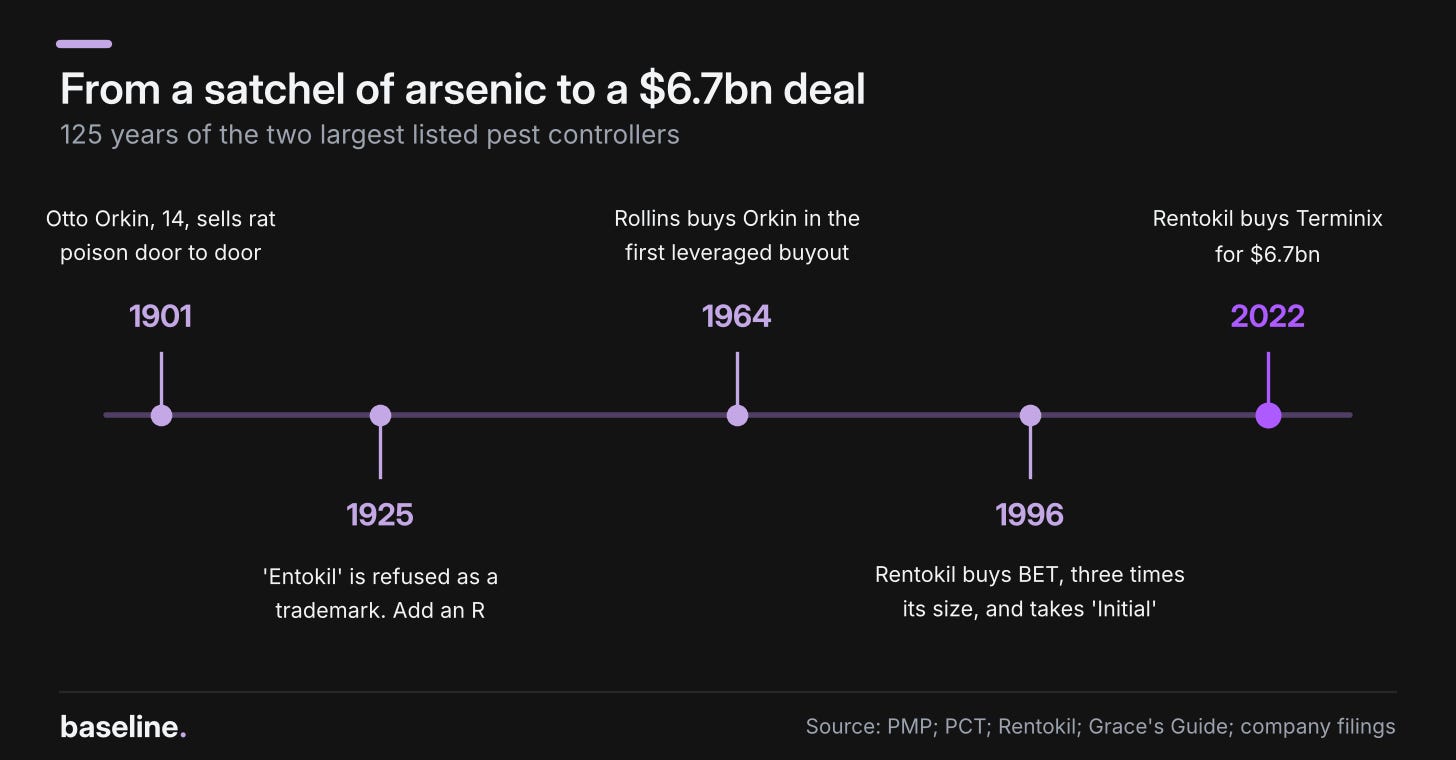
The second difference is what each company paid for its routes. Rentokil bought Terminix for $6.7bn in cash and shares, completing in October 2022. That price now sits underneath Rentokil’s return on capital, and a rat in Memphis pays no more for being dealt with by an expensive acquisition. Rollins built Orkin’s network over decades and mostly adds to it in small pieces: seven deals for $27m in the third quarter. Our reading is that much of the gap in returns is probably the price Rentokil paid rather than anything wrong with the work itself. Baseline’s scores look at the business, not at what its owner paid for it, which is why they see two near twins.
The integration did some harm. Rentokil’s management has acknowledged on its results calls that moving branches onto new systems hurt leads and, later, customer retention. The plan went from nine supported regional brands to about thirty, and the 20% North American margin target for 2027 was withdrawn in July. Terminix also left something in the accounts. Baseline scores Rentokil 4 on Accounting, not 5, partly because a $195m charge for old termite claims was kept out of adjusted profit in 2025, and because the Terminix brand is treated as never wearing out, which avoids about $96m a year of amortisation.
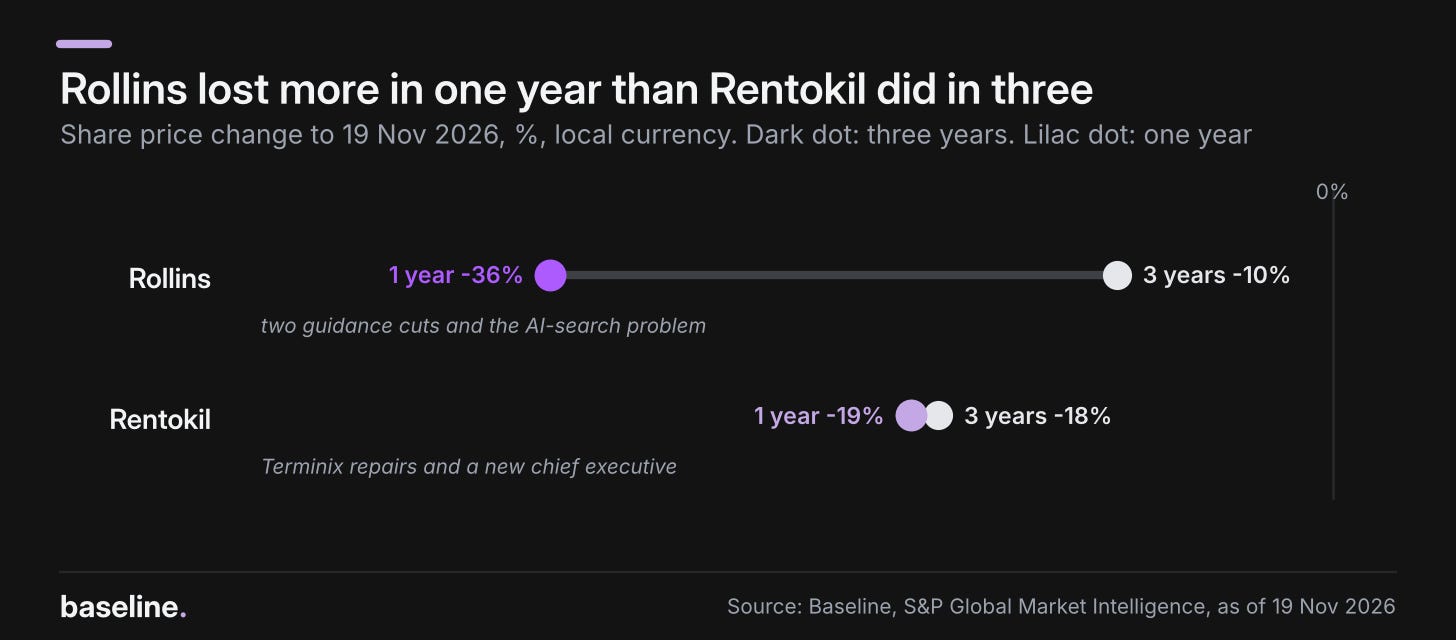
Both shares have had a poor year, with Rollins down 36% and Rentokil down 19%.
Rollins has cut its 2026 organic growth outlook twice, from 7% to 8% down to at least 6% in July, then to 4% to 6% in October.
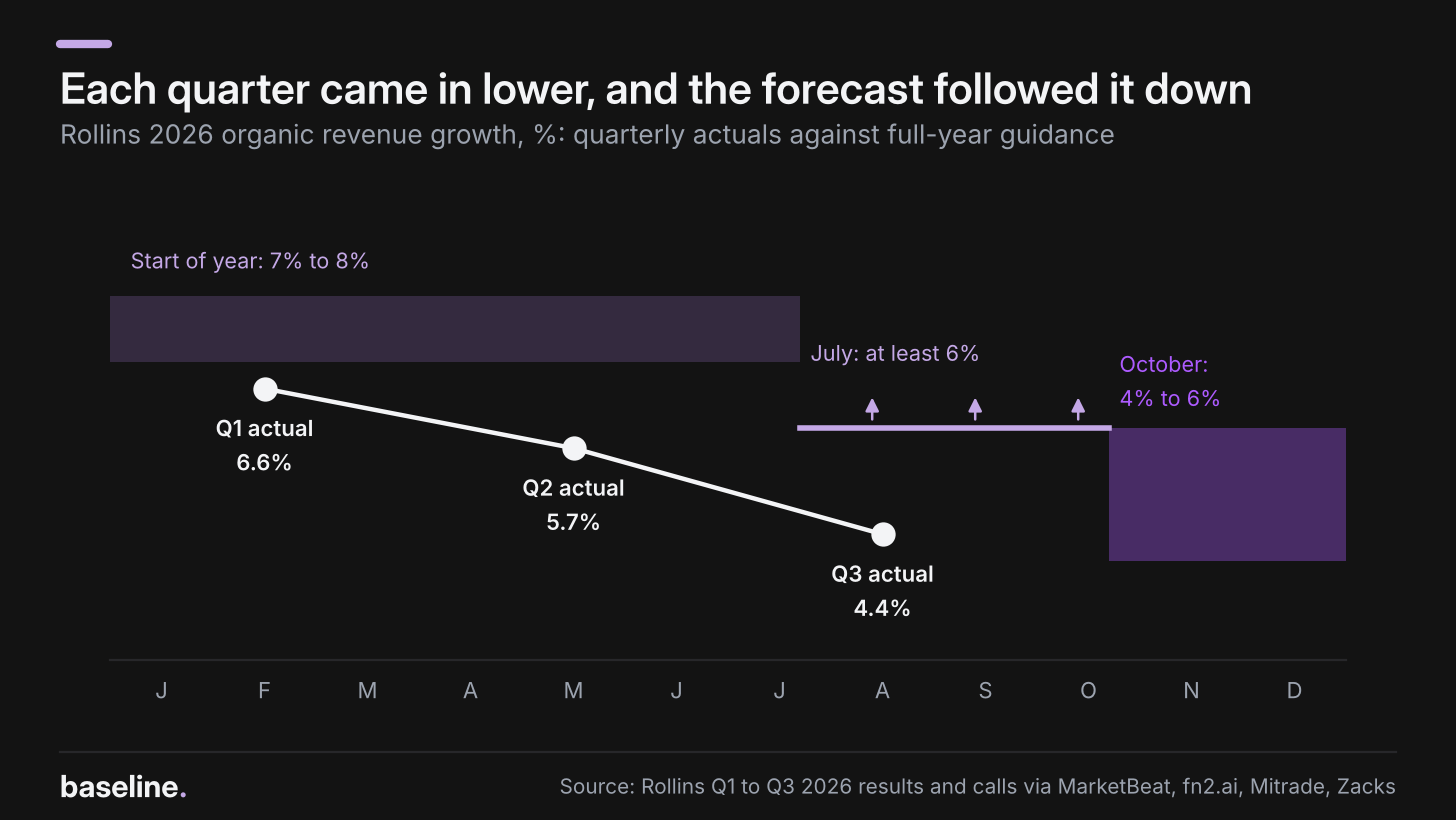
Its residential business grew just 2.3% organically in the third quarter, against 6.6% in commercial, and its chief executive told analysts the company was “not satisfied with these results”.
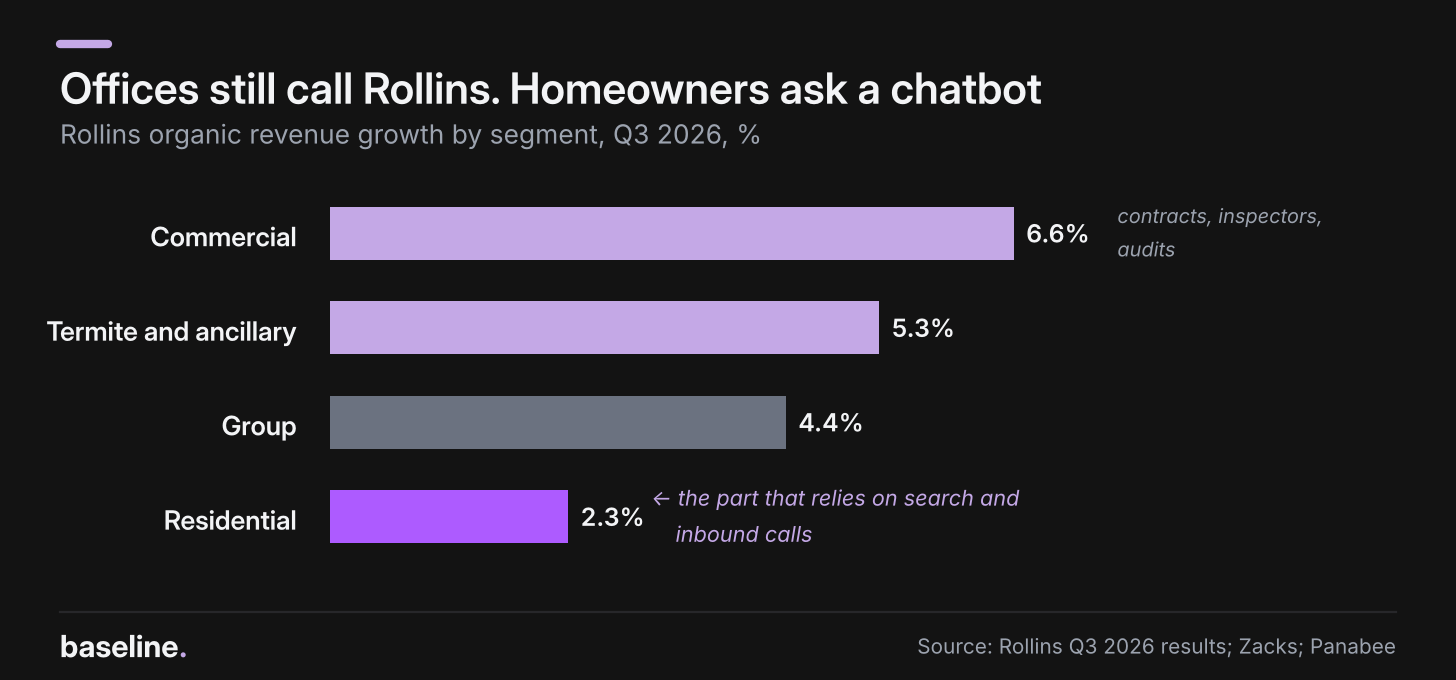
Homeowners with mice used to search for an exterminator, and the big brands paid to sit near the top of the results. Now more of them ask an AI assistant, which, Rollins management says, recommends a wider range of providers. Baseline scores Rollins 2 on Competitive Rhythm for that reason, and 2 on Barriers to Entry because a rival needs one licensed technician, a van and standard chemicals to get going. A chatbot that is as happy to suggest the one-van operator down the road as Orkin takes away a good part of what the big brands paid for.
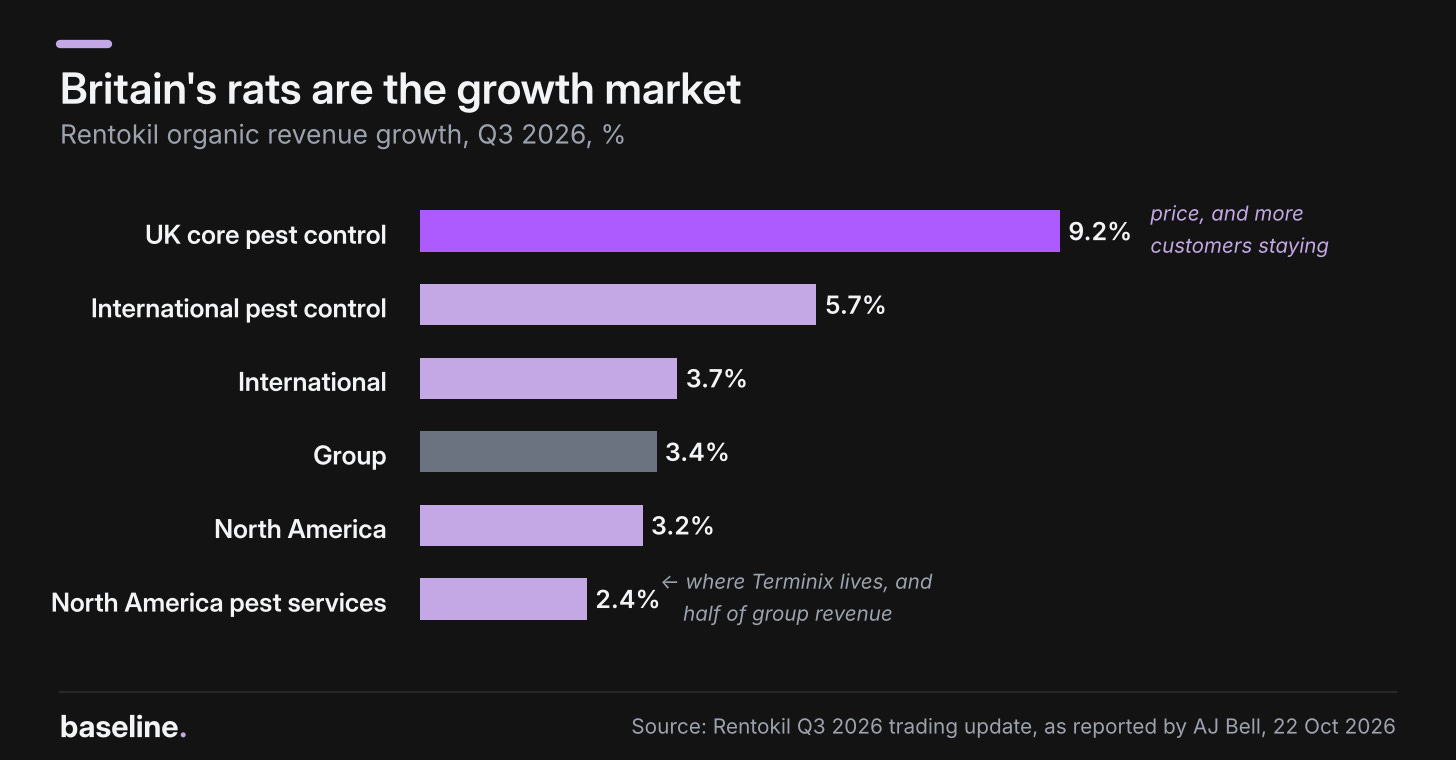
Rentokil’s third quarter, reported on 22 October, was steadier. Organic growth was 3.4%, North American pest services grew 2.4%, residential lead flow slipped about 1% and UK core pest control grew 9.2%, helped by price and better retention, according to AJ Bell’s report on the update. The shares rose 7.1% that day, with a $200m buyback announced alongside the sale of its lake management business.
Baseline View has both at 4 and improving. For Rentokil the case is operating earnings about a fifth to a quarter higher in four years, mostly from keeping more of the customers it already has, with moderate confidence because recurring volumes have not yet turned positive. For Rollins it is growth of 6% to 8% a year per share, provided residential customers stop getting more expensive to win.