Using MCP servers for stock research
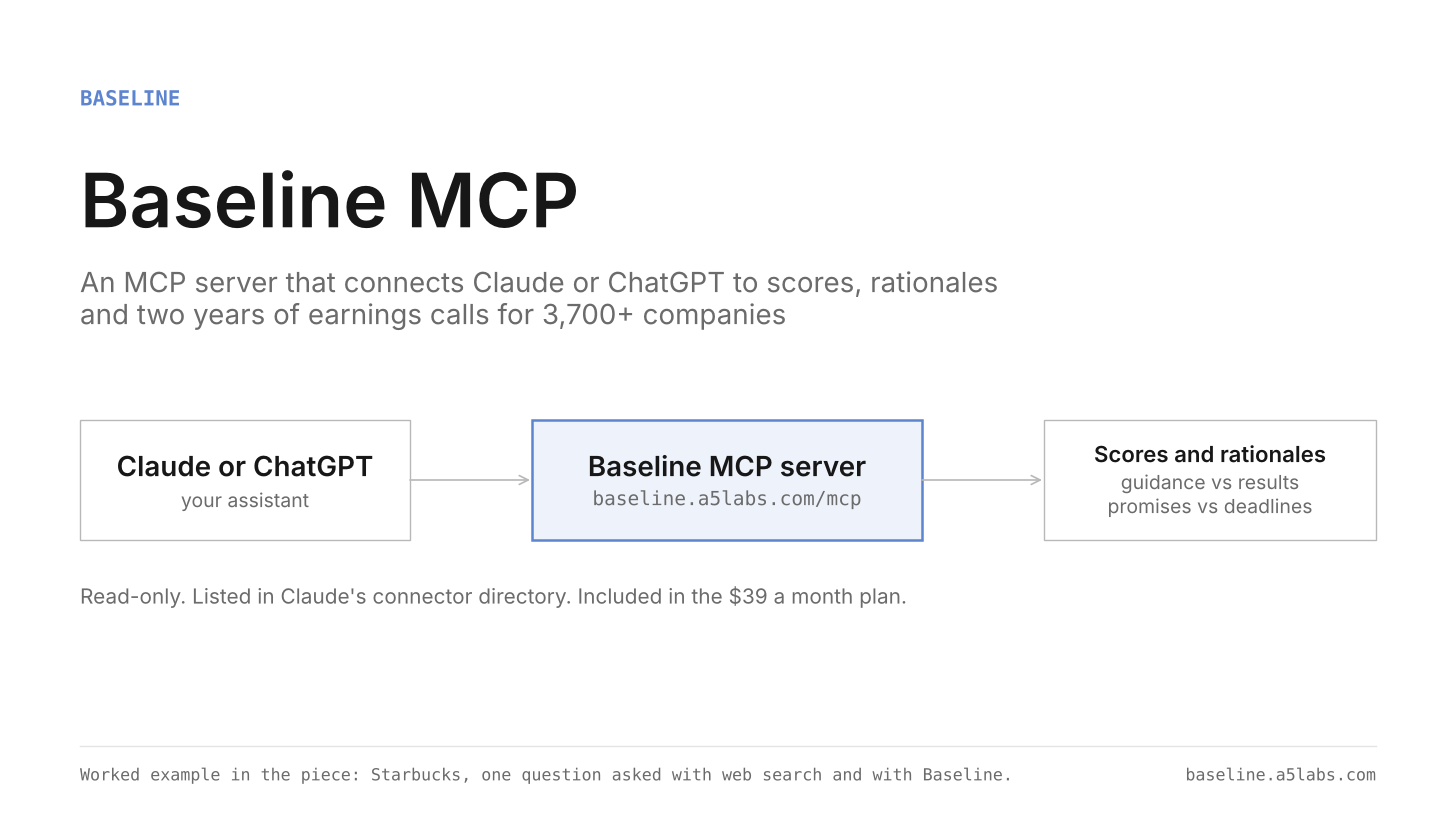
What an MCP is, how it works, and what we use it for at Baseline.
I found the biggest time drag in investment research was not the analysis itself but the collection of data. Open the annual report, retype the segment table, pull the transcript, search it for “pricing”, paste the quote into the note.
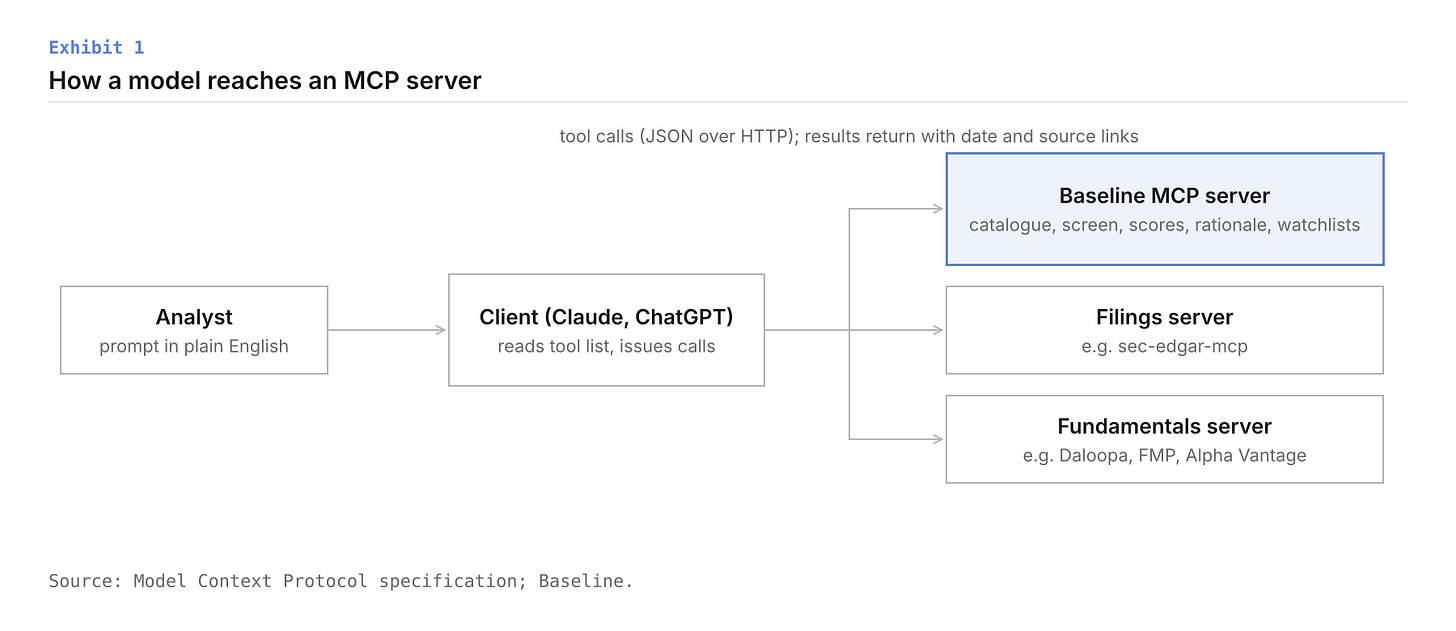
Chatbots have the same issue. When you submit a complex query, the model spends several minutes searching for data, then returns the best output it could compile in that time. The biggest unlock for solving this has been MCP (the Model Context Protocol), which plugs a chatbot into an external server so the model can spend its time on analysis rather than retrieval.
We have built an MCP server for Baseline. This piece explains what it does and how we use it.
What an MCP does
A data provider (like Baseline) runs a server and publishes a short list of things a model can ask it for, each with a name and the inputs it takes. The model reads that list once and can then call any of them. It never touches the database, only the answers it asks for. In Baseline’s case, it gives Claude access to all of the scores and rationales across 30+ fields and 3,700+ stocks.
How we use Baseline MCP
We connected Claude to Baseline MCP and asked what had changed. This was its answer:
“Without Baseline, I said Starbucks’ sales recovery was real, and I sounded sure. I’d read the press releases and the coverage. What I hadn’t read was the analyst Q&A where management said about half of that growth came from customers of stores it had closed, plus delivery.”
“With search alone, I’m a fast reader with no memory. Every company starts from zero, and I read whatever ranks. Baseline is the memory: every call, every promise, and what happened next.”
We asked one question twice, once with web search and once with Baseline:
“Is Starbucks’ turnaround actually working, or is it still mostly promises?”
With web search: a good answer
Claude ran 21 searches and page reads and wrote something acceptable: *“Same-store sales have swung from falling to growing 7.9%, driven by more visits, not just higher prices. Earnings guidance has been raised twice.” *It even caught that the latest quarter’s margin was flattered by tariff refunds.
Its conclusion was that customers are back, and profits are starting to follow.
With Baseline: more context
To construct a Baseline score and rationale, we ingest far more context than a chatbot gets from web search. For Safran’s Mission Criticality score, for instance, we ingest company filings, earnings call transcripts, capital markets day presentations, valuation data, web search and more. We also ingest the same material for Safran’s own earlier answers and for its peers in the Commercial Aerospace Engines comp set (GE Aerospace, RTX, Rolls-Royce).
This lets the model give a much richer answer, because it can pick up information disclosed on a competitor’s earnings call, for instance. The Starbucks findings below are the kind of context that turns up.
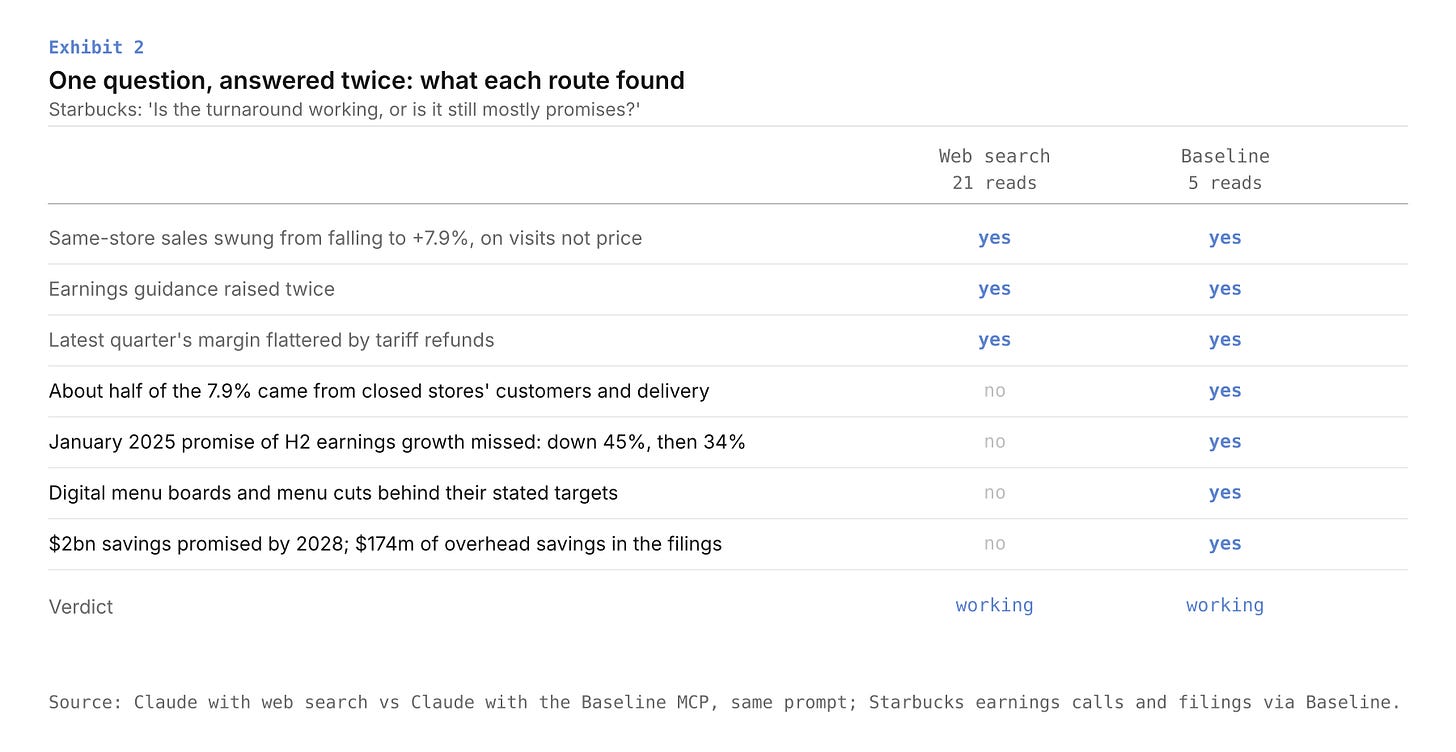
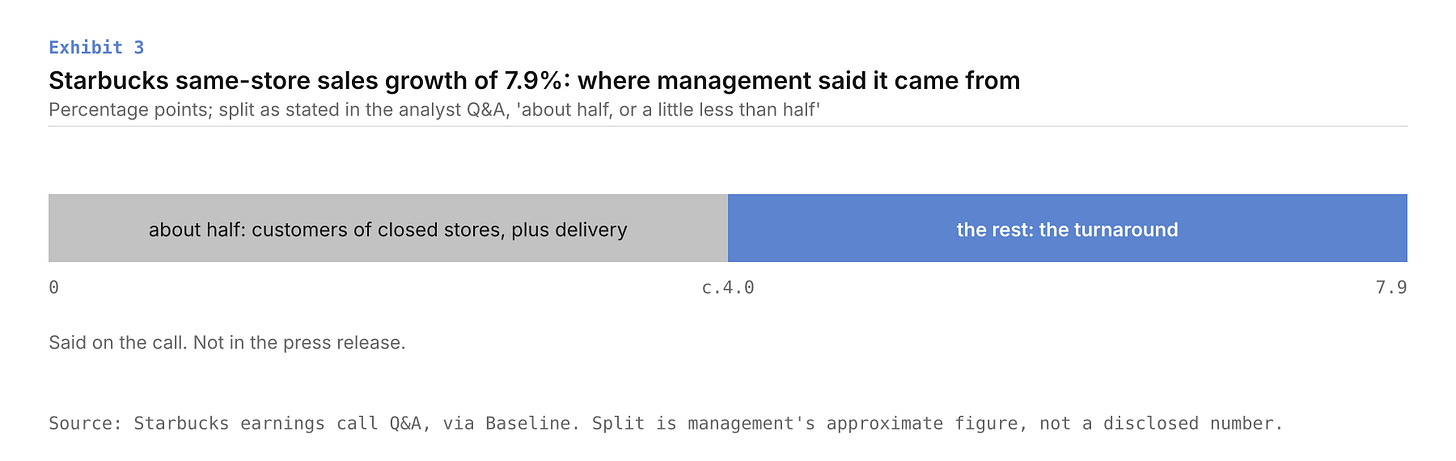
Asked by an analyst, management said “about half, or a little less than half” of the 7.9% came from closed stores’ customers moving to nearby ones, plus delivery. It was said on the call. It is not in the press release, which is what the web-search answer anchored on.
In January 2025 Brian Niccol, the chief executive, said earnings would grow in the second half of the fiscal year. They fell 45%, then 34%.
Digital menu boards were promised for every store by year-end; the target is now 80 to 90%. The menu was meant to shrink by about 30%; so far it is 25%.
Starbucks promised $2bn of savings by 2028 and has not said how much it has found. The filings show $174m of overhead savings.
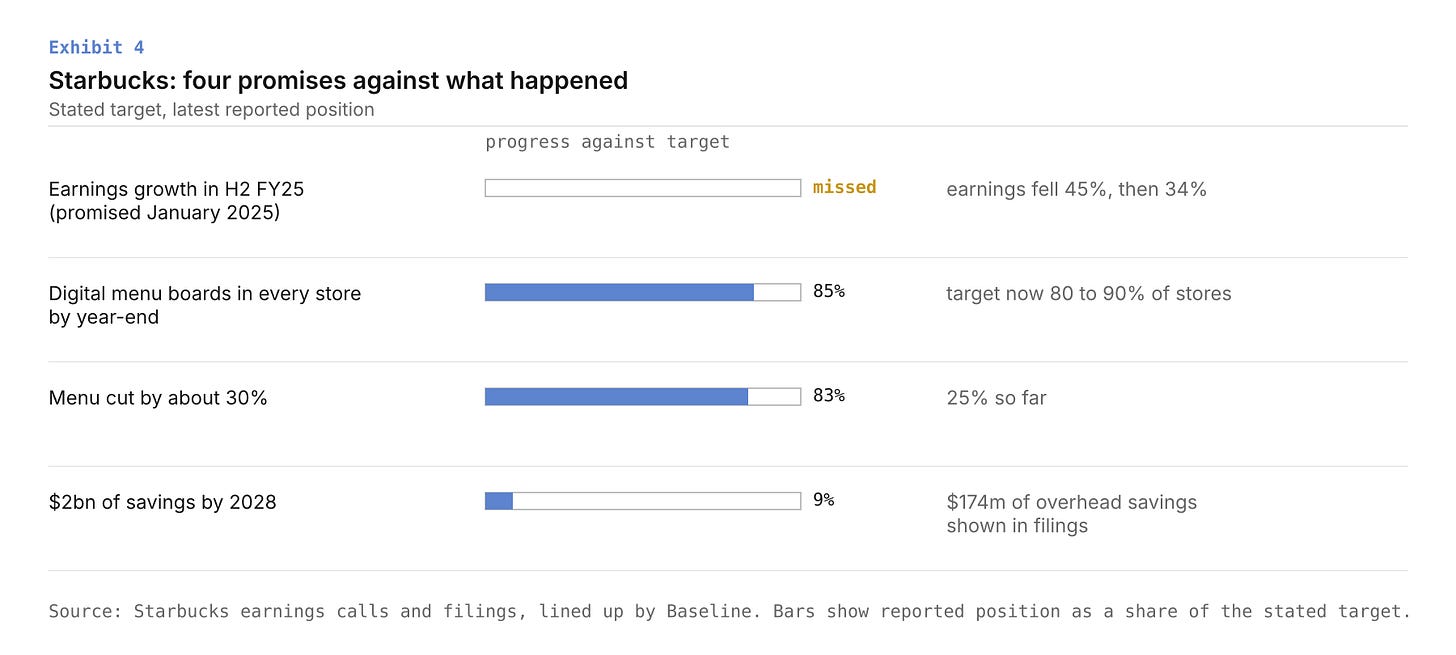
None of this is hidden; it is all on the calls. But finding it means reading every call and holding each promise up against what happened next. This is the premise of Baseline: the questions an analyst asks of a stock are worked through once, when quarterly results are released, so the work is already done when you ask.
The memory
Baseline holds that memory for 3,700+ companies. For each one, the last two years of earnings calls are lined up:
- every guide against the result
- every promise against its deadline
- the one-offs inside each quarter
- what management declined to say
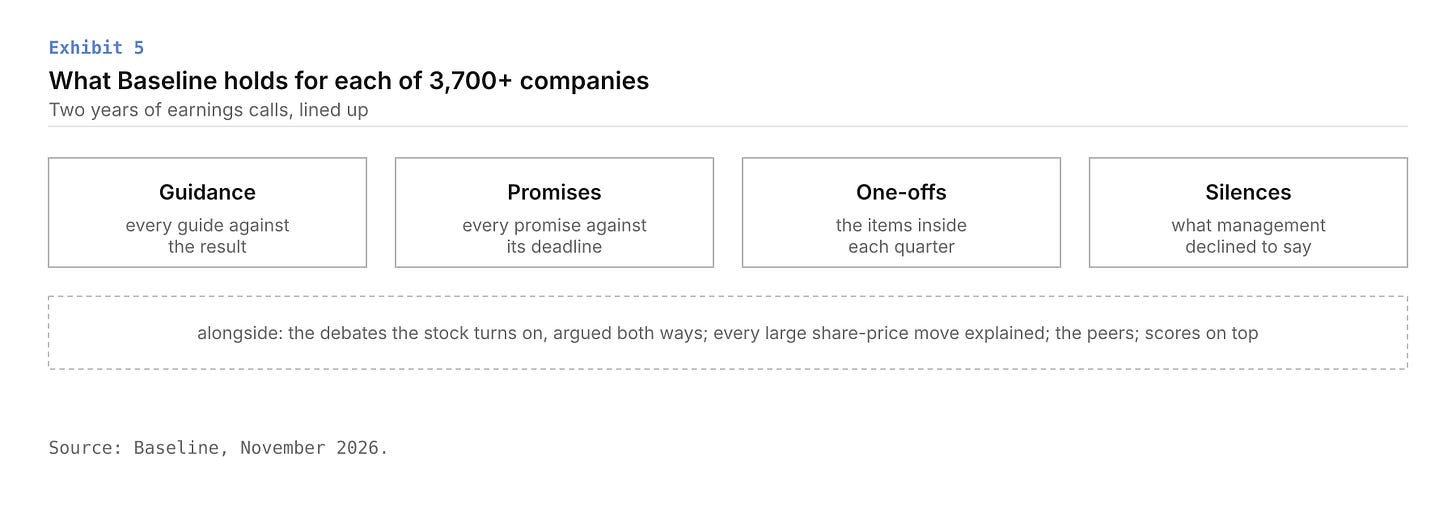
Next to those sit the debates the stock trades on, argued from both sides, every big share-price move explained, and the peers.
Connect in two minutes
Baseline MCP is listed in Claude’s connector directory and is awaiting approval from OpenAI. You can also connect by hand.
Server URL: https://baseline.a5labs.com/mcp
- Claude: Settings, Connectors, Add custom connector. Paste the URL, name it Baseline, and sign in.
- ChatGPT: Settings, add a custom connector with the same URL, and sign in.
The connection is read-only. If your assistant does not reach for Baseline straight away, start with “Using Baseline…”
Try it on a company you know. Ask what management promised last year and what happened. If it matches your memory, the other 3,700 were read the same way.
The connector is included in Baseline at $39 a month, with no limits. If you already subscribe, it is on your account now.
Ask it
- “What did management promise last year, and what actually happened?”
- “Which promises has Starbucks stopped talking about?”
- “How much of last quarter’s growth will repeat?”
- “Which of my holdings has a debate the next results could settle?”
- “Why did my largest holding fall on the days it fell?”